



















































Some people hear “mobile game” and immediately think of shallow time-fillers, annoying adverts, cheap copies or games designed only to keep people tapping. Those games exist, of course. Anyone with a phone has probably downloaded something that looked fun and deleted it ten minutes later.
But that is not the whole picture.


Mobile gaming has become one of the easiest ways for people to play. It fits into spare minutes, long commutes, quiet evenings and short breaks. Not everyone owns a console or gaming PC. Almost everyone has a phone.
That alone makes mobile gaming worth taking seriously.
People now use their phones for everything from puzzle games and strategy titles to cloud gaming, role-playing games, word games, card games and quick sessions of online blackjack. The range is much wider than the old stereotype suggests.
Mobile games are not all the same, and they should not be judged as if they are.
Convenience is a real strength
The biggest advantage of mobile gaming is simple: it is already in your pocket.
You do not need to turn on a console, sit at a desk, update a launcher, find a controller or clear an evening. You can play for five minutes while waiting for a train or for half an hour on the sofa.
That convenience changes the way people play.
A mobile game does not always need to be huge. It can be built around short sessions, quick decisions and steady progress. That does not make it weaker than a longer game. It just means it fits a different part of someone’s day.
For many players, that is exactly the appeal.
Not every game has to demand full attention for hours. Sometimes, the best game is the one you can pick up, enjoy quickly and put down without feeling lost next time.
Mobile games can be smarter than people expect
There are plenty of simple mobile games, but simple does not always mean basic.
A good puzzle game can test logic in a clean, focused way. A strategy game can ask players to plan several steps ahead. A word game can become part of someone’s daily routine. A rhythm game can be built around timing and practice.
Mobile games often work best when they understand the limits of the device.
A small screen is not ideal for every genre. Touch controls do not suit every type of action. But when a game is designed properly for mobile, those limits can become part of the design.
The best mobile games do not feel like weaker console games. They feel like games made for the device they are on.
That distinction matters.
Touch controls can work when games respect them
Bad mobile controls are easy to spot.
Tiny buttons, crowded screens, awkward movement and clumsy menus can ruin a game quickly. Some mobile versions of console-style games feel uncomfortable because they are trying to force too much onto a touchscreen.
But touch controls can work well when the game is built around them.
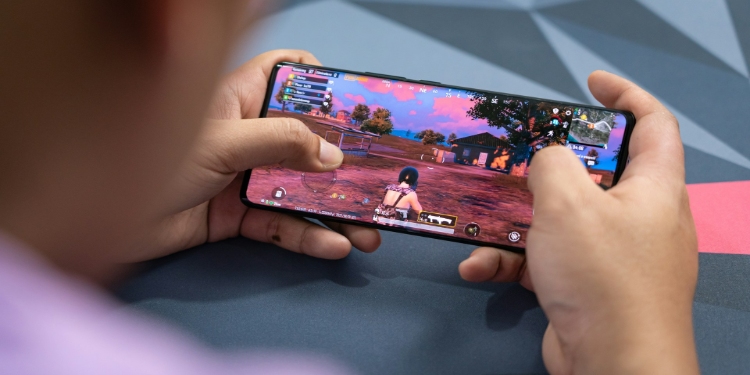
Dragging, tapping, swiping, holding and pinching can feel natural for puzzle games, management games, card games, drawing games, rhythm games and certain types of strategy. The controls are direct. You touch the thing you want to move or change.
That can make some games feel more immediate than they would with a controller.
The issue is not that phones cannot handle proper games. The issue is whether the design fits the screen, the input and the way people actually use their phones.
Mobile gaming is often more accessible
Mobile gaming reaches people who may never buy a console.
That includes casual players, older players, younger players, people with limited space, people who travel often, and people who do not want to spend hundreds on hardware. A phone lowers the barrier.
The cost can also be lower, although this depends heavily on the game.
Some mobile games are free to start. Some are low-cost premium games. Some are included through subscriptions. Of course, there are also games with aggressive purchases, and those deserve criticism. But it would be unfair to treat every mobile game as if it uses the worst payment model.
Access matters.
A person who plays a few games on their phone is still playing games. They are still making choices, learning systems, solving problems and finding enjoyment through play. That should not be treated as less valid because the device is smaller.
Cloud gaming is changing the phone’s role
Phones are no longer limited to traditional mobile games.
Cloud gaming has made it possible to stream larger titles to mobile devices, provided the internet connection is strong enough. This does not work perfectly for everyone, and it is not a replacement for local hardware in every situation, but it has changed what a phone can be used for.
A player can continue a bigger game away from their usual setup. They can use a controller with their phone. They can play something that would never run natively on the device.
That opens the door to a different kind of mobile gaming.
It also blurs the old line between mobile players and console or PC players. The phone becomes a screen, a controller hub, or a quick way to access a library.
There are still issues with input delay, data use, screen size and ownership. Even so, cloud gaming has made mobile play harder to dismiss.
The bad reputation is not completely unfair
Mobile gaming does have problems.
Some games are built around adverts that interrupt the experience constantly. Others push purchases too aggressively. Some copy successful games with little care. Some use timers, energy systems and reward loops that make the game feel more like a habit than a choice.
Players are right to be wary of that.
The mobile market is crowded, and it can be hard to separate thoughtful games from lazy ones. A bad first impression can shape how people view the whole space.
But every platform has weak games.
There are poor console games, unfinished PC releases and expensive titles that rely on repetitive design. Mobile gaming should be criticised where needed, but it should not be dismissed entirely because of its worst examples.
The better question is whether a game respects the player’s time, attention and money.
Short sessions can still create strong habits
Mobile games often become part of daily life.
A player might do one puzzle every morning, check a strategy game at lunch, play a few rounds before bed, or return to a word game with friends. These sessions may be short, but they can still feel meaningful.
The routine is part of the appeal.
A game does not have to be dramatic to become familiar. Sometimes, a small daily challenge is enough. Players enjoy the comfort of returning to something they understand.
This is one reason mobile games can build loyal audiences. They do not always compete by being bigger. They compete by being easy to return to.
That is a different kind of strength.
Mobile gaming has earned its place
Mobile games are not perfect, and the criticism around adverts, copied ideas and pushy purchases is often fair.
But the best mobile games show that the platform has real value. It is convenient, accessible, varied and capable of smart design. It can support quick puzzles, deep strategy, social play, cloud streaming and quiet routines.
A phone will not replace every gaming setup, and it does not need to.
Mobile gaming works because it fits into places where other games often do not. It gives people a way to play without asking for a full evening, a large screen or expensive hardware.
That does not make it less serious. It makes it different.
And in a medium as broad as gaming, different is worth respecting.

David Prior
David Prior is the editor of Today News, responsible for the overall editorial strategy. He is an NCTJ-qualified journalist with over 20 years’ experience, and is also editor of the award-winning hyperlocal news title Altrincham Today. His LinkedIn profile is here.