


















































Professional LED light therapy is becoming a more visible part of Central London’s skin-treatment market, but the change is not being driven by one viral device or celebrity endorsement. It reflects a broader shift in what clients are asking for: non-invasive treatment, minimal disruption, clearer explanations and a plan that can be fitted around work rather than recovered from in private.
For years, LED was often presented as a supporting step at the end of a facial. A client might spend most of the appointment on cleansing, extraction or exfoliation, followed by a short period beneath a coloured light. Specialist providers are now reversing that hierarchy. The light protocol, device and treatment schedule become the main service, with consultation and skin assessment built around them.


The result is a small but noticeable category of clinics focused on phototherapy rather than offering it as one item on a long menu. Marylebone, with its concentration of beauty, health and private-care businesses, is a natural location for that model.
Why demand is changing
The rise of professional LED sits at the intersection of several consumer trends. The first is a preference for treatments that do not require needles, anaesthetic or visible healing. The second is growing familiarity with red-light and blue-light devices through social media and home beauty technology. The third is a more cautious attitude towards exaggerated aesthetic promises.
Clients increasingly want to know what a treatment can realistically achieve, how long it will take and what the evidence actually relates to. LED is well suited to that conversation because its benefits are usually described as supportive and cumulative. Red light is commonly used for skin rejuvenation, visible radiance and recovery. Blue light is used in protocols for inflammatory blemishes. Near-infrared light is used for deeper photobiomodulation applications. None of these should be presented as a cure-all, and results depend on the concern, device, dose and consistency.
The demand is also practical. A 20-minute session with no expected peeling or swelling can be booked before work, during a lunch break or between other appointments. That does not make the treatment trivial. It makes professional standards more important, because the ease of the experience can disguise the need for proper screening and a rational protocol.
The home-device effect
The consumer LED market has played a major role in raising awareness. Flexible masks, rigid masks, wands and panels have made wavelengths part of mainstream beauty vocabulary. People who would never have searched for “photobiomodulation” now recognise red and blue light and arrive at clinics with detailed questions.
Home devices have also highlighted the limits of shopping by colour alone. Two red-light products can differ in wavelength, output, distance, coverage and recommended use. A device that is effective only when used several times a week is of little value if it is uncomfortable or difficult to fit into a routine. Product specifications are not always presented consistently, making comparisons difficult.
Professional treatment offers an alternative for people who want the device selected for them and the schedule supervised. It can also appeal to those who have bought a home mask but are unsure whether they are using it appropriately. The key difference should be expertise, not simply a brighter room or a higher price.
What specialist provision looks like
A specialist LED appointment begins with suitability. The practitioner should ask about the client’s concern, current skincare, recent procedures, medication and any condition that may increase sensitivity to light. Photosensitising medicines and light-sensitivity disorders require particular care. Significant or changing skin problems may need medical assessment rather than an aesthetic treatment plan.
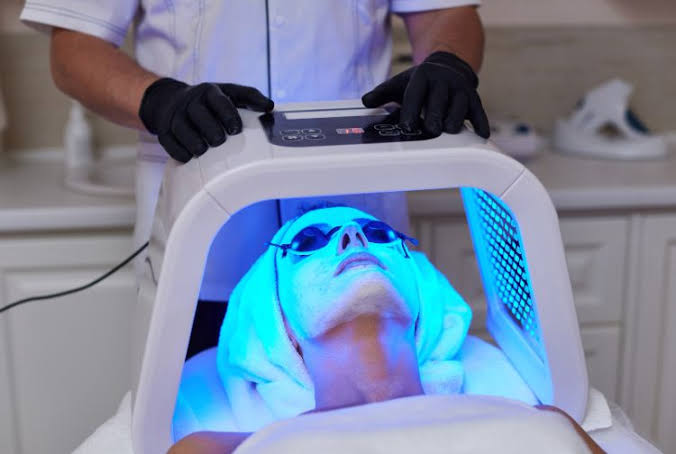
The clinic should then explain the chosen wavelength or combination. Blue light at around 415nm is used at the skin’s surface in acne-focused protocols. Red light around 633nm is associated with photobiomodulation applications in the skin, including rejuvenation and recovery support. Near-infrared around 830nm penetrates more deeply and is invisible, despite being delivered by the same professional system.
The treatment area is normally clean and free from make-up or heavy products. The panel is positioned according to the device protocol, and the exposure lasts for a set period. The client should be told what to expect, how often treatment is proposed and when progress will be reviewed.
For consumers researching professional LED phototherapy in London, the most useful information is not a list of every condition that has ever been studied. It is a clear description of the device, session length, pricing, practitioner, location, suitability checks and booking process.
Why Marylebone is a logical base
Marylebone combines residential streets, private healthcare, hospitality, offices and strong transport links. It attracts local clients as well as people travelling from other parts of London for appointments. A course-based treatment needs that accessibility. The theoretical benefit of frequent sessions is irrelevant if the location makes attendance unrealistic.
A specialist LED clinic at 82 York Street sits between Marylebone and Baker Street, with access from several Underground and rail routes. The area’s existing reputation for health and beauty services may help clients feel comfortable booking a technology-led treatment, but the location alone is not a quality guarantee. Consumers still need to assess the practitioner, device and claims.
This distinction matters because Central London pricing can create an assumption that a service is automatically premium. A high fee may reflect rent, branding or location rather than better treatment. Conversely, a specialist clinic may charge more than a salon because it invests in a professional device, longer consultation, training and course monitoring. The value needs to be visible in the service, not merely the postcode.
The evidence question
Photobiomodulation has a substantial research history, but “LED therapy works” is too broad a statement to be useful. Studies investigate particular wavelengths, doses, schedules and outcomes. Research on red and near-infrared light has reported improvements in measures such as skin roughness, complexion, collagen density and wrinkle appearance. Research on combined blue and red light has reported reductions in inflammatory acne lesions in some groups.
However, the evidence is not equally strong for every advertised use. Study sizes vary, treatment parameters differ and commercial devices are not interchangeable. Blue and red visible light may help inflammatory pimples, but it does not treat every type of acne and should not delay medical care for nodules, cysts or scarring. Claims about dramatic fat loss, instant lifting or curing chronic disease should be treated with scepticism.
A credible provider should be able to separate established use, emerging evidence and anecdotal experience. It should also avoid borrowing evidence from a clinical study that used a different wavelength or device while implying that the same result is guaranteed.
The role of medical-grade devices
“Medical-grade” is one of the most frequently used phrases in aesthetics, and consumers should ask what it means in context. A professional device may have documented specifications, quality controls, regulatory certification and protocols intended for trained users. That does not remove the need for correct operation, and it does not make every claim about the technology true.
Dermalux Tri-Wave MD systems are built around blue, red and near-infrared wavelengths and are designed for professional treatment. A clinic using such a system should still explain why a setting has been selected and how the course will be assessed. The brand name is useful information, but it is not a substitute for practitioner judgement.
The same principle applies to intensity. More power is not always better. Photobiomodulation is dose-dependent, and treatment is not improved by simply maximising exposure. Distance, time and energy delivered need to work together. Consumers do not need to become optical engineers, but they should expect the clinic to understand those factors.
Pricing and course structure
Professional LED pricing in London varies widely. Some clinics bundle light with facials or procedures; others sell it as a standalone session or course. At the specialist Marylebone provider examined for this article, a single 20-minute session is listed at £75, with reduced per-session prices for courses.
Packages can encourage consistency, but they should not pressure a client into buying before suitability is established. A sensible approach is to discuss the goal, start with an appropriate session or short course, and review progress. The clinic should explain the expiry period, cancellation terms and what happens if treatment is paused.
Consumers should also ask whether consultation time is included, whether photographs will be taken and whether the same device and protocol will be used throughout. A discounted package is not good value if appointments are rushed or settings change without explanation.
What LED can and cannot replace
LED can sit alongside daily skincare, but it does not replace sunscreen, cleansing or medically indicated acne treatment. It may support recovery after certain procedures, but it is not a substitute for the procedure itself. Red light does not create the same effect as injectable treatment, resurfacing or radiofrequency tightening. Blue light cannot address every cause or type of acne.
This limitation is part of the reason specialist LED services may continue to grow. The treatment can be positioned honestly as one component of skin maintenance rather than sold as an alternative to everything else. For clients who do not want aggressive intervention, that modest role may be exactly the attraction.
It also supports a more measured consultation culture. The practitioner can recommend a course when appropriate, a one-off session for a limited objective, or no treatment when the concern needs a different route.
Questions consumers should ask
Before booking, clients should know the name of the device, wavelengths used and typical session time. They should ask who performs the treatment, what training they have and how suitability is assessed. They should disclose medication and recent procedures rather than assuming that a non-invasive treatment has no contraindications.
They should also ask what evidence supports the specific result being discussed. “LED is clinically proven” is not enough. Proven for what outcome, using which light, over how many sessions? A good answer does not need to be full of jargon, but it should be specific.
Finally, clients should ask how progress will be measured. Consistent photographs, symptom tracking and scheduled review are more reliable than promises that the skin will “feel different” after an undefined period.
The role of reviews and visible proof
Because LED results are gradual, social proof needs careful handling. Reviews are most useful when they describe the consultation, comfort, punctuality and course experience rather than repeating technical marketing phrases. Before-and-after images should use comparable lighting, angle and camera settings, and clinics should state that individual results vary. Consumers should be cautious when photographs show different make-up, facial expression or exposure. A specialist provider can strengthen trust by publishing the treatment dates, number of sessions and wavelength used where client consent allows. The objective is not to create a dramatic transformation at any cost, but to show what a realistic course may achieve and how the service was delivered. Independent reviews, transparent complaints handling and a clear policy for correcting inaccurate claims are likely to become more important as the number of LED providers increases.
A category moving beyond novelty
The emergence of specialist LED clinics suggests that phototherapy is becoming a standalone consumer category rather than remaining a facial add-on. Home masks will continue to expand the market, while professional providers compete on device quality, expertise, location and the clarity of their treatment plans.
That competition could improve standards if it encourages clinics to explain settings, screen clients properly and publish realistic information. It could also create more marketing noise if every coloured-light service adopts medical language without evidence.
For consumers, the safest response is neither blind enthusiasm nor automatic dismissal. Professional LED phototherapy has credible applications and a growing evidence base, but it works through repeated, correctly delivered treatment rather than spectacle. The strongest clinics will be those that make the process easy to understand, straightforward to attend and honest about what the light can – and cannot – do.
What happens next
The growth of LED will probably make the market more selective rather than less. As consumers learn to ask about wavelengths, device models, screening and course planning, clinics will need to provide clearer answers. The businesses most likely to benefit are those that can explain both the possibilities and the limits of treatment without relying on theatrical claims. For London clients, specialisation may therefore become a useful shortcut to finding informed, consistent care.