



















































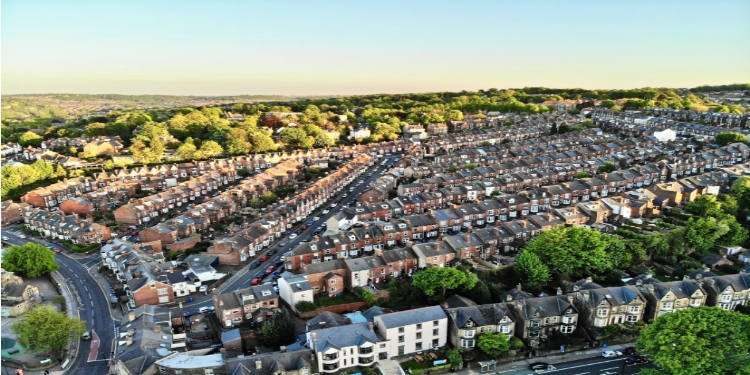
We spent fifty years regenerating urban brownfield sites under the comfortable delusion that British weather was merely a minor inconvenience involving damp coats and delayed trains. But, now, a month’s worth of rainfall in the space of a few days is a fairly regular reality. For construction, this means flooding site huts, drowning electrical plants, stalled crane movements, and soupy foundations.
Extreme rainfall events are forcing the hand of the entire industry.

Ground conditions don’t care about planning deadlines. It’s quite clear now that designing for short-term commercial convenience leaves UK developments dangerously exposed to the Climate Change Committee’s warnings on escalating flood risks and thermal instability.
Ground stabilization and structural retention
Managing lateral forces has always been hard, but that multiplies the moment a cloudburst hits. Anyone who’s worked on-site before knows that saturated earth pushes against temporary site shuttering with incredible force, and that waiting three weeks for in-situ concrete to cure inside a muddy trench during a wet November is expensive and time-consuming.
The alternative? Placing engineered precast concrete retaining walls straight onto prepared blinding layers pins vulnerable soil banks into position instantly. Offsite casting in means complete concrete mixes cure under ideal conditions, which is vital if you want them to reliably resist (increasingly) aggressive groundwater, road salts, acidic soils, and severe freeze-thaw cycles.
With precast units in place in hours, the risk of trench walls caving in during heavy rain is eliminated, allowing site teams to backfill immediately without needing temporary prop rentals, complex timber formwork, or prolonged open excavations.
A New Landscape
These days, planning officers and institutional investors refuse to back urban regeneration schemes that treat ground conditions as an afterthought. Joint guidance from the Town and Country Planning Association on climate action makes it plain that developments have to demonstrate long-term structural resilience. If they can’t, developers will struggle to secure private investment, local authority sign-offs, construction bonds, and commercial property insurance.
Urban regeneration plans rely on climate-adaptive infrastructure because brownfield sites are naturally high-risk.
Unlocking old gasworks, industrial waterfronts, sloped railway sidings, and disused docklands requires heavy subterranean retaining systems that absorb extreme hydrostatic spikes without shifting. You can install all the green roofs, solar arrays, bioswales, and rain gardens you want at surface level, but if underlying earth movement breaches the perimeter or shifts a foundation, the entire development fails financially and structurally.

David Prior
David Prior is the editor of Today News, responsible for the overall editorial strategy. He is an NCTJ-qualified journalist with over 20 years’ experience, and is also editor of the award-winning hyperlocal news title Altrincham Today. His LinkedIn profile is here.