

















































Every marketing team knows how to track Google rankings. Far fewer know whether ChatGPT, Gemini, or Perplexity recommend their brand when buyers ask for solutions.
That gap is what AI visibility optimization is designed to solve. But as more teams started measuring AI visibility, they realized that simply knowing whether they appeared wasn’t enough. They also needed to understand why competitors were being cited, which prompts triggered those answers, and what to optimize next.


Those growing requirements have pushed many teams to reassess the first generation of AI visibility platforms and compare best alternatives to Peec AI that provide deeper analysis and clearer optimization workflows.
This article explains what AI visibility optimization means in 2026, why it differs from traditional SEO, and the best practices that actually improve your visibility across AI search engines.
What AI visibility optimization actually means
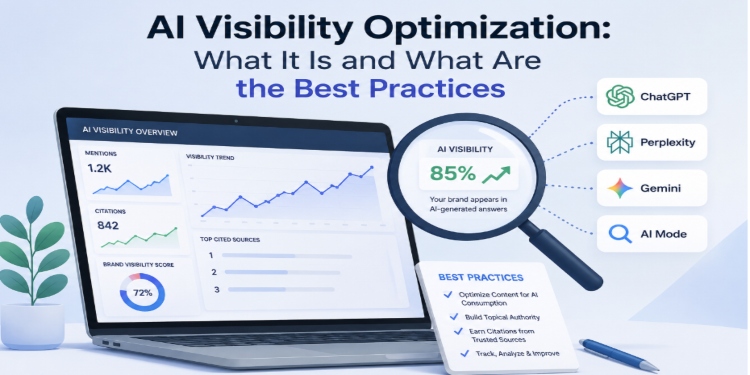
AI visibility optimization is the process of improving how often and how favourably your brand appears in AI generated answers across platforms like ChatGPT, Perplexity, Gemini, Google AI Overviews, and Google AI Mode.
It is not the same as SEO. A brand can hold the number one position on Google for a competitive keyword and still be completely absent from the AI answers users get when they ask the same question in natural language. The two systems draw on different signals and reward different things.
Traditional SEO rewards backlinks, keyword relevance, and technical site health. AI visibility is determined by whether your brand is present in the sources AI models draw from, how authoritatively your content answers questions, how consistently third parties reference and cite you, and whether the structure of your content makes it easy for AI models to extract and use.
According to Gartner, search engine volume is projected to drop 25% by 2026 as AI chatbots and virtual agents handle more of the queries that used to go to Google. For brands that have not yet looked at their AI visibility, that is not a distant problem.
How it differs from what came before
The comparison that helps most people is this: traditional SEO gets you found on a list. AI visibility optimization gets you recommended in a conversation.
When a user searches Google, they see a list of results and choose where to click. When a user asks an AI assistant the same question, they receive an answer that names specific brands, products, or sources — with reasons. Being in that answer is the goal. Being absent from it means you were never part of the conversation.
This changes what success looks like. The metric is not positioned on a page. It is citation frequency, share of voice across prompts, sentiment in the response, and which sources the AI credited when it mentioned you. As covered in this breakdown of AI keyword research tools UK marketers are using now, the tools marketers rely on are increasingly being built to surface these kinds of signals — not just traditional keyword and ranking data.
Best practices for AI visibility optimization in 2026
1. Monitor before you optimize
The first step is knowing where you stand. Run your brand name and category keywords as prompts in ChatGPT, Perplexity, Gemini, and Google AI Mode. Note whether you appear, how you are described, which competitors appear alongside or instead of you, and which sources the model cites.
Doing this manually once gives you a snapshot. Doing it systematically and consistently across platforms gives you data you can act on. Platforms like Wellows automate this across five major AI engines and surface citation context — which prompt triggered the mention, which source the model used, and how that changes over time — so teams can move from observation to strategy.
| What to track | Why it matters |
| Citation frequency | How often your brand appears in AI answers |
| Share of voice | Your presence vs competitors across the same prompts |
| Source attribution | Which of your pages or third party mentions AI models draw from |
| Sentiment | Whether you are recommended, mentioned in passing, or cited as a caveat |
| Prompt triggers | Which questions cause AI to mention your brand |
2. Build content AI models can extract and cite
AI models do not browse the web the way search engine crawlers do. They surface content that is clear, structured, authoritative, and easy to extract as a direct answer to a question.
Practically, this means:
- Writing in plain declarative sentences that answer specific questions directly
- Using descriptive headings that mirror how users phrase questions in natural language
- Including structured data markup (FAQ schema, Article schema, HowTo schema) to give AI models explicit context
- Covering topics comprehensively rather than shallowly — AI models favour sources that treat a subject with depth
- Keeping content factually accurate and regularly updated, as outdated information reduces the likelihood of citation
3. Earn third party citations and mentions
AI models weight external references heavily. A brand mentioned consistently across credible third party sources — review sites, industry publications, expert commentary, analyst reports — is far more likely to be surfaced in AI answers than one that exists only on its own website.
This is not a new idea. It mirrors what link building does for traditional SEO. But the mechanism is different. You are not trying to accumulate backlinks for PageRank. You are trying to build a body of external evidence that AI models interpret as a signal of genuine market authority.
Practical steps include contributing to industry publications, earning coverage in credible media, participating in expert roundups, and ensuring your brand appears in the kinds of third party comparisons and category pages that AI models frequently draw from when answering recommendation queries.
4. Treat AI visibility as a channel, not a project
The biggest mistake teams make is treating AI visibility optimization as a one-time audit rather than an ongoing channel with its own metrics and review cycle.
AI models update their training data and response patterns continuously. A brand that was absent from AI answers six months ago may now be appearing. One that was recommended consistently may have been displaced by a competitor with better content coverage. The only way to know is to keep watching.
As discussed in this overview of B2B digital marketing strategy best practices, the channels that compound over time are the ones where teams build consistent measurement habits early. AI visibility is no different.
Set a monthly review cadence. Track the same prompt set across the same platforms each time. Measure share of voice, citation sources, and sentiment as you would any other performance channel.
What good looks like
A brand with strong AI visibility in 2026 is being cited consistently across multiple AI platforms when users ask relevant questions. The citations are drawing from a mix of the brand’s own content and credible third party mentions. The sentiment is positive and the brand is recommended rather than simply referenced. And the team behind it can see all of that in a dashboard rather than discovering it by accident.
That is not a complicated destination. But getting there requires treating AI visibility as a discipline with its own measurement framework, not an extension of what you are already doing for Google.
The brands starting that process now are building an advantage that will be significantly harder to close in twelve months.
Tools worth knowing for AI visibility optimization
You cannot improve what you cannot see. These are the platforms teams are using in 2026 to monitor and improve their AI visibility:
| Tool | What it does in one line |
| Wellows | Complete AI visibility platform that tracks brand citations across AI models. Shows the prompt behind each answer, the source cited, and where competitors sit in it, runs a cannibalization check before any content optimization. |
| Profound | Connects AI citation data to actual site traffic so enterprise teams can measure the revenue impact of AI visibility |
| Otterly AI | Entry-level prompt monitoring across ChatGPT and Perplexity — straightforward setup, good for teams getting started |
| SE Ranking | Combines AI Overview tracking with traditional SEO data inside one dashboard — useful for agencies managing both channels |
| Ahrefs Brand Radar | Adds basic AI citation monitoring inside the Ahrefs suite for teams already using the platform |
| Semrush AI Toolkit | Brings AI Overview and LLM mention tracking into the Semrush ecosystem for teams consolidating tools |
The key distinction across all of them: monitoring tools tell you whether you appeared. The better platforms tell you why, what triggered it, and what to do next. That second layer is where AI visibility optimization actually happens.
Frequently asked questions
What is AI visibility optimization?
AI visibility optimization is the practice of improving how often and how favourably a brand appears in AI generated answers across platforms like ChatGPT, Perplexity, Gemini, and Google AI Mode. It focuses on citation frequency, source authority, content structure, and third party mentions rather than traditional keyword rankings.
How is AI visibility different from SEO?
Traditional SEO gets your pages ranked in a list of search results. AI visibility determines whether your brand is named and recommended when users ask AI assistants a question. The signals AI models use — source authority, content extractability, external citation patterns — are different from the ranking factors that drive Google performance.
How do I know if my brand is visible in AI search?
The starting point is running your brand name and category prompts in ChatGPT, Perplexity, and Gemini manually. For ongoing monitoring at scale, platforms like Wellows track citation presence across five major AI engines and surface the context behind each mention.
How long does it take to improve AI visibility?
There is no fixed timeline. Brands with strong existing content authority and credible third party coverage often see faster improvement. Content and schema changes can take weeks to influence AI model outputs. Third party citation building takes longer. Consistent monitoring is essential to track what is working.
Do I need a separate tool for AI visibility?
Traditional SEO tools do not measure what happens inside AI generated answers. A dedicated AI visibility platform is necessary if you want to track citation frequency, share of voice across prompts, or the source attribution behind each mention.
Conclusion:
AI visibility optimization is quickly becoming as essential as traditional SEO. Brands that start measuring, improving, and monitoring their presence in AI-generated answers today will be far better positioned as search continues to shift toward conversational experiences