



















































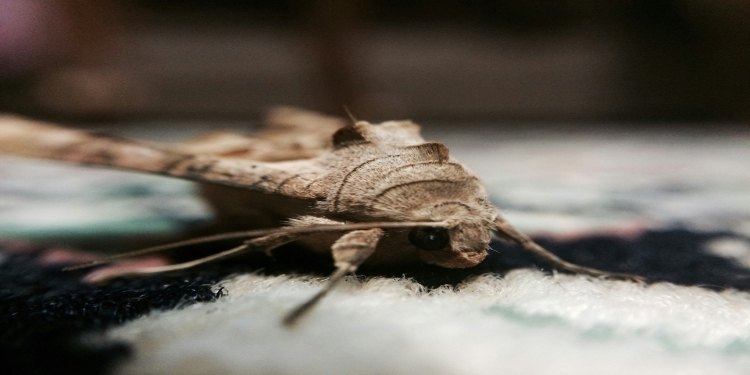
Britain is quietly losing a war in its wardrobes. Pest control firms across the country report that moth callouts have climbed steadily for over a decade, dry cleaners describe customers arriving with bags of hole-riddled knitwear, and heritage organisations that monitor insect pests in historic properties have logged clothes moth numbers at some of the highest levels since records began.
For an insect that neither bites, stings nor spreads disease, the clothes moth has become a remarkably expensive housemate. So what’s driving the surge, and if the holes have started appearing in your own home, what actually works against them?


The perfect conditions we built ourselves
Several slow changes in how Britain lives have stacked the odds in the moths’ favour.
- Winters no longer kill them off. Cold snaps once acted as a natural annual cull, halting breeding and killing off larvae in unheated homes. Milder winters and universal central heating have removed that brake. In a modern insulated home kept at 20 degrees, clothes moths breed comfortably all year round, compressing what was once one or two generations a year into three or four.
- Our homes got softer and fuller. Fitted wool carpets, upholstered everything, under-bed storage boxes and wardrobes packed to bursting create exactly the dark, undisturbed, fibre-rich environments moth larvae need. The spare room nobody enters and the wardrobe corner nobody reaches are, from a moth’s perspective, prime real estate.
- Natural fibres came back. After decades of synthetic dominance, wool, cashmere and silk returned to British wardrobes as markers of quality and sustainability. Moth larvae eat keratin, the protein in animal fibres, and cannot digest synthetics at all. The revival of natural materials restocked their food supply, and the growing love of vintage and secondhand clothing added a transmission route: infested garments carried unknowingly from one home to the next.
- We disturb them less. The spring clean, the seasonal turning-out of cupboards, the beating of rugs on the washing line: the traditional rituals that once interrupted moth life cycles have largely disappeared. Larvae thrive on being left alone, and modern life obliges.
Know what you’re dealing with
Two species cause nearly all the damage in UK homes. The common clothes moth targets garments and textiles: wool coats, cashmere jumpers, silk, feathers and fur, favouring hidden areas like underarms, collars and the folds of stored clothing. The case-bearing carpet moth works lower down, grazing wool carpets from the edges of rooms and beneath furniture, where the vacuum rarely reaches.
Crucially, the fluttering adult moths you occasionally see are not the ones eating anything. Adults don’t feed at all; they exist to mate and lay eggs, up to two hundred per female, hidden in quiet, fibre-rich spots. The eggs hatch into small cream-coloured larvae that feed for two months or more, and these larvae cause every hole and every threadbare patch. Any response that only targets visible moths, a swat here, a spray there, leaves the actual problem untouched.
The warning signs, roughly in the order most people meet them: unexplained holes in natural-fibre clothing, bare patches at carpet edges and under furniture, fine silky webbing or small rice-grain cases in wardrobe corners, gritty sand-like debris in drawers, and small golden moths making short, weak flights in the evening. One moth is a caution. Regular sightings or damage in more than one room means an established breeding population.
What genuinely works
For light infestations caught early, a disciplined DIY response can succeed, and its most powerful weapon is the least exciting one: the vacuum cleaner. Daily, thorough vacuuming of affected rooms, with real attention to edges, corners and the floor beneath furniture, physically removes eggs and larvae from the environment. Empty the vacuum outside each time, or the catch simply crawls back.
Clothing and textiles that can tolerate it should be washed at 55 degrees or hotter, which kills all life stages. Delicates that can’t take the heat can go the other way: sealed in bags and frozen for two weeks. Pheromone traps, available for a few pounds, catch adult males and serve as a running scoreboard; a declining weekly catch means your campaign is working, a steady one means it isn’t. Once clean, off-season woollens should be stored in sealed bags or airtight boxes, removing the food supply entirely.
Where honest advice matters is at the limits of DIY. Established infestations routinely survive it. Larvae tucked beneath fitted wardrobes, inside floor voids or across several rooms are beyond the reach of surface sprays, and in flats and terraces an infestation may be seeded from a neighbouring property altogether. The pattern is familiar to every professional in the industry: months of shop-bought products, a brief lull, and the holes returning, while carpets and clothing rack up losses that dwarf the cost of doing it properly once. If damage persists after weeks of effort, if moths appear in multiple rooms, or if a previous treatment has already failed, it is worth calling in dedicated moth treatment experts rather than reaching for another aerosol, since ending an infestation depends on the unglamorous specifics: identifying the species correctly, treating the hidden harbourages a householder can’t reach, and timing follow-up visits to intercept the eggs that survived the first pass. Specialist focus exists in this corner of pest control precisely because half-finished moth jobs come back.
Keeping them out for good
Whether victory comes by vacuum or by professional treatment, prevention is what makes it permanent, and it costs almost nothing.
Store clothes clean: larvae are drawn to fibres carrying traces of sweat and skin, so garments should never be put away dirty at season’s end. Seal what matters: cashmere, heirloom textiles and anything irreplaceable belongs in airtight storage between wearings, since cedar and lavender deter at best but a sealed bag denies absolutely. Disturb the quiet places: move furniture occasionally, vacuum beneath it, air stored clothing a couple of times a year, because moths cannot establish where they are regularly interrupted. And keep a single pheromone trap running permanently in the highest-risk wardrobe; for a few pounds it provides the early warning that turns the next incursion into a footnote rather than a campaign.
The moth surge shows no sign of reversing. The conditions driving it, warm homes, mild winters and wardrobes worth eating, are here to stay. But at the level of any individual household, this remains an entirely winnable fight. The insects are slow, predictable and vulnerable at every stage to heat, hygiene and disturbance. Act on the first hole rather than the fifth, target the larvae rather than the flutterers, and Britain’s knitwear can yet see out many more winters intact.

David Prior
David Prior is the editor of Today News, responsible for the overall editorial strategy. He is an NCTJ-qualified journalist with over 20 years’ experience, and is also editor of the award-winning hyperlocal news title Altrincham Today. His LinkedIn profile is here.