




















































When drivers see minor dents, scuffs, or paint damage, they often question the restoration process. Before committing to SMART repair in Aberdeen, people typically seek clarification, especially when the damage appears slight yet noticeable. Knowing how a professional SMART repair works reduces a lot of the worry associated with car restoration and helps set reasonable expectations. From the initial examination to completion, the procedure follows a well-defined, organised workflow to produce accurate results without unnecessary effort.
Initial Assessment and Damage Review
A thorough evaluation is the first step in any SMART repair. To determine the type, extent, and location of the damage, a professional inspects the affected area. This stage determines whether a SMART strategy is appropriate for the problem or if an alternative approach is needed. Structural damage does not typically qualify, but paint chips, bumper scuffs, minor dents, and surface scratches do.


The technician also considers the paint type, the panel material, and the surrounding environment at this point. This information ensures the finish will integrate seamlessly with the rest of the car and guides the restoration process. Customers are better able to understand what can be accomplished and how long the process is expected to take when communication is clear at this stage.
Preparation of the Affected Area
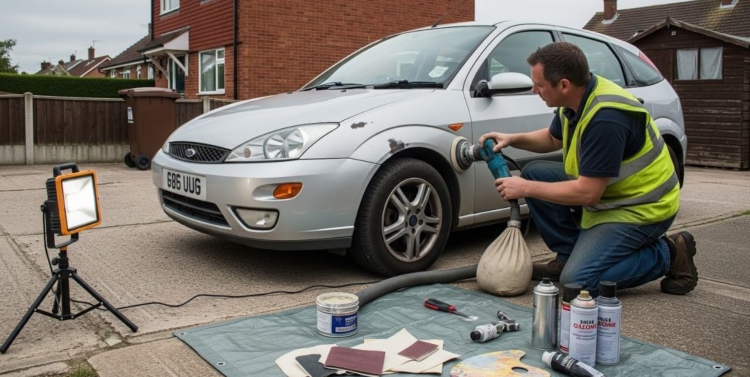
Preparation begins upon completion of the assessment. The affected area is cleaned thoroughly to remove residue, wax, and debris. Any sharp edges or free paint are smoothed out. In addition to avoiding future defects, this process leaves a smooth surface for repair.
Masking prevents overspray or unwanted contact with other panels, trim, or lights. Accuracy is vital, since SMART repair targets a specific area rather than the entire panel. The fix will remain sealed and look perfect if it is well prepared.
Repairing Dents or Surface Imperfections
In cases of dents or slight deformations on a panel, technicians will reshape it using specialised equipment. Light force is applied to either the surface or the back, depending on the material and accessibility. It is designed to recover the original form with minimal strain on the plastic or metal. For chips or scratches, a small amount of filler should be applied to smooth the surface. This material is used in thin layers and, after curing, is precisely carved.
Paint Matching and Colour Blending
One of the most essential things in any repair is paint matching. Technicians blend the paint to match the existing shade, taking into account age, exposure, and finish. Nobody should be sloppy since contemporary car colour palettes can be complicated.
SMART repair is a process of blending and not repainting a complete panel. Fresh paint is feathered to the surrounding area to provide a smooth visual transition. This process removes the colour variation that would be observed in larger repainting operations, ensuring uniformity.
Controlled Paint Application
If needed, new paint is laid in well-calibrated layers with professional spray guns. The layers are cured between applications to ensure even coverage and the required texture. In this process, the technician is keen on thickness and finish. The limited space for repairs reduces overspray and requires strict observation. Rather than emphasising the reconstructed area, it aims to restore the factory’s original appearance.
Final Inspection and Quality Checks
Technicians do a final check, after which the vehicle is returned. This check assesses the overall appearance, surface smoothness, and colour consistency. Even minor changes are addressed immediately. Technicians usually point out the part of the work that has been fixed so you can assess the repair and ask questions. This transparency guarantees a fit between expectations and outcomes and the development of trust.
Choose SMART Repairs
SMART repairs are usually completed much faster than traditional bodywork. Depending on the situation and complexity, several tasks can be completed in a single visit. This would be efficient for drivers with tight schedules who do not want to be inconvenienced for long.
SMART repairs can be performed at home, in the office, or anywhere else, are usually mobile and cost-effective, and can be completed to save time. Customers benefit from vehicle repairs that cause minimal disruption to their daily routine.

David Prior
David Prior is the editor of Today News, responsible for the overall editorial strategy. He is an NCTJ-qualified journalist with over 20 years’ experience, and is also editor of the award-winning hyperlocal news title Altrincham Today. His LinkedIn profile is here.