





















































Fatal-accident investigations often produce the first facts that shape a wrongful-death claim. A police conclusion does not necessarily resolve every civil-liability issue. A crash report may identify a driver, while phone records, vehicle data, medical records, and witness accounts may reveal facts that the initial report cannot establish. Georgia had an estimated 1,373 traffic fatalities in 2024, according to preliminary data.
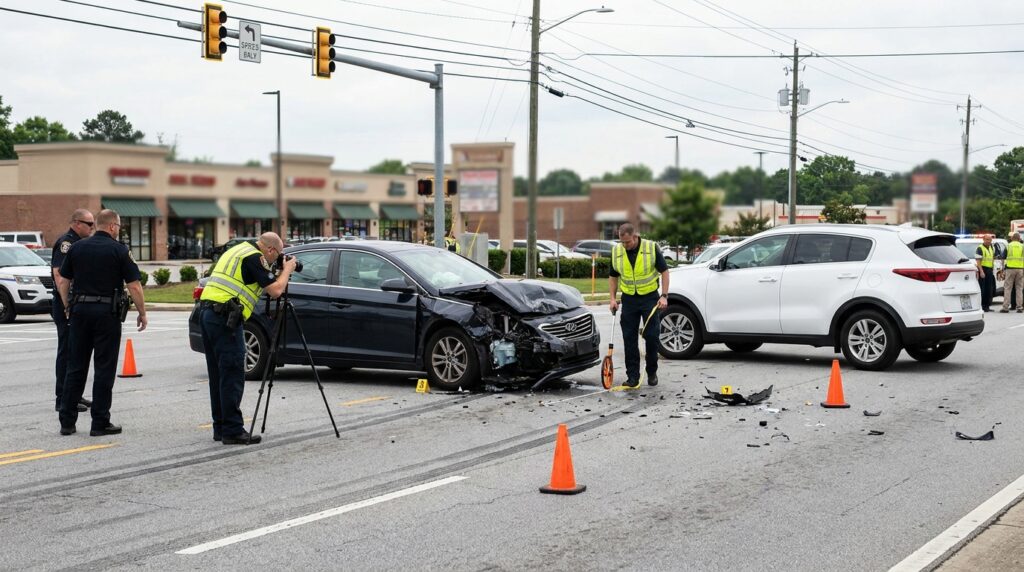
Police Records Start The Investigation
Records establish the initial factual record. The crash scene often determines what evidence survives. Gwinnett County Police investigators investigate fatal and life-threatening crashes. GDOT uses the GDOT-523 crash report as Georgia’s official crash-reporting document, and GEARS stores crash reports statewide.


Different Duluth crash locations can present different roadway and traffic conditions. A collision investigation may examine signal timing, turning movements, lane position, roadway conditions, and the agencies involved.
Fatal Crashes Require More Than A Traffic Report
Citations do not automatically establish civil liability. A traffic citation does not by itself establish civil liability. Investigators must connect conduct to causation. O.C.G.A. § 40-6-273 requires a driver involved in an accident causing injury, death, or apparent property damage of at least $500 to immediately notify the appropriate law-enforcement agency. O.C.G.A. § 40-6-278 authorizes the commissioner of transportation, by rule, to require additional investigation or reports for crashes involving serious bodily injury or death.
“Police reports capture immediate scene details, but civil liability requires connecting driver conduct to the fatal outcome. Reconstructing a crash through event data recorder information, video footage, and physical evidence provides the comprehensive proof needed to demonstrate causation,” stated Sarah Moskowitz, a Duluth wrongful death attorney at Slam Dunk Attorney, a 2025 Best of Gwinnett Winner, Lead Counsel Verified firm, and BBB Accredited Business with an A+ Rating.
A crash reconstruction investigation may analyze event data recorder information, vehicle damage, braking marks, vehicle positions, surveillance footage, and roadway measurements. Traffic-camera footage, business video, dash-camera footage, and 911 records may help establish the sequence of a crash.
Insurance And Liability Evidence
Investigators must identify both the responsible parties and the insurance coverage that may respond to the loss. The investigation may review driver insurance, vehicle ownership, commercial policies, and other potentially liable parties.
Georgia’s crash-reporting materials include insurance and witness information among the information collected in a crash report. Coverage evidence can clarify which insurer received notice, what policy applies, and whether additional liability sources require investigation.
Medical Evidence Connects The Crash To Death
Medical records answer a different question. They connect the physical event to the fatal injury. Emergency records, imaging, toxicology, and autopsy findings can show whether trauma caused death directly or another condition contributed.
Georgia death records include the cause, date, and place of death, as recorded on the death certificate. The Georgia Office of Vital Records charges $25 for a certified death certificate plus an $8 processing fee for online orders, with processing taking up to 10 weeks. Northside Hospital Duluth may appear in records when emergency treatment occurs there. The medical chronology should match the crash chronology.
Holding responsible parties accountable for the loss of a loved one requires a compassionate approach paired with a meticulous review of medical records, physical evidence, and police reports. If you need to evaluate a wrongful death claim in Duluth, Georgia, Slam Dunk Attorney provides cost-free initial consultations. To discuss your options with their team, call (678) 329-9750 or visit 2250 Satellite Blvd, Ste. 120, about an 8-minute drive from Mega Mart, 2106 Pleasant Hill Rd.
Who Can Bring A Georgia Wrongful Death Claim?
Georgia law specifies which surviving relatives or personal representatives may bring a wrongful-death action depending on the relationship to the decedent and the circumstances of the death. Georgia Code § 51-4-2 gives the surviving spouse or, if there is no surviving spouse, the child or children the right to recover for the wrongful death of a spouse or parent, while separate statutes govern the wrongful death of a child and certain claims by a personal representative. O.C.G.A. § 51-4-2 provides that the surviving spouse may recover for the wrongful death of a spouse, and, when no surviving spouse exists, the child or children may recover.
A wrongful-death claim and claims brought by the personal representative of the estate are distinct causes of action. The personal representative may recover certain funeral, medical, and other necessary expenses, while separate survival claims may involve damages for injuries sustained by the decedent before death. Federal courts applying Georgia law treat those causes of action as distinct.
How Investigators Preserve Evidence Before It Disappears
Time creates an evidence problem. Physical and electronic evidence may become unavailable or change over time, making timely identification and preservation important. A timely preservation demand can request that relevant records be preserved before routine retention practices result in their deletion or alteration. A preservation strategy should identify the person or entity that controls potentially relevant records.
Local Records Can Change The Investigation
Duluth geography can shape the evidence path. A Duluth crash investigation may examine traffic signals, turning lanes, access points, roadway movements, traffic conditions, and available surveillance footage. Road design and traffic conditions can affect causation. Investigators may need records from each agency that handled a crash.

The Two-Year Deadline Can Reshape The Strategy
Deadlines can move faster than evidence. Georgia’s limitation period can expire before the investigation feels complete. Georgia courts generally apply a two-year limitation period to wrongful-death actions under O.C.G.A. § 9-3-33. In Georgia, a wrongful-death claim generally accrues at death, but separate estate claims may have different accrual and tolling rules.
The investigation should proceed while relevant evidence is identified, preserved, and evaluated. A wrongful-death investigation may involve crash reports, death records, medical records, witness information, insurance records, and preservation measures. The legal claim and factual investigation should progress together.
Witness Evidence Can Clarify The Crash
Witness statements can help investigators establish what happened before, during, and after a fatal crash. Investigators may identify drivers, passengers, pedestrians, nearby witnesses, and 911 callers, then compare their accounts with physical and electronic evidence.
GDOT instructs investigators to document witness statements and correlate those statements with scene evidence and electronic data. Witness evidence can help establish speed, distraction, impairment, lane movement, or other contributing conduct when investigators test those accounts against the physical record.
What A Complete Investigation Should Establish
The investigation must connect separate proof streams. A strong wrongful-death investigation should connect four questions: what happened, who caused the event, how the event caused death, and which statutory plaintiff may bring the claim. Each answer depends on different records and sometimes different investigators.
The investigation should build a consistent timeline from roadway evidence through medical causation and then apply Georgia’s wrongful-death rules to documented facts.

David Prior
David Prior is the editor of Today News, responsible for the overall editorial strategy. He is an NCTJ-qualified journalist with over 20 years’ experience, and is also editor of the award-winning hyperlocal news title Altrincham Today. His LinkedIn profile is here.