




















































It sounds like a hypothetical. A thought experiment. The kind of question that would get a polite smile at a logistics conference before the conversation moved on.
But for the engineers, contractors, and operations directors who build and run the world’s largest distribution facilities, it is not hypothetical at all. It is the single most consequential technical decision in the construction of any major warehouse, and when it goes wrong, the consequences are immediate, measurable, and expensive.


The floor slab is not a backdrop to the action inside a distribution centre. It is the infrastructure on which every other system depends. Get it right, and millions of daily operations flow invisibly and efficiently. Get it wrong, and the problems begin within months, sometimes weeks, of opening day.
The Hidden Science Behind a Warehouse Floor
When Amazon specifies a new fulfilment centre, the concrete floor receives the same level of engineering scrutiny as the steel frame above it. At one major Amazon facility in the United States, construction required floor flatness ratings of FF 50 and floor levelness ratings of FL 34.5, figures that place it significantly above standard commercial warehouse specification and reflect the precision demands of high-speed automated systems operating inside.
Those numbers are not arbitrary. In the world of industrial flooring, FF and FL ratings are the technical language of floor performance. FF measures the smoothness of a surface over short distances, while FL measures how level it is over longer spans. For context, a standard wide-aisle warehouse typically requires an FF of 25 and an FL of 20. Facilities running automated guided vehicles, or AGVs, demand considerably more, often FF 50 or above, with some robotic storage systems requiring ratings as high as FF 75.
The reason is straightforward: automated vehicles navigate using sensors, and sensors need predictable surfaces. A floor deviation of a few millimetres, invisible to the human eye, can cause an AGV to drift off its programmed path, trigger a collision, or simply stop working until the error is cleared by an operator. In a facility processing hundreds of thousands of orders a day, those interruptions multiply rapidly.
This is the domain where industrial concrete flooring by Twintec Group has set the benchmark for performance. With decades of experience engineering high-performance concrete floor slabs for the world’s most demanding logistics and retail operations, the expertise behind these solutions recognises that a warehouse floor is not poured and forgotten. It is designed from the ground up to tolerate specific loads, maintain flatness under continuous traffic, and perform without joint failure for the lifespan of the building.
What Actually Goes Wrong, and What It Costs
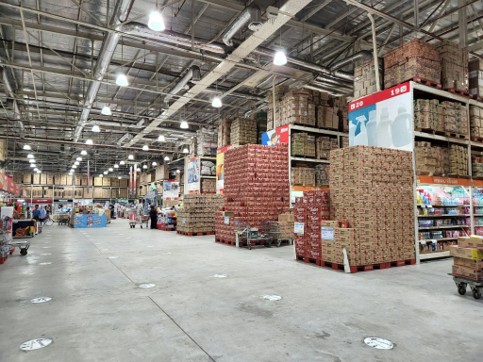
Source: https://www.pexels.com/photo/man-walking-in-warehouse-4483775/
The most common failure mode in large-scale warehouse floors is joint deterioration. Concrete naturally expands and contracts with temperature changes, and construction joints are engineered to accommodate that movement. When joints are poorly specified, under-reinforced, or lack effective load transfer devices, the edges begin to chip and widen under forklift traffic.
What starts as a modest gap at a joint eventually becomes, in the words of one operations manager, a “relative canyon.” Forklift operators begin swerving to avoid the worst sections, creating unofficial routing patterns that add time to every cycle. Smaller pallet jack wheels, unable to bridge the joint gap cleanly, cause further edge spalling with every crossing. The damage compounds.
The operational mathematics of that deterioration are sobering. Research from forklift industry data suggests that approximately 20% of all forklift maintenance costs can be attributed directly to damaged concrete and failed expansion joints. Tyre replacements, suspension wear, hydraulic system stress, all accelerated by surfaces that were never fit for the equipment they were asked to support.
For a retailer like Walmart, which operates distribution centres of three million square feet or more, the financial exposure from a poorly specified floor extends far beyond maintenance budgets. Unplanned downtime at a major fulfilment hub, even partial operational shutdowns affecting specific zones or aisle systems, can generate six-figure losses within a single day. A building that cost hundreds of millions to construct can be compromised by a floor specification that was under-engineered by a fraction of its total cost.
The repair path for a failed industrial floor is neither simple nor cheap. Reinstating failed joints, resurfacing delaminated concrete, and relevelling sections that have settled due to poor sub-base preparation typically requires phased shutdowns, specialist contractors, and significant lead time. For an always-on distribution operation, there is rarely a convenient window for that kind of work.
The Automation Problem Nobody Is Talking About Enough
The stakes have risen sharply in the past decade with the rapid expansion of warehouse automation. The same logistics giants who once relied on human pickers navigating wide aisles with counterbalanced forklifts are now deploying dense robotic systems where the margin for floor imperfection is almost zero.
For automated storage and retrieval systems, floor flatness requirements can reach FF 75 and above, with maximum surface deviation tolerances measured in millimetres per three-metre straightedge. These are not specifications that a standard commercial concrete contractor can reliably achieve without specialist knowledge, equipment, and mix design.
A distribution centre built on a floor that was adequate for the operation it was designed for can become a liability within a few years if that operation evolves. Heavier robotic platforms, narrower operating aisles, taller automated racking, all of these changes increase the demand placed on the floor below. A slab that met specification on opening day may not meet the specification required by the system introduced in year three.
The solution is not simply to build to higher standards from the outset, though that helps. It is to approach the floor as an engineered asset with a defined lifespan and performance envelope, rather than as a commodity element of the construction package. The difference in cost between an adequately specified floor and a genuinely engineered one, at the scale of a major distribution centre, is typically a fraction of one percent of the total project value. The difference in operational risk over a ten or twenty year building life is not comparable.
Amazon and Walmart understand this, which is why their floor specifications are among the most demanding in the industry. The question, for every developer and operator building at scale, is whether the lesson has been learned before the first forklift rolls in, or after.