





















































The Bitcoin price rose by more than 20% over two days, reaching its highest level since early June. For the cryptocurrency market, which has been under pressure in recent months due to high interest rates and ongoing regulatory uncertainty, such a sharp rise is an important signal. The Ethereum price rose by around 20% in a single day, while the XRP chart showed a gain of more than 23% over the same period, with other altcoins also moving higher. However, the current rally can hardly be called a full-scale recovery toward historical highs. Bitcoin is still nearly 60% below its October 2025 peak of just over $126,000.
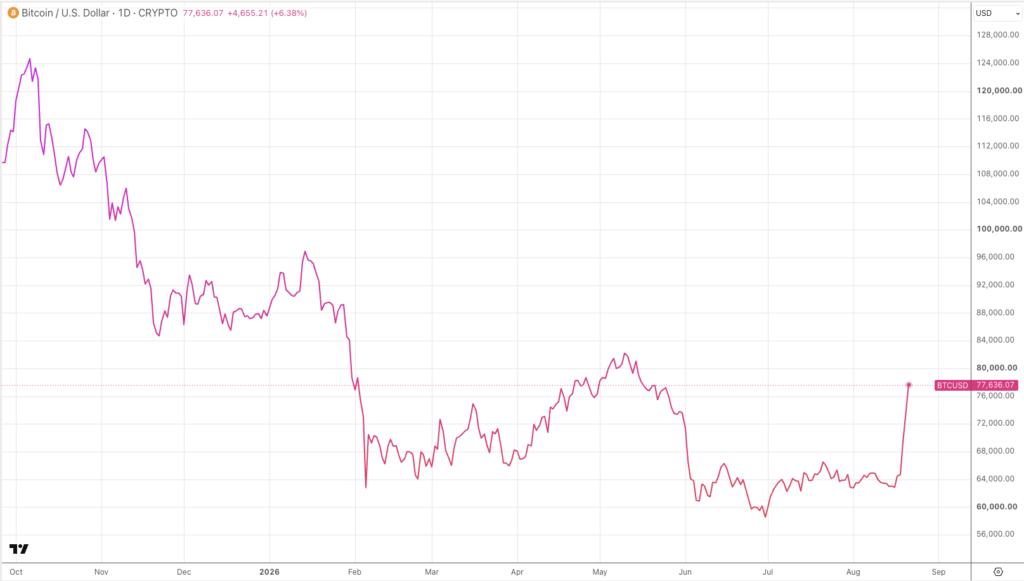
One of the immediate drivers of the rally was the decline in U.S. Treasury yields, which eased pressure on riskier assets. The liquidation of short positions provided an additional boost. Over several trading sessions, traders were forced to close short positions worth approximately $2.7 billion. However, a much more interesting factor is the renewed interest of U.S. policymakers in establishing a clearer regulatory framework for cryptocurrencies.


At the center of this renewed attention is the CLARITY Act, a bill intended to establish clearer rules for the digital asset market in the United States. On Thursday, the White House held an unscheduled meeting with the leaders of major cryptocurrency companies, including Coinbase, Kraken, Robinhood, Ripple, and Chainlink. Donald Trump called on Congress to pass the bill by the end of the year, emphasizing the need to maintain the United States’ technological lead over China and other countries.
For the cryptocurrency industry, the adoption of such a law could be far more significant than another move in Bitcoin’s price. Clear rules could reduce regulatory risks for exchanges, digital asset issuers, and financial companies, potentially creating conditions for an influx of new institutional capital. That is why the market is following the political process so closely.
However, there are currently few reasons for excessive optimism. After the Senate adjourned for the August recess without holding a vote, the likelihood of the CLARITY Act passing this year dropped significantly. The next key event will be the procedural vote on September 15. If the bill does not receive the necessary support, its prospects of passing by the end of the year will be in serious doubt.
At the same time, the cryptocurrency industry is beginning to evolve in another direction, driven by artificial intelligence. Binance has launched Agent OS, a platform that allows AI agents to independently analyze market information and execute trades on behalf of users. The system can connect to ChatGPT, Codex, Claude Code, and Cursor, access account data, and submit trading orders.
This represents the next stage in the automation of cryptocurrency trading. Previously, traders and developers primarily managed algorithms themselves; now, some decisions can be delegated to autonomous AI agents. The user still retains control over their funds. Binance offers special subaccounts that allow users to restrict agents’ access to funds, with withdrawals blocked by default.
This could create a new class of participants in the cryptocurrency market. AI agents could analyze prices, news, and portfolio positions around the clock, while interacting not only with exchanges but also directly with blockchain protocols and DeFi platforms. Binance already allows agents to perform such operations, although relatively strict daily limits apply.
At the same time, competition in this segment has already begun. Kraken, Coinbase, and OKX are developing similar tools using the MCP protocol. For cryptocurrency exchanges, this is about more than technology. The more operations users delegate to AI agents, the greater the share of trading activity and financial flows that these platforms could capture.
Thus, the current crypto rally reflects several processes at once. In the short term, the market has been supported by lower U.S. Treasury yields and the liquidation of short positions. In the medium term, support could come from hopes for clearer U.S. cryptocurrency regulation. In the long term, AI agents could provide the industry with another source of growth as they gradually evolve from an experimental technology into full-fledged financial tools. The combination of these factors could shape the future trajectory of the crypto market far more significantly than any short‑term movement in Bitcoin’s price.

David Prior
David Prior is the editor of Today News, responsible for the overall editorial strategy. He is an NCTJ-qualified journalist with over 20 years’ experience, and is also editor of the award-winning hyperlocal news title Altrincham Today. His LinkedIn profile is here.