

















































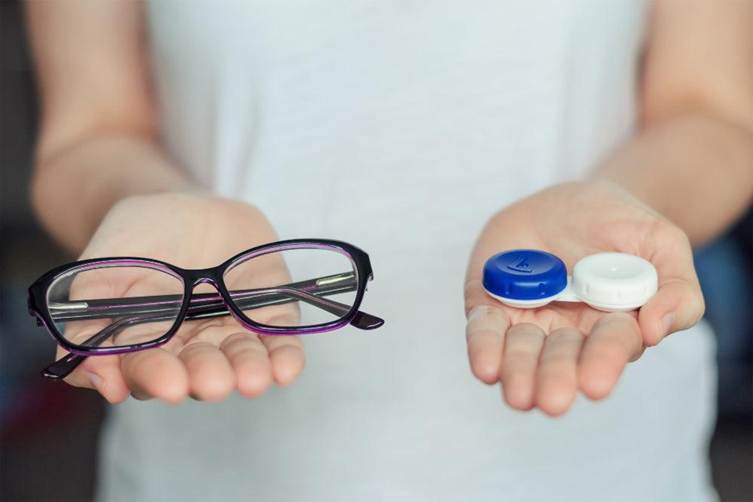
Many people assume that once they have a glasses prescription, they have what they need to order contact lenses. This is one of the most common misconceptions in eye care. The two documents are not interchangeable, and the reasons why are more practical than bureaucratic. Understanding the difference between a contact prescription and a glasses prescription also clarifies what people mean when they search for conversion methods and whether those methods actually work.
Are a Glasses Prescription and a Contact Lens Prescription the Same?
No. Both documents contain information about corrective power, but that is where the similarity ends. A glasses prescription and a contact lens prescription are separate medical documents for two different corrective devices. Each is issued following a different type of examination, contains different fields of information, and is valid only for the device it specifies. A glasses prescription does not contain the measurements needed to safely fit a contact lens, and in the UK, contact lens prescriptions can only be issued by a registered optometrist or dispensing optician following a contact lens fitting. A glasses prescription from a standard sight test does not satisfy this requirement, regardless of how recent it is.

Why the Prescriptions Differ: Vertex Distance
The fundamental reason a contact lens prescription differs from a glasses prescription in corrective power is vertex distance. Glasses sit approximately 12 to 14 millimetres in front of the eye. Contact lenses sit directly on the corneal surface with zero distance between lens and eye. This positional difference changes the effective power that reaches the retina.
For prescriptions below plus or minus 4.00 diopters, the difference in effective power is small enough that clinicians generally consider it negligible, and the sphere power on both prescriptions will typically be identical or differ by 0.25 diopters. For prescriptions above plus or minus 4.00 diopters, vertex distance correction becomes clinically significant. A glasses prescription of minus 6.00 diopters translates to approximately minus 5.75 in a contact lens prescription. A glasses prescription of plus 5.00 diopters may correspond to approximately plus 5.50 in contacts because moving the lens closer to the eye increases its effective plus power. The further from 4.00 diopters the prescription sits, the greater the correction required. This calculation is what underpins the conversion charts available online, and it applies only to the sphere power component.
What a Glasses Prescription Contains
A standard glasses prescription lists fields for each eye, identified as OD for the right eye and OS for the left. The sphere value (SPH) is the primary corrective power in diopters: negative for short-sightedness, positive for long-sightedness. The cylinder value (CYL) indicates the power to correct astigmatism, expressed as a negative number in most UK prescriptions. The axis is a number between 1 and 180 specifying the orientation of the cylinder correction. An ADD value is present for people with presbyopia, representing the additional magnification needed for near vision. The pupillary distance (PD) is the measurement in millimetres between the centres of the two pupils, used to position the optical centres of the glasses lenses in the frame. PD is specific to glasses and has no equivalent in a contact lens prescription.
What a Contact Lens Prescription Contains
A contact lens prescription contains all the vision correction fields found in a glasses prescription, adjusted where necessary for vertex distance, plus several additional fields that have no equivalent in a glasses prescription. These additional fields relate to the physical fit of the lens on the eye rather than the optical correction it provides.
Base Curve
Base curve, abbreviated BC, is a measurement in millimetres that describes the curvature of the back surface of the contact lens. It must correspond closely to the curvature of the wearer’s cornea to ensure the lens sits correctly on the eye. A base curve that is too steep will fit tightly and restrict oxygen flow and tear exchange beneath the lens. A base curve that is too flat will fit loosely, move excessively during blinking, and cause discomfort and blurred vision. Typical base curve values for soft contact lenses range from 8.3 to 9.0 millimetres. This measurement can only be determined through keratometry or corneal topography during a contact lens fitting examination and cannot be estimated from a glasses prescription.
Diameter
Diameter, abbreviated DIA, is the measurement in millimetres of the full width of the contact lens from one edge to the other. It determines how much of the eye the lens covers and affects stability, comfort, and oxygen delivery. Soft contact lens diameters typically range from 13.8 to 14.5 millimetres. Like base curve, diameter is determined during a fitting examination and varies between lens brands and types. It is not present on a glasses prescription and cannot be inferred from one.
Brand and Lens Type
Unlike glasses prescriptions, contact lens prescriptions specify a particular lens brand and product. Contact lens parameters are not standardised across manufacturers: a lens from one brand at a base curve of 8.6 millimetres will not fit identically to a lens from a different brand at the same stated value because materials, edge designs, and overall geometries differ. The brand on your prescription reflects what your optician found to be the best fit for your eye during the trial fitting, and switching brands without reassessment carries genuine risks to fit and comfort.
Expiry Date
Contact lens prescriptions include an expiry date, typically two years from the fitting examination in the UK, though some opticians issue one-year prescriptions and recommend annual check-ups for monitoring eye health. An expired contact lens prescription cannot be used to order lenses from a regulated UK supplier.
Can You Convert a Glasses Prescription to a Contact Lens Prescription?
In a narrow mathematical sense, it is possible to estimate the sphere power component of a contact lens prescription from a glasses prescription using the vertex distance formula for higher prescriptions. For prescriptions below plus or minus 4.00 diopters, the sphere power is typically the same. This is the basis for the conversion charts widely available online. However, this estimate addresses only the sphere power. It produces no base curve, no diameter, no lens brand, and no fitting assessment, and it cannot account for astigmatism or add power. An online conversion chart produces an estimated number, not a prescription, and that number cannot be used as a contact lens prescription by any regulated UK supplier.
The correct approach is a separate contact lens fitting appointment with a registered optician, covering corneal measurements, tear film assessment, trial lens fitting, and a confirmation period of wear. This appointment is required by law and is the only legitimate route to a valid contact lens prescription in the UK.
Do You Need a Separate Appointment for a Contact Lens Prescription?
Yes. A contact lens fitting is a separate appointment from a standard sight test and in most cases carries a separate fee. The optician measures corneal curvature, assesses the health of your corneal surface and tear film, selects a trial lens, and has you wear it before issuing the prescription. For astigmatism, the process is more involved because toric lenses require rotational stability assessment. In the UK, NHS-funded sight tests are available for eligible groups including people under 16, under 19 in full-time education, over 60, and people with diabetes or glaucoma. Contact lens fittings are generally private services charged separately, typically between 25 and 60 pounds depending on practice and prescription complexity.
Using Your Contact Lens Prescription for Coloured Lenses
The same rules apply when purchasing coloured contact lenses, whether they carry a corrective power or are plano lenses with no vision correction. In the UK, all contact lenses are classified as medical devices regardless of their power, and all require a valid contact lens prescription from a registered optician. The prescription must specify base curve, diameter, and either a confirmed power or a zero power for plano lenses. A glasses prescription cannot substitute for a contact lens prescription when ordering coloured contacts, and the corrective power alone is not sufficient without the fitting parameters.
For those with a valid contact lens prescription who want to explore coloured options, Coloured Prescription Contact Lenses covers a range of options suitable for different prescription types and powers, allowing you to find a coloured lens that matches both your corrective needs and your aesthetic preferences.
Final Thoughts
A contact lens prescription and a glasses prescription are different documents that serve different purposes. The conversion that people search for online addresses only the sphere power adjustment caused by vertex distance, and only for higher prescriptions. Everything else that makes a contact lens prescription unique, the base curve, diameter, brand, and fitting assessment, requires a separate appointment with a registered optician. That appointment is not a formality but a genuine assessment of whether contact lenses are safe and appropriate for your eyes. For those who already have a valid contact lens prescription and are ready to explore their options, Bella Lenses offers a range of prescription contact lenses including coloured options across multiple powers and wearing schedules.