




















































7 Real-World Use Cases
All terrain tires are built to handle more than just the morning commute, but they’re not right for every driver. Knowing exactly where they perform, and where they don’t, is what separates a smart upgrade from an expensive mistake. Here are seven real-world situations where an AT tire earns every kilometer.


1. Weekend Trail Driving and Light Off-Roading
This is the core use case all-terrain tires were designed for. Gravel trails, rocky fire roads, river crossings, compacted dirt, an AT tire handles all of it without requiring you to buy a dedicated mud-terrain tire that turns your daily drive into a noise nightmare.
The aggressive shoulder blocks and open tread voids that define an AT tire bite into loose surfaces and self-clean as you go. That means grip when the surface shifts under you, not just when it’s predictable.
Sidewall integrity is what separates a capable trail tire from one that fails. Reinforced sidewalls and upper sidewall protection are worth prioritizing here, trail debris doesn’t care about your tire’s marketing claims, and a sidewall puncture in a remote location is a far more serious problem than a tread puncture.
2. Daily Commuting on Mixed Road Surfaces
Most AT tire buyers are not hardcore off-roaders. They drive to work on sealed roads five days a week, then take the truck out on a gravel road or rural property on weekends. That’s exactly the split an AT off road tires is designed to manage.
The key is balance. A well-engineered AT tire prioritizes on-road comfort and quietness without sacrificing the off-road capability that makes it worth buying. You don’t want a tire that punishes your weekday commute just to handle a weekend trail.
For this use case, tread noise is the spec to watch. More aggressive tread patterns generate more road noise at highway speeds. If your commute involves significant motorway time, look for AT tires that specifically engineer for noise reduction alongside off-road grip.
3. Unpaved Rural and Farm Roads
Loose gravel, dusty red clay, seasonal mud patches, compacted dirt driveways, these surfaces destroy all-season tires over time. They are exactly what AT tires are engineered to shrug off.
Farmers, rural property owners, and anyone whose access road changes character with the weather need a tire that doesn’t require swapping out seasonally. An AT tire’s wider tread voids clear debris continuously, while its reinforced construction resists the slow punctures that gravel roads serve up.
This is a long-term cost argument as much as a performance one. All-terrain tires on a rural route typically outlast all-season tires on the same surface because they were built for what the road is actually doing to them.
4. Rainy Season and Wet Condition Driving
AT tires handle wet roads better than most drivers expect. The deep tread grooves and open tread design that give them grip on dirt work the same way on wet asphalt, they channel water out from under the contact patch aggressively, reducing aquaplaning risk.
This is especially relevant in tropical and subtropical climates where monsoon season turns roads unpredictable. An AT tire’s tread voids don’t fill up with water the way a fine-tread touring tire can. Grip stays more consistent across changing surface conditions.
The trade-off is worth being clear about: AT tires are not UHP wet-weather tires. Peak wet cornering at high speed belongs to performance rubber. But for everyday wet-road driving, particularly on surfaces that transition between sealed and unsealed, the AT tire’s drainage capacity is a genuine advantage.
5. Towing and Hauling with Trucks and SUVs
Towing shifts the load demands on your tires dramatically. You need stability under load, resistance to heat build-up during long highway runs, and traction when pulling away from a stop with a trailer attached. LT-rated AT tires are built for exactly this duty cycle.
The reinforced sidewalls that help on trails also help when towing. They resist side-load deformation during cornering when a loaded trailer is pushing back against the vehicle. Higher ply ratings in LT-metric AT tires increase load capacity and thermal stability compared to P-metric all-season options.
One check before buying: confirm your AT tire’s load index matches your vehicle’s GVWR when fully loaded. Not all AT tires are rated for heavy towing, verify the specs against your actual haul weight.
6. Overlanding and Long-Distance Adventure Travel
Overlanding demands more from a tire than any single use case. You need on-road efficiency across thousands of kilometers, off-road capability when the trail demands it, resistance to punctures in remote areas, and the durability to handle all of it without failure.
The self-sufficiency requirement of overlanding is what makes construction quality matter most. Thick sidewalls reduce the likelihood of an unrepairable sidewall tear in a remote location. High natural rubber content in the tread compound increases cut and chip resistance on sharp rock surfaces. These are failure-prevention specs, evaluate them seriously before choosing an overland tire.
Tread depth is also worth checking. Deeper tread provides longer service life on variable surfaces, which matters when you’re covering serious distance between service stops.
7. Mild Winter and Seasonal Driving Conditions
AT tires are not snow tires. That distinction matters and this article won’t paper over it. If you’re in a region with regular deep snow and sustained sub-zero temperatures, dedicated winter tires are the correct answer.
That said, all-terrain tires handle light to moderate winter conditions, fresh powder, slushy roads, frozen gravel better than all-season touring tires. The open tread voids that work in mud and loose dirt also provide bite in shallow snow.
Look for the Three-Peak Mountain Snowflake (3PMS) certification if winter performance is a priority. It confirms the tire has passed standardized testing for severe snow conditions and is not just a marketing claim. For drivers in climates with occasional winter weather rather than sustained winter, a 3PMS-rated AT tire can eliminate the seasonal swap while still providing meaningful traction over a standard all-season.
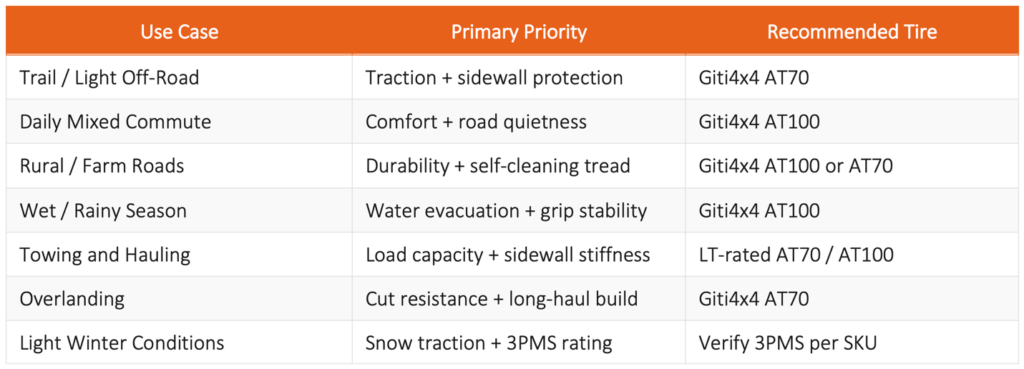
Which Giti AT Tire Fits Your Use Case?
Frequently Asked Questions
Are all-terrain tires good for highway driving?
Yes, with a caveat. Modern AT tires engineered for a 70/30 on-road/off-road balance treat highway performance as a design priority, not an afterthought. Expect slightly more road noise than a dedicated touring tire, but stable, comfortable motorway driving overall. The more aggressive the tread pattern, the more noise you carry onto the highway. Match the tread aggressiveness to your actual off-road demands.
Can I use all-terrain tires in the rain?
All-terrain tires perform well in the rain for everyday driving speeds. Their open tread voids channel water away from the contact patch effectively, reducing aquaplaning risk compared to fine-tread touring tires. They are not optimised for peak wet-cornering at high speed, that is the domain of performance all-weather or summer tires, but for mixed-surface and variable-weather driving, AT tires deliver solid, consistent wet traction.
How long do all-terrain tires last?
Under typical mixed-use conditions, well-maintained AT tires can cover 40,000 to 60,000 miles (approximately 64,000 to 96,000 km). Aggressive off-road use will reduce tread life. Regular rotation every 8,000 to 10,000 km and maintaining correct inflation pressure are the two most effective ways to extend service life. Under-inflation is the single biggest accelerator of premature AT tire wear.
What is the difference between the Giti4x4 AT70 and AT100?
The Giti4x4 AT100 is built for drivers who split their time roughly 70% on-road and 30% off-road, balancing daily comfort with capable off-road performance. The Giti4x4 AT70 is for drivers with stronger off-road demands: it features a military-inspired tank-tread crown block design, 5mm reinforced sidewalls, and a chain curbing block system for upper sidewall protection. Choose the AT100 if your off-road use is occasional. Choose the AT70 if it’s serious.
Are all-terrain tires worth it for city driving only?
No. If you genuinely never leave sealed roads, an all-terrain tire is not the right tool. You will pay more, experience more road noise, and carry tread designed for surfaces you never use. For pure city driving, a quality all-season or all-weather tire is the better fit. AT tires earn their value when your driving regularly includes unpaved, loose, or variable-surface conditions.
Do all-terrain tires work in snow?
For mild snow and slush, yes. For sustained deep snow or ice, no, dedicated winter tires remain the safe choice for severe winter conditions. The open tread design of AT tires provides better snow traction than standard all-season touring tires. The Three-Peak Mountain Snowflake (3PMS) certification is the objective benchmark to look for, it confirms the tire has passed standardized severe-snow testing, not just a manufacturer claim.
The Bottom Line
All-terrain tires earn their place when your driving genuinely spans multiple surface types: mixed commuter and weekend off-road use, rural and farm roads, towing, overlanding, and variable-weather conditions. They are not the right answer for pure city commuters, serious mud, or sustained winter driving.
If your off-road use is occasional and on-road comfort matters, the Giti4x4 AT100 is the balanced call. If you push further into technical terrain and need the tire to hold up there, the Giti4x4 AT70 is built for it.
Explore the full Giti4x4 AT range at giti.com and find the tire that matches your actual driving — not the driving you think you do.