





















































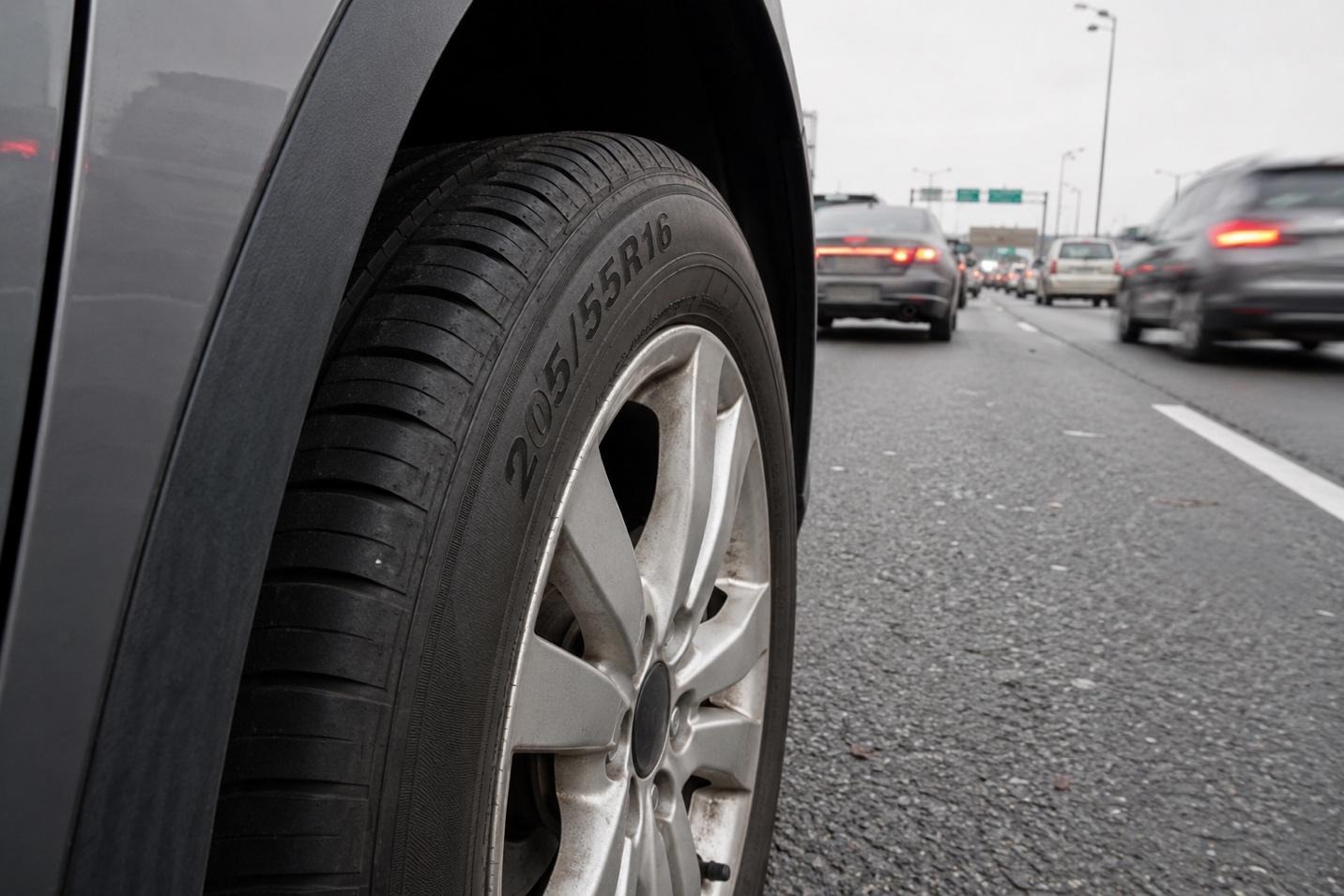
The 205/55r16 is a 16-inch, 55-series, 205mm wide tire fitted as original equipment on more compact and mid-size passenger vehicles globally than almost any other size. If your car came off a production line between 1995 and today and sits in the compact or family segment, there is a reasonable chance this is the size on your door placard. But being common is not the same as being simple. Drivers replacing a 205/55R16 still need to match the correct load index and speed rating, understand what tire category fits their climate, and avoid the common mistake of treating all 205/55R16 tires as interchangeable. This guide covers all of it.
The 205/55R16 Size Code, Decoded
The three numbers and one letter in a tire size code each carry a fixed technical meaning. None of them is a marketing label.


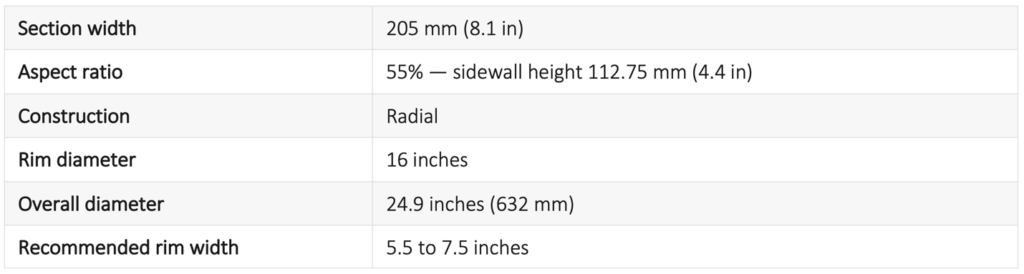
The 55-series aspect ratio is the detail that defines the character of this tire. At 55% of the 205mm section width, the sidewall height is just under 113mm, tall enough to absorb road imperfections and deliver genuine ride comfort, short enough to give the car reasonably responsive steering. It is the middle ground between the punishing low-profile sizes on sports cars and the soft, tall-sidewall fitments on older economy vehicles. That balance is a significant part of why this size became a default for family and commuter cars.
The 16-inch rim requirement is fixed. A 205/55R16 tire mounts only on a 16-inch wheel, within a recommended rim width of 5.5 to 7.5 inches. Running outside that width range affects the contact patch shape and shoulder wear distribution.
Why This Size Became the Global Standard for Everyday Cars
The dominance of 205/55R16 is not an accident. It is the outcome of several engineering and manufacturing decisions converging at the same point.
The weight-to-footprint match is near-optimal for C-segment vehicles. A 205mm contact width is wide enough to distribute the load of a 1,200 to 1,500 kg vehicle across a useful footprint without creating excessive rolling resistance. It is narrow enough to fit inside standard wheel arches without modification. Manufacturers designing a family hatchback or a compact sedan in the 1990s and 2000s consistently landed on 205/55R16 as the size that required no compromises in chassis design.
The 16-inch rim is the smallest diameter that provides adequate brake caliper clearance for modern front disc brakes on these vehicles. Going smaller forces brake engineering compromises. Going larger adds cost and unsprung weight without meaningful benefit for this segment. 16 inches sits at the economic and engineering sweet spot.
The 55-series sidewall is the ride comfort and cost balance point. A 45-series sidewall on the same width gives sharper handling but a firmer ride and higher wheel and tire cost. A 65-series gives better comfort but makes the car feel vague. 55 is where most drivers of family vehicles land without noticing, because the tire is doing its job without asking for attention.
The result is a size that fits a 6-inch rim (the most common and least expensive steel rim width in this diameter), works across a weight range of 900 kg to 1,600 kg, and requires no special alignment or suspension geometry. It is the size engineers reach for when the brief is reliable, cost-effective, and globally available.
Which Vehicles Use 205/55R16 as OEM
The following vehicles are among the most widely recognized OEM fitments for this size. Always verify against your specific vehicle’s door placard before purchasing, as variant-level differences within the same model can change the required size.
European and Asian hatchbacks
- Volkswagen Golf (Mk5, Mk6, Mk7 in standard trim)
- Volkswagen Golf GTI (select variants)
- Seat Leon (Mk2 and Mk3 standard variants)
- Skoda Octavia (multiple generations)
- Vauxhall/Opel Astra (Mk5 and Mk6)
- Peugeot 308 (Mk1 and Mk2 standard variants)
- Renault Megane (Mk3 and Mk4 standard variants)
Compact and mid-size sedans
- Honda Civic (multiple generations)
- Toyota Corolla (multiple generations)
- Mazda3 (Mk1 and Mk2)
- Hyundai Elantra (multiple generations)
- Kia Forte and Cerato (multiple generations)
- Ford Focus (Mk2 and Mk3 standard trim)
The pattern is consistent: high-volume, mass-market compact vehicles built for global markets where the combination of ride comfort, handling balance, and purchase cost matters most to the buyer.
Speed Rating and Load Index in 205/55R16
The letters and numbers that follow the tire size on a sidewall or product listing are not arbitrary. They carry legal and structural meaning that determines whether a tire is correct for your vehicle.
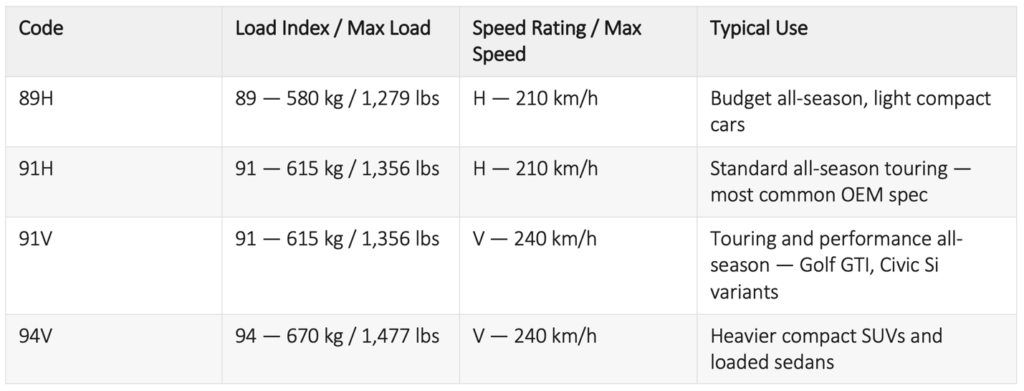
The most important rule: never install a tire with a load index or speed rating below the figure on your door placard. The door placard specifies the minimum for your vehicle’s weight and designed top speed. Downgrading either is a structural safety compromise, not a specification variance. It may also void your vehicle warranty and affect insurance coverage in the event of an incident.
For most vehicles using 205/55R16 as OEM, the door placard specifies 91H or 91V. The difference between H and V is 30 km/h of certified speed capacity (210 vs 240 km/h). For the vast majority of everyday driving, H is sufficient. If your vehicle specifies V as is common on GTI and Si performance variants. V is the minimum and you should not downgrade to H regardless of price difference.
Tire Categories Available in 205/55R16
All-Season Touring
All-season touring tires are the dominant category in 205/55R16 and the correct choice for most everyday drivers in temperate climates. They are designed to deliver consistent traction and handling across dry, wet, and light winter conditions year-round. Treadwear warranties on this category in 205/55R16 typically run from 50,000 to 85,000 miles, reflecting the longer-wearing compounds used in touring construction.
What all-season tires give up relative to a dedicated summer tire is grip precision at high temperatures and cornering load. For drivers who use their vehicle for commuting, errands, and occasional longer trips, that trade-off is entirely reasonable. For drivers who place their car in demanding cornering situations regularly, a dedicated summer tire will perform noticeably better in warm conditions.
Summer and Performance
Summer tires in 205/55R16 are available and appropriate for performance variants of the vehicles in this size, Golf GTI, Civic Si, and similar. They use softer, grippier compounds that maximize dry and wet grip in temperatures above approximately 7 degrees Celsius. Below that threshold, the compound stiffens and traction drops sharply.
If you drive a standard Golf or Civic primarily for commuting and weekend trips in mixed weather, a summer tire is not the right category. If you drive a performance variant and prioritize handling feel and wet braking over longevity and cold-weather usability, it is worth the consideration.
Winter
Winter tires in 205/55R16 are widely available across major manufacturers. The 55-series sidewall and moderate width of this size actually make it well-suited to winter use: the taller sidewall handles snow compression better than a low-profile, and 205mm is narrow enough to cut through light snow to reach the road surface. Drivers in markets with consistent sub-zero temperatures or regular snowfall should fit a dedicated winter set on a second set of 16-inch rims and run a summer or all-season set the rest of the year.
How to Choose the Right 205/55R16 Tire
The decision comes down to three variables: climate, use case, and OEM specification compliance. Work through them in order.
- Step 1 — Check the door placard: Confirm the required load index and speed rating. Every tire you consider must meet or exceed both.
- Step 2 — Identify your climate: Year-round temperate weather means all-season touring. Warm climate with no winter means summer. Sustained cold, snow, or ice means a dedicated winter set.
- Step 3 — Identify your use case: Daily commuter and family use points to all-season touring with the highest treadwear warranty you can find in the correct load and speed specification. Performance driving or a sporty variant points to a summer tire with a strong EU wet braking grade.
- Step 4 — Prioritize EU wet braking grade: Within the options that meet steps 1 to 3, the EU label wet braking grade (A to G) is the most safety-relevant differentiator. Prioritize A or B.
- Step 5 — Use treadwear warranty as a value signal: For all-season touring tires, a longer treadwear warranty reflects the manufacturer’s confidence in the compound’s longevity. 60,000 to 85,000 miles is the competitive range for quality options in this size.
Frequently Asked Questions
Is 91H or 91V the right specification for my car?
Check your door placard. It will specify the minimum speed rating. If it shows H, either H or V is acceptable, V meets or exceeds the H requirement. If it shows V, only V or higher is acceptable. H does not meet a V requirement. The practical difference for everyday driving is minimal, but the specification compliance is not optional.
Can I replace 205/55R16 with 205/60R16?
Technically possible but not straightforward. A 205/60R16 has a taller sidewall, producing an overall diameter of approximately 26.1 inches versus 24.9 inches for the 205/55R16. That is a 4.8% increase in diameter, outside the commonly accepted 3% tolerance. The result is a speedometer that reads lower than actual speed, potential clearance contact with the wheel arch liner, and a change in the steering response feel. Stick to 205/55R16 unless a fitment specialist confirms the alternative is clear on your specific vehicle.
How long should 205/55R16 tires last?
Real-world treadwear depends on driving style, inflation maintenance, alignment condition, and road surface. Under normal conditions, a quality all-season touring tire in this size with a 60,000 to 70,000-mile warranty will typically last 5 to 7 years for a driver covering 10,000 to 12,000 miles per year. The more important threshold is age: replace tires after 6 years from the manufacture date regardless of remaining tread depth. Find the manufacture date in the last four digits of the DOT code on the sidewall “1524” means week 15 of 2024.
Do I need to replace all four tires at once?
Not necessarily, but the strongest recommendation is to replace in axle pairs at minimum, both front or both rear together. Running mismatched performance tires on the same axle creates uneven traction side to side, which affects braking stability and handling balance. If your budget forces replacing only one tire, mount the new tire on the rear axle regardless of which corner is worn, and move the better of the two rear tires to the front. Never mount a single new tire on the front axle only.
What is the correct tire pressure for 205/55R16?
Correct tire pressure is set by the vehicle manufacturer, not the tire manufacturer. Check the door placard or the fuel filler flap on your specific vehicle. A common range for passenger cars in this size is 30 to 36 PSI, but the correct figure varies by vehicle, load, and whether the OEM fitment is standard load or XL. Do not use the maximum pressure printed on the tire sidewall, that is a structural limit, not a recommended operating pressure.
Summary
The 205/55R16 became the standard size for everyday compact and family cars because it solves multiple engineering requirements simultaneously: sufficient contact width for vehicle weight, comfortable sidewall height for ride quality, 16-inch rim compatibility for braking system clearance, and global manufacturing availability at competitive cost. Those qualities make it one of the most widely fitted tire sizes in the world and they also make it a size where the differences between tire options are real and worth understanding before you buy.
Match load index and speed rating to the door placard first. Choose the tire category based on your climate. Use the EU wet braking grade to compare options within the compliant shortlist. For daily drivers prioritizing longevity, a treadwear warranty of 60,000 miles or above is the benchmark for this size