










































Forex trading has become more accessible, but access alone does not create good traders. For many women, the appeal is not “quick profit.” It is the chance to build financial knowledge, develop flexible skills, and make more confident money decisions.
Still, forex is risky. Beginners can lose money quickly when they trade without a plan. The women who progress are usually the ones who treat trading as a skill, not a gamble.

The Rise of Women in Forex Trading
The growth of women in forex reflects a wider shift in financial access. Retail platforms, online education, and trading communities have made the market easier to enter. The real difference, though, is not just technology. It is the ability to learn, practise, and improve without needing institutional access.
From Male-Dominated Industry to Global Access
Trading was once associated with banks, dealing rooms, and professional networks. That image made the market feel distant for many beginners.
Now, a new trader can open a demo account, study currency pairs, and practise order execution from home. This has made trading for women more realistic, especially for those starting outside traditional finance.
How Technology Changed the Game
Apps, charting tools, webinars, and trading communities have reduced the cost of learning. But technology also brings noise: social media tips, rushed signals, and overcomplicated indicators.
Useful tools support better decisions. Resources such as TFXC trading can help traders focus on structure, planning, and measurable improvement rather than hype.
Why More Women Are Entering Forex Trading
Women are entering forex for practical reasons: independence, flexibility, and financial confidence.
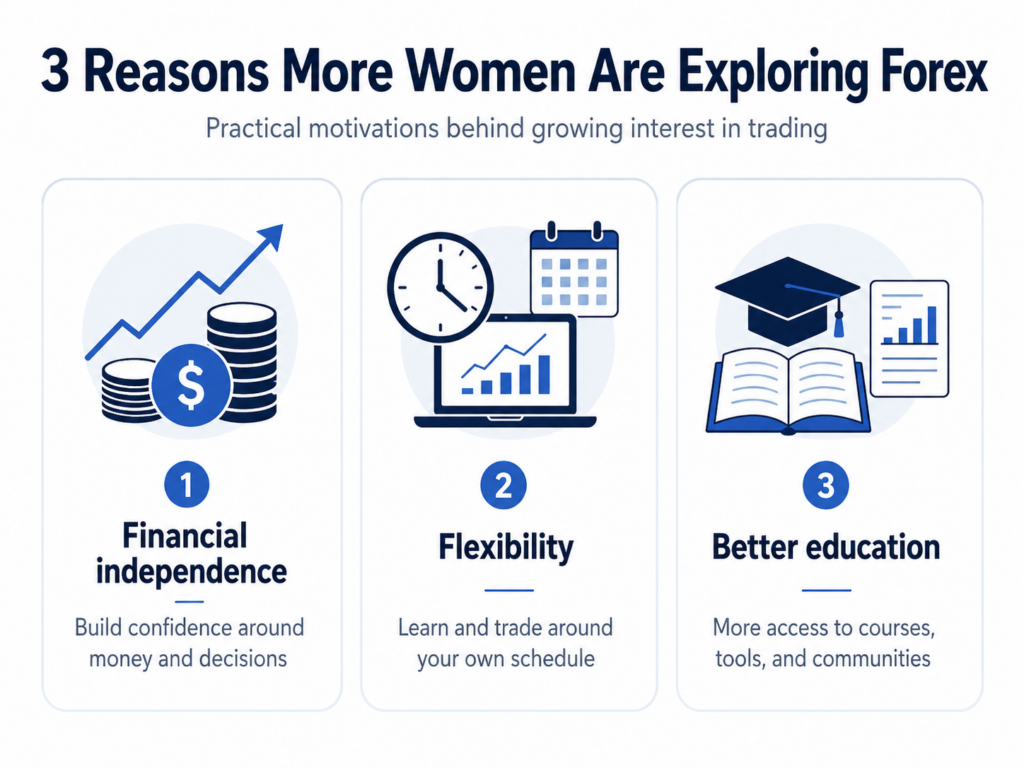
1. Financial independence
Trading should never be treated as guaranteed income, but learning markets can improve confidence around risk and decision-making. In the UK, income and work patterns remain part of the wider financial independence conversation. The Office for National Statistics publishes earnings and working-hours data that gives useful context for why many people seek additional financial skills.
2. Flexibility and remote learning
Forex is open throughout the trading week, which appeals to people balancing work, study, family, or business. The danger is treating flexible access casually. Trading between tasks without a plan often leads to poor entries.
3. Better education
More accessible financial education has helped more women traders participate in markets that once felt closed. The OECD’s financial education work focuses on literacy, inclusion, and consumer protection, all relevant to new traders learning how to assess risk.
What Makes Female Traders Different
It is too simplistic to say all female traders behave the same way. Still, some habits often linked with better trading outcomes are worth noting.
More selective decision-making means not treating every price move as an opportunity. Strong traders wait for setups that match their plan.
Lower overtrading can also help. Research by Barber and Odean found that men traded more frequently than women in their sample, and frequent trading reduced returns more heavily for men. This does not mean every female forex trader is cautious by default. It shows why restraint can be useful.
Emotional control matters after wins and losses. Beginners often increase trade size after a loss or enter late because they fear missing out. Better traders notice those reactions before acting on them.
Do Women Actually Perform Better in Trading?
Performance depends on education, experience, capital, market conditions, and behaviour. Gender alone does not make someone a good trader. But the behaviours often associated with strong performance, patience, selectivity, and measured risk can benefit anyone.
1. What studies suggest
Investor-behaviour studies should not be stretched too far, especially because many focus on stocks rather than forex. The practical lesson still applies to female forex traders and all beginners: trading too often can damage results.
2. Risk vs reward approach
A strong trade is not only about being right. It is about whether the possible reward justifies the possible loss.
3. Long-term thinking
One winning trade may be luck. A repeatable method tested over many trades is closer to real skill. This is where women forex traders can benefit from a patient, process-led approach.
The Real Advantage: Better Trading Habits
The strongest edge is not prediction. It is behaviour. Good traders build habits that prevent one emotional decision from damaging weeks of progress.
| Trading Area | Weak Approach | Stronger Approach |
| Trade choice | Follow social media excitement | Wait for a defined setup |
| Position size | Change size emotionally | Use planned exposure |
| Review | Focus only on profit/loss | Review decision quality |
| Goal | Chase fast wins | Build repeatable habits |
A useful beginner rule: if you cannot explain why the trade belongs in your strategy, skip it.
Challenges Women Still Face in Forex Trading
More access does not mean every barrier has disappeared. Some women still face low confidence, limited representation, and trading spaces that reward noise over skill.
Industry bias remains part of the wider financial world. The European Parliament’s overview of gender equality highlights ongoing work around equal treatment, economic participation, employment, and representation.
Confidence gaps often come from unfamiliar terminology, crowded platforms, and conflicting advice. The solution is a smaller learning path: one or two currency pairs, one setup, and one clear review process.
Representation matters because it changes what feels possible. Seeing serious women in trading helps beginners view forex as a learnable skill, not a space reserved for a certain personality type.
What Successful Female Traders Do Differently
The most successful female traders usually do not depend on one indicator, one mentor, or one lucky setup. They build a routine around learning, testing, and reviewing.
Focus on Strategy Over Tools
A platform is not a strategy. An indicator is not a strategy. A signal is not a strategy.
A real strategy explains:
- what market condition you trade;
- where you enter and exit;
- how much you risk;
- when you stay out.
Learning Before Trading
A serious beginner learns the mechanics first: spread, leverage, margin, stop-loss, drawdown, and position size. These terms affect how quickly poor decisions can become real losses.
Structured Approach to Growth
Progress should be measured by behaviour, not only by account balance. Cleaner entries, fewer impulsive trades, and better trade notes are all signs of improvement. That is where female trading becomes more professional: through steady development, not pressure to perform quickly.
Examples of Successful Female Traders
Examples can be useful, but they should not become comparison traps. The goal is not to copy someone else’s style. It is to understand the seriousness behind long-term performance.
Kathy Lien
Kathy Lien is one of the most recognised names in currency trading education. She is often mentioned among the top female traders because she combines market knowledge with clear teaching.
Linda Raschke
Linda Raschke is widely respected for short-term trading, technical skill, and longevity. Her career shows that strong trading is not about constant action. It is about preparation, timing, and knowing when conditions are not good enough.
For beginners, reading lists of the best female traders, that is the better lesson: study the habits, not the reputation.
How Women Can Start Forex Trading Today
Starting well means starting slowly. The goal is to build enough understanding that early mistakes are small and useful.
1. Start with education
Learn how currency pairs move, what affects price, and how trades are priced. Avoid anyone promising easy profit.
2. Use demo accounts
A demo account helps beginners practise order placement, stop-loss use, and trade review without risking real money.
3. Build a strategy
A beginner strategy should answer:
- What pair am I trading?
- What setup am I waiting for?
- Where is my stop-loss?
- Where could I take profit?
- How much am I prepared to lose if wrong?
The Future of Women in Forex Trading
The future looks stronger because access, education, and visibility are improving. More women will enter forex as long-term learners, part-time traders, and active intraday traders.
The traders who last will not be defined by labels or online hype. They will be the ones who treat forex as a great skill, build gradually, and make decisions they can explain.