




















































The upright monument — a vertical tablet of polished granite standing at the head of a grave — is the oldest persistent form of American memorial marker. It was present in colonial New England churchyards before the professional cemetery existed. It survived the lawn cemetery movement of the 19th century, which reorganized burial grounds around continuous turf and urged the elimination of architectural variation. It survived the mid-20th century standardization push in national cemeteries. It is still being ordered in large numbers in 2025, in Pennsylvania and Ohio and California and Texas and North Carolina, by families who have never thought about cemetery design theory and aren’t interested in it.
They just know what looks right.


Understanding why the upright format endures — and how it has changed — requires looking at what it does that other memorial formats don’t.
For families across those same states, upright headstones remain the first instinct when the cemetery call comes, and the reasons for that instinct are worth examining closely rather than dismissed as habit.
Visibility is the most obvious factor. A standing stone can be seen from the cemetery path. It reads across a distance that a flush marker simply cannot match. The shadow it casts on the ground at certain angles confirms the physical presence of the stone — a visual confirmation that something has been placed here deliberately and permanently. But visibility only partly explains the consistent preference in certain regional and cultural contexts.
In Catholic communities across the Northeast and Midwest — Philadelphia, Chicago, Paramus, Columbus — the upright tablet is expected the way certain religious imagery is expected. Not because there’s a formal requirement, but because generations of family members are already buried under standing stones, and the departure from that form would require active justification. Family sections in Catholic cemeteries frequently carry standing monuments going back four or five generations. Consistency is its own meaning. A flat marker in that context wouldn’t be wrong; it would be an interruption.
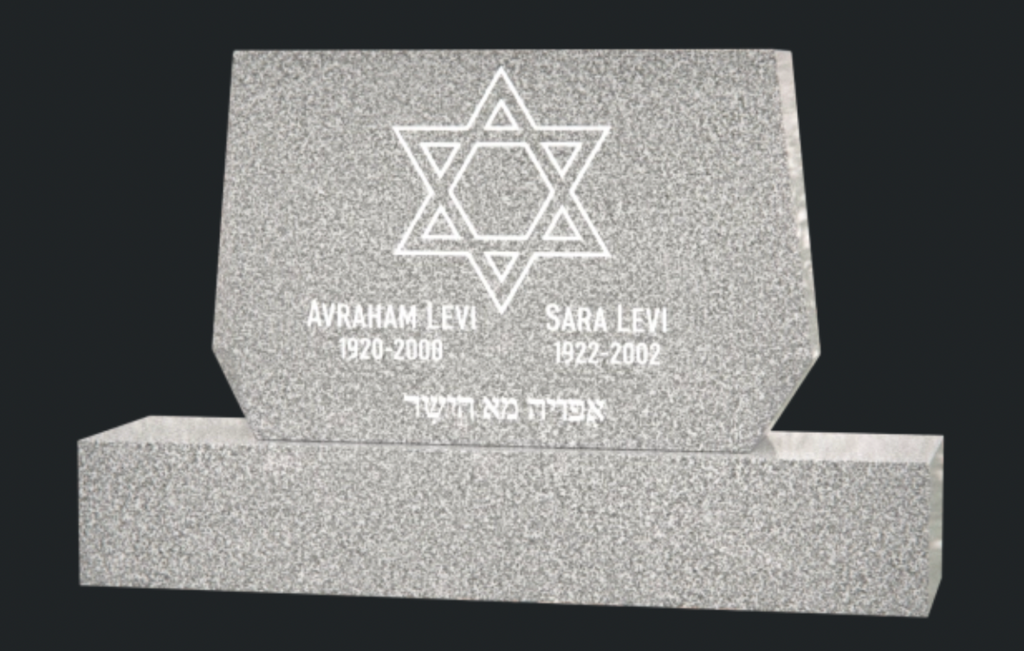
In Jewish cemeteries across New York, New Jersey, and California, the upright monument with Hebrew text serves a different but similarly rooted function. The placement of the Hebrew name, the Hebrew calendar date, the specific phrasing at the stone’s top — these elements of a recognizable visual language depend on the upright format. They don’t translate to a flush marker or bench memorial with the same cultural legibility.
Military sections in national cemeteries represent the most formalized version of this logic. The VA-standard white granite upright at Arlington in Virginia, at Fort Sam Houston in Texas, at Willamette in Oregon — identical dimensions, identical typography — delivers its message through uniformity. Rows of standing stones the same height, same width, same font: every grave equal. No family can purchase more height or more presence. The upright format, there, carries a moral and civic argument that no other shape could make.
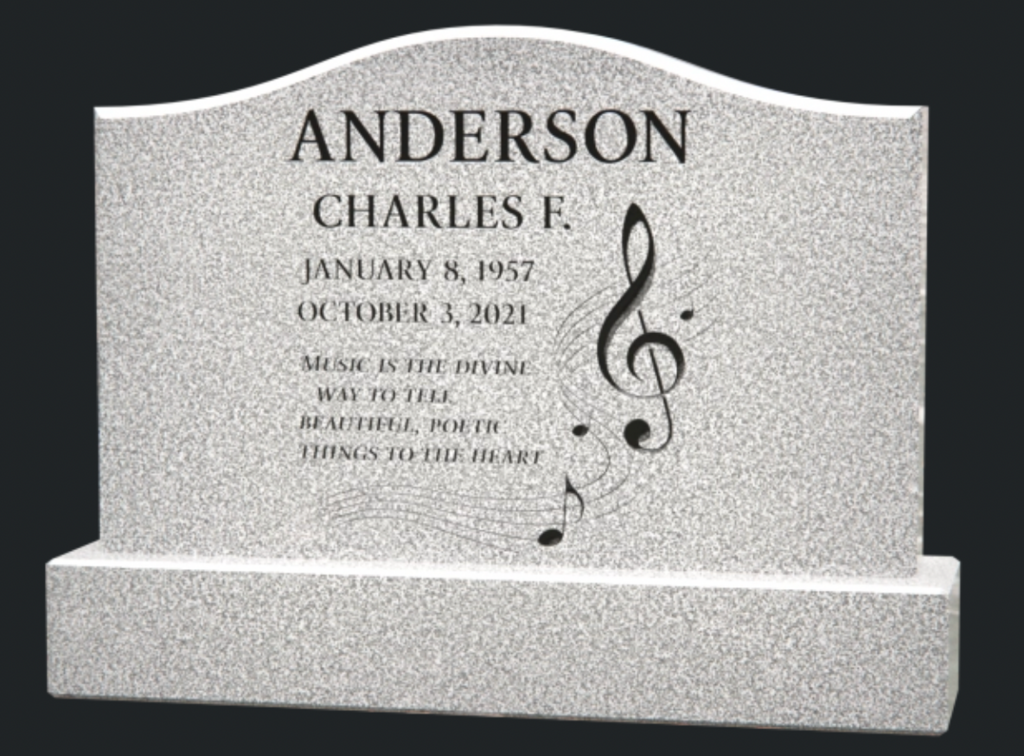
The design range within the contemporary upright category is considerably wider than most families realize before they begin looking. The straight-edged tablet with a flat top is one form — clean, formal, institutional. Arch-top uprights carry a Gothic register that suits traditional Catholic and Orthodox contexts. Ogee profiles flow organically in ways that read as personal. Heart-shaped uprights maintain the format’s vertical presence while softening its tone. Custom-shaped tops — cross silhouettes, tree shapes, pagoda rooflines, angel figures — turn the format into a sculptural piece while keeping its fundamental character.
Relief carving is the design capability specific to the upright format. A flat marker, by definition, cannot carry raised three-dimensional imagery — the stone would become a maintenance hazard on a lawn surface. An upright monument can carry a carved angel figure in full relief, a Madonna niche with a recessed figure, a bas-relief tree with birds, a detailed cross with vined border, all physically raised above the stone face and casting actual shadows in raking light. That sculptural quality belongs to the standing form and to no other.
Companion uprights — wider tablets with two inscription panels flanking a central image — are architecturally complete memorial pieces in a way that flat companion markers typically aren’t. The central carved element belongs to both panels simultaneously. The stone reads as a unified memorial for two people rather than two adjacent individual pieces. Families in California, Texas, Oklahoma, Illinois, and North Carolina who have chosen companion uprights often describe the decision as the one they felt most settled about afterward, because the form makes the relationship visually legible in a way that nothing else in the memorial vocabulary matches.
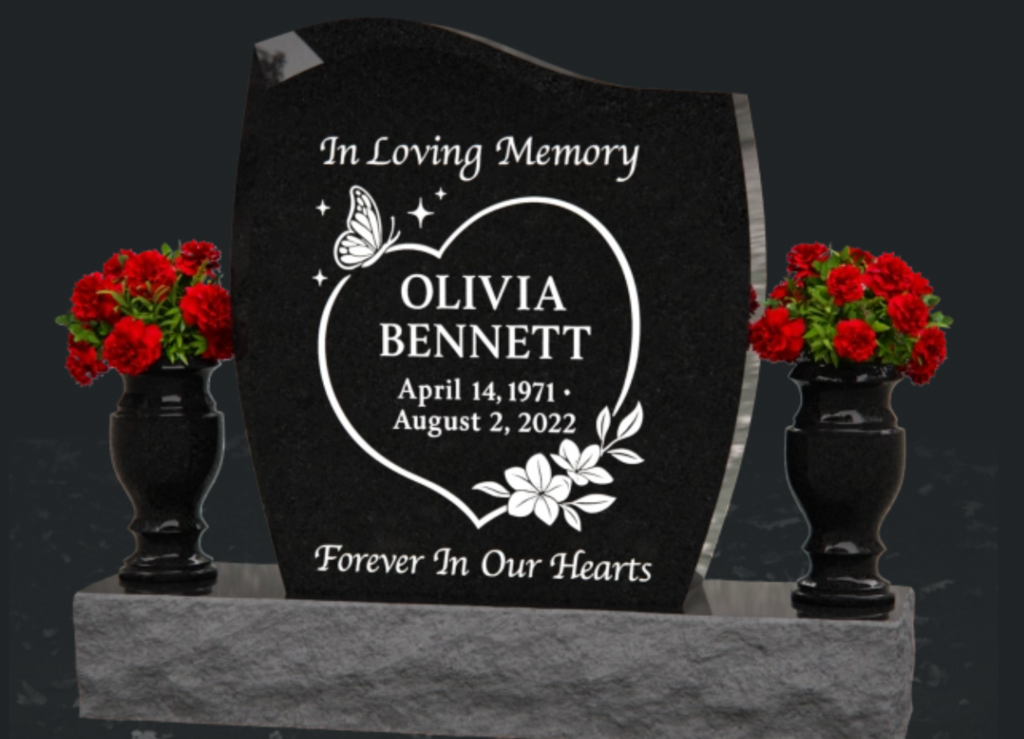
Material selection for upright monuments follows the same library as flat markers but with different visual implications, because the polished face is vertical and catches light at different angles throughout the day. Indian Black Premium — the dominant choice for upright memorials nationwide — produces white-engraved imagery that reads with maximum clarity at any distance and any time of day. Blue Pearl from Norway, with its iridescent feldspar grain, displays its shifting color character more obviously on a vertical face than on a flat one, because the angle changes as the visitor moves around the stone. Balmoral Red from Finland reads warm and distinctive in a cemetery environment of mostly black and grey standing stones.
Compact upright monuments in standard dimensions start at approximately $2,240, inclusive of all engraving, a 3D design proof rendered on the actual selected granite surface, nationwide delivery, and cemetery coordination including permit submission and installation. Larger pieces with relief carving, companion formats, and custom shapes scale from that point. A lifetime guarantee on the stone is standard across the range.
The AR visualization tool now available on individual product pages addresses the scale problem that has historically been the most consistent source of upright monument disappointment post-installation. An upright that looked proportional on a paper proof can read oversized or undersized at the actual grave. AR preview — positioning the finished stone at accurate dimensions in a real environment through a mobile device — makes proportion visible before production begins.
For families in Pennsylvania, Ohio, Illinois, New Jersey, California, Texas, Oklahoma, Florida, and North Carolina where the upright remains the dominant or preferred format, Remembrance Headstones produces the full range of styles from traditional tablet forms to relief-carved religious monuments across more than 40 granite types, with 14 showroom locations and nationwide installation service.
Full catalog and current pricing at remembranceheadstones.com.