


















































Brands that deliver the promised quality to customers can get the desired benefits. Therefore, product durability testing is vital. It helps the brand check how long the product can remain safe under various conditions, such as environmental exposure and repeated use. To meet the customers’ demands, brands test their products, including automotive components, retail goods, packaging, electronics, and other products. It helps them maintain quality and win customers’ trust.
Brands can enhance their reputation and product performance through durability testing. In this blog post, you will gain in-depth knowledge of durability, its types, and tasting methods across various industries. It helps you to know the importance of quality testing.


What Is Durability
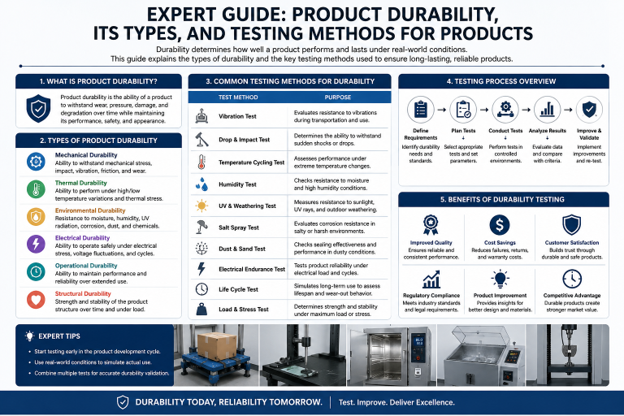
Durability is the ability of a product or material to maintain performance and structural robustness over time under both normal and harsh conditions. Durable products stay in their actual quality under pressure, environmental, and physical damage. In industries like packaging, solutions such as custom printed mylar bags no minimum help protect products, reduce waste and costs, and improve customer satisfaction.
Types of Durability
Different products require varying levels of durability due to their use and environmental conditions. Here are some major types of durability that are considered during product testing.
Physical Durability
Physical durability is the product’s ability to prevent the physical forces, such as friction, abrasion, pressure, and other factors. It’s important for all products, including packaging, industrial products, automotive, and construction items. For example, shipping containers keep the products inside safe from tearing, crushing, and other damage during transit and storage.
Chemical Durability
Chemical durability is the ability of the products to resistant against the harmful chemical reactions because of acids, solvents, moisture, cleaning agents, and oils. Products that are resistant to these chemicals can maintain their structure and perfume well to help us get the desired benefits. When it comes to the packaging, takeout packaging boxes are manufactured with moisture-resistant materials to keep products safe from moisture and maintain their quality.
Thermal Durability
Thermal durability ensures how products tolerate temperature fluctuation because some products can lose their quality under high temperatures and can become brittle in cold surroundings. So, thermal testing is vital for checking components, especially in automotive, electronics, and aerospace materials, as well as heat-sealed packaging products.
Environmental Durability
The resistance of the products against the humidity, UV light, dust, and other environmental factors is called their environmental durability. Because products can lose their grace and shine when displayed or worked outside. So, outdoor products require a high level of environmental durability. With this test, you can keep products safe during shipping.
Mechanical Durability
Products that remain safe during repeated stress, bending, vibration, and other mechanical movement. The resistance power against these harmful factors is called the product’s mechanical durability. For example, machine parts, hinges, tools, and flexible packaging materials.
Durability Testing Methods
Durability testing determines the product’s lifespan and weaknesses before it is sold to clients. These tests ensure that the products can withstand environmental and physical damage.
Accelerated Testing
In accelerated testing, the product is exposed to more stressful conditions to check the years of use in a short timeframe to ensure its durability. Product manufacturers use various types of testing to check the product quality.
Common accelerated testing methods include:
- High-temperature exposure
- Rapid humidity changes
- Continuous vibration testing
- Repeated pressure cycles
- UV radiation simulation
Accelerated testing is conducted in various industries, including automotive, packaging, and electronics, to ensure product longevity.
Environmental Testing
Environmental testing shows how products withstand environmental conditions such as moisture, sunlight, temperature shifts, and corrosive atmospheres.
Typical environmental tests include:
- Salt spray testing
- Rain and water resistance testing
- Thermal shock testing
- Humidity chamber testing
- UV exposure testing
Environmental testing is essential for products used outdoors or stored under changing climate conditions. Packaging manufacturers also use environmental testing to ensure products remain intact during shipping and storage. Products like custom printed mylar bags pass the environmental testing to verify moisture resistance, odor protection, and temperature stability.
Mechanical Testing
The product’s resistance to physical damage and repeated movement is measured by mechanical testing. It helps product manufacturers to understand the structural durability and strength of the products.
Common mechanical durability tests include:
- Tensile strength testing
- Drop testing
- Flex testing
- Compression testing
- Impact resistance testing
Mechanical testing is used in various industries to prevent product damage, repair, and costly replacement during shipping, handling, and daily use.
Packaging Durability Testing and Its Types
Packaging durability testing is vital because it serves as a safe storage solution for products. Packaging with the necessary durability provides complete protection to products from contamination, physical harmful factors, moisture, dust, and spoilage. Manufacturers test packaging materials to evaluate their ability to withstand transportation, storage, and consumer handling. Flexible packaging products, such as custom printed mylar bags no minimum require comprehensive durability assessments to ensure they maintain product freshness and structural integrity.
Key packaging durability tests include:
Seal Strength Testing
Seal strength testing is conducted to check the seal quality of the packaging or bags by applying pressure and stress. A weak seal can expose the product to air, moisture, and other contaminants, causing a loss of product quality.
Puncture Resistance Testing
This test is conducted with the help of sharp objects to check how well packaging materials withstand punches.
Moisture Barrier Testing
To assess the resistance of products to moisture, humidity, and water vapor, manufacturers conduct moisture barrier testing. Commonly, food and pharmaceutical packaging need to pass this test.
Drop Testing
With the repeated drops, products can get damaged. Therefore, drop testing is conducted to check the packaging resistant against pressure, weight, and damage due to sudden falls. A protective packaging stays in its actual shape, style, and structure and provides safe storage for products during shipping and warehousing.
Compression Testing
To check the stacking ability of the packaging, the packaging manufacturer passes it from the compression test. A well-designed and durable packaging provides safe and easy stacking during storage and shipping.
Durability Testing Methods: Comparison Table
Different durability testing methods provide exact information on product performance. Manufacturers conduct multiple tests to obtain a range of results.
| Testing Type | Purpose | Applications | Advantages |
| Accelerated Testing | Simulates long-term use quickly | Electronics, packaging, automotive | Faster product evaluation |
| Environmental Testing | Measures resistance to climate conditions | Outdoor products, packaging | Predicts environmental impact |
| Mechanical Testing | Evaluates physical strength | Machinery, containers, flexible packaging | Detects structural weaknesses |
| Chemical Testing | Assesses chemical resistance | Medical products, industrial coatings | Ensures material stability |
| Thermal Testing | Tests heat and cold tolerance | Automotive, aerospace, food packaging | Prevents temperature-related failures |
Each method shows different durability concerns.
- Accelerated testing focuses on long-term lifespan prediction, while environmental testing examines climate resistance.
- Mechanical testing emphasizes physical strength and operational reliability.
- Combining these testing methods allows manufacturers to create safer, more reliable, and higher-quality products.
Conclusion
To ensure the product’s durability, performance, and other physical features, product durability testing plays an important role. By testing resistance to physical stress, environmental conditions, temperature changes, and repeated use, manufacturers can identify weaknesses before products reach consumers. Methods like accelerated, environmental, and mechanical testing help improve product lifespan and quality. Packaging durability testing is also important, as durable solutions such as custom printed mylar bags protect products, maintain freshness, reduce waste, and enhance customer satisfaction. These protective packaging solutions also boost the brand identity and trust.