






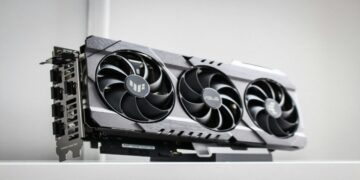












































Artificial intelligence is rapidly reshaping the global data center industry. From large language models and AI image generation to autonomous driving and cloud computing, modern AI systems require an unprecedented amount of computing power and data transmission capacity. Behind every AI training cluster are thousands of GPUs exchanging enormous volumes of information in real time, often across highly complex network architectures.
As AI infrastructure continues expanding globally, many manufacturers are also investing heavily in advanced optical connectivity solutions to support next-generation data center deployments.


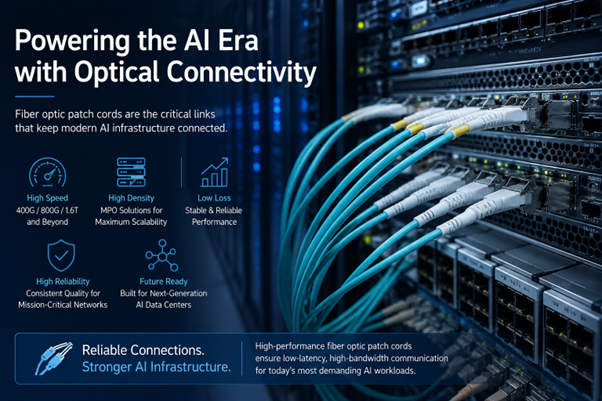
Among the many components involved in this transformation, high-performance fiber optic patch cords are quietly becoming a critical part of modern AI infrastructure. They serve as the physical links connecting switches, transceivers, servers, and high-density optical networks, enabling the low-latency communication required by AI computing environments.
In many ways, the future of AI depends not only on processors and software, but also on the quality and scalability of the optical infrastructure supporting them.
AI Workloads Are Driving an Explosion in Data Traffic
Traditional cloud computing already required massive bandwidth, but AI infrastructure is operating at an entirely different scale.
Training modern AI models involves thousands of GPUs working simultaneously and continuously exchanging parameters, tensor data, and synchronization information. Unlike conventional enterprise traffic patterns, AI traffic is extremely east-west intensive, meaning large amounts of data move internally between servers rather than simply flowing in and out of the data center.
This has accelerated the deployment of:
- 400G and 800G optical networks
- Spine-leaf architectures
- High-density GPU clusters
- Ultra-low latency interconnect systems
According to several industry forecasts, AI-related data center traffic is expected to grow multiple times over within the next few years. As a result, optical networking is no longer just a supporting system — it has become a core part of AI infrastructure design.
Why Copper Cabling Is Reaching Its Physical Limits
For many years, copper cabling was sufficient for short-distance data transmission inside server rooms. However, the rapid increase in bandwidth requirements is pushing copper technology closer to its practical limits.
At higher transmission speeds, copper connections face several major challenges:
Signal Loss Over Distance
As data rates increase, signal attenuation becomes more severe in copper cables, especially over longer distances.
Higher Power Consumption
High-speed copper interconnects often consume more power for signal conditioning and error correction, which creates additional thermal challenges inside AI clusters.
Electromagnetic Interference
Dense AI computing environments contain large amounts of electrical equipment, making EMI a growing concern for stable high-speed transmission.
Cable Bulk and Airflow Issues
Large-scale copper deployments create thicker cable bundles that can negatively impact airflow and cooling efficiency in high-density racks.
Because of these limitations, hyperscale operators are increasingly shifting toward optical interconnect solutions. Fiber optics provide significantly higher bandwidth, lower latency, longer transmission distances, and improved signal integrity compared to traditional copper systems.
The Hidden Role of Fiber Optic Patch Cords in AI Networks
When people talk about AI infrastructure, they usually focus on GPUs, switches, or optical transceivers. However, one often-overlooked component is the fiber optic patch cord itself.
In reality, patch cords are everywhere inside modern data centers.
They are used to connect:
- Switch-to-switch links
- Spine-to-leaf architectures
- Server-to-switch connections
- Optical distribution frames
- High-density transceiver systems
- Cross-connect and structured cabling systems
A single hyperscale AI data center may contain tens of thousands of fiber connections operating simultaneously.
Even small performance inconsistencies can create problems when scaled across an entire AI cluster. Insertion loss, return loss, connector precision, and polishing consistency all become increasingly important in ultra-high-speed optical environments.
This is one reason why many operators are paying closer attention to the quality and reliability of their optical cabling infrastructure rather than treating patch cords as simple accessories.
Why MPO Connectivity Is Growing So Quickly
As AI infrastructure evolves toward 400G, 800G, and future 1.6T architectures, traditional duplex fiber connections are no longer sufficient for many high-density applications.
This is where MPO technology becomes increasingly important.
MPO patch cords allow multiple optical fibers to be integrated into a single compact connector, enabling much higher fiber density and supporting parallel optical transmission.
Compared with traditional duplex cabling, MPO systems offer several advantages:
Higher Port Density
More fibers can be deployed in limited rack space, which is essential in modern AI clusters where equipment density continues to increase.
Faster Deployment
Pre-terminated MPO assemblies simplify installation and reduce deployment time for large-scale data center projects.
Better Cable Management
High-density cabling helps reduce congestion and improves airflow inside server cabinets.
Support for Next-Generation Optical Networks
Many 400G and 800G transceiver architectures rely heavily on parallel optics, making MPO connectivity increasingly common in hyperscale deployments.
As AI infrastructure scales further, MPO-based structured cabling is expected to become even more widespread.
Reliability Matters More Than Ever
In traditional enterprise environments, occasional network interruptions might be inconvenient. In AI training environments, however, network instability can become extremely expensive.
If one node experiences transmission issues during distributed AI training, synchronization efficiency across the cluster may decrease significantly. In large GPU deployments, even minor optical performance inconsistencies can affect overall system efficiency.
Because of this, optical infrastructure reliability has become a much bigger priority than before.
Modern AI data centers increasingly emphasize:
- Low insertion loss
- Stable return loss performance
- High-precision connector polishing
- Strict end-face inspection
- Long-term durability
- Consistent factory testing standards
This is especially important for large-scale deployments where thousands of connections must maintain stable optical performance simultaneously.
As AI infrastructure continues expanding globally, the quality requirements for fiber optic patch cords will likely become even more demanding.
Optical Infrastructure Is Becoming the Foundation of AI Computing
The AI industry is often associated with software breakthroughs and advanced semiconductors, but behind every AI model is a massive physical infrastructure network responsible for moving enormous amounts of data at extremely high speeds.
As computing clusters continue growing, optical communication systems are becoming one of the foundational technologies enabling the next generation of AI development.
Fiber optic patch cords may appear simple compared to GPUs or switches, but they remain essential building blocks within modern optical networks. From high-density MPO deployments to ultra-low-latency AI interconnects, reliable fiber connectivity is now deeply integrated into the future of AI infrastructure itself.
In the coming years, as hyperscale AI data centers continue evolving toward faster and denser architectures, the importance of high-quality optical cabling solutions will only continue to grow.