




















































The Loughborough Meat Grinder
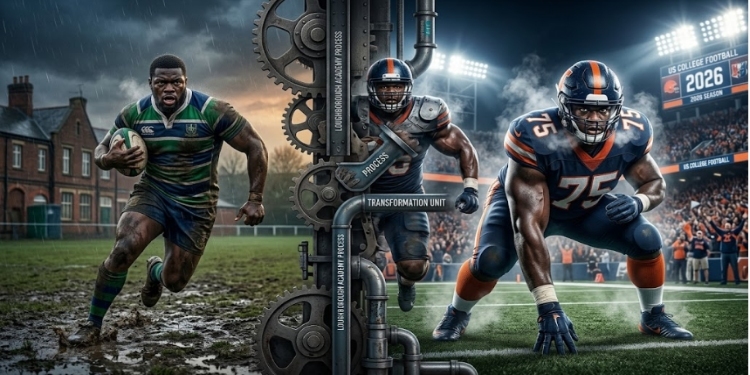
College football’s defensive line problem is an open secret among Power Four recruiters. There simply are not enough 300-pound domestic teenagers capable of bending at the knees and violently displacing human mass to supply 134 FBS programs. Look closer at the 2026 rosters, and you will spot the NFL’s calculated, multi-million-dollar solution quietly reshaping the trenches. The NFL Academy at Loughborough University is not a quaint foreign exchange program; it operates as an industrial meat grinder designed to turn British rugby forwards into Division I road graders.
Teenagers with backgrounds in the fluid, aerobic endurance of rugby union arrive at Loughborough and immediately face a brutal biomechanical shock. American football demands explosive, four-second bursts of anaerobic carnage. Director of Performance Chris Bear bypasses traditional strength regimens, prescribing a ruthless diet of deficit trap bar deadlifts to build the grappling leverage needed to survive Saturdays in the SEC. Let’s be real about the sheer volume of calories required to make this work. The nutritional logistics of feeding sixty-plus British teenagers actively trying to pack on fifty pounds of functional armor demands military precision.


SEC defensive line coaches do not hand out full-ride scholarships based on grainy HUDL tape shot against part-time baristas in Middlesex. Head Coach Steve Hagen solved this credibility gap by dragging his Loughborough roster directly into the fire. The Academy spent the last two seasons running a gauntlet against American high school royalty—trading blows with Florida’s Edgewater, matching up against Massillon in Oregon, and hosting De La Salle at Tottenham Hotspur Stadium. The psychological scarring from those games is highly intentional. It proves to American scouts that these imports will not fold when the stadium lights turn on.
Trench Warfare and The Mercenary Economy
The physical transition only covers half the battle. To survive the modern NCAA transfer portal, an athlete needs the cold-blooded mindset of a Wall Street day trader. Take Daniel Akinkunmi, a London-born offensive lineman who spent his high school years enduring a five-hour daily round trip to training, microwaving his prep meals on a commuter train. That specific Nigerian-British immigrant work ethic caught the eye of Oklahoma’s legendary offensive line coach Bill Bedenbaugh. Today, Akinkunmi operates as a 310-pound anchor for the Sooners. He spends his afternoons getting recognized on the streets of Norman, Oklahoma—a jarring reality for a kid used to the quiet modesty of South London school sports. Even lower-leg injuries requiring a scooter during spring camp could not keep him out of the film room.
Physical traits still trump experience in this ruthless business. Pitt took a massive swing on Akram Elnagmi purely because the Bristol native boasts a terrifying seven-foot wingspan. His older brother played for the UWE Bullets, but Akram possessed the raw frame that Power Four coaches salivate over. He transitioned from bullying private school kids on the rugby pitch to dealing with ACC edge rushers in less than two years. Frankly, the learning curve is vertical.
Other British imports have learned to play the boardroom game just as aggressively as the Americans. Kofi Taylor-Barrocks originally chased the Deion Sanders hype train to Colorado, only to hit the portal and secure a spot as a UTEP edge rusher. Darren Agu left the brutal SEC trenches at Vanderbilt for a premier pass-rushing role at New Mexico. These lateral moves prove the overseas cohort is no longer just grateful for a scholarship. They are actively manipulating their market value and chasing premium snap counts across different time zones.
The Philadelphia Exception: Loyalty in a Rented Locker Room
Market value usually dictates that a standout player bails for the highest NIL bidder. The American Athletic Conference lost almost its entire top-tier tight end production to the transfer portal this past winter. Peter Clarke refused to budge. The 6-foot-6, 265-pound South Londoner stayed at Temple University, morphing into a unicorn in the 2026 landscape: a loyal senior.
Clarke sees a dirty mirror image of his native Brixton in the gritty “Temple Tough” ethos of North Philadelphia. He did not just stay for football, though. He married a former Temple basketball player, had twins, and entrenched himself in the university’s donor ecosystem. Back in the winter, this kid from the UK delivered a keynote speech at an alumni event that directly squeezed $500,000 into the program’s Competitive Excellence Fund. That is the kind of off-field capital head coaches kill for.
On the field, Clarke operates as a devastating blocker who idolizes the physical violence of Rob Gronkowski. He represents the absolute ceiling of the international tight end experiment. The rugby background gives him the heavy hands of an offensive tackle and the fluid spatial awareness to navigate underneath zone coverage. He actively enjoys putting defensive ends into the dirt against their will.
Insomnia, EA Sports, and the Transatlantic Betting Slip
The British fanbase must maintain a near-masochistic commitment to track this imported talent. Midnight kickoffs force dedicated viewers to navigate Saturday mornings in total digital blackouts, desperately dodging social media spoilers until they can stream the VOD over their morning coffee. It is a grueling viewing schedule, but the financial mechanics of the sport have deeply incentivized the UK audience.
Sharp bettors across the Atlantic are no longer just blindly backing NFL franchises. They wake up and instantly check the live college football odds, looking to see how their homegrown heroes impact the point spreads of massive Big 12 or ACC matchups. A fan in Bristol might not fully grasp the nuance of Oklahoma’s inside zone blocking scheme, but they certainly know if Akinkunmi’s offensive line covered a seven-point spread against Texas.
Modern athletic bragging rights are minted directly on the servers of EA Sports. The release of College Football 27 gave international fans a tangible metric for their local talent. A quick glance at the game reveals Clarke boasting an 88 overall rating with a 96 in “Toughness.” You can verify Taylor-Barrocks’ 83 speed rating or feel the 84 impact blocking of Akinkunmi in the virtual trenches. These ratings operate as a universal translation matrix, proving to a kid in a London flat exactly how a British teenager stacks up against five-star recruits from Florida.
The First-Round Reckoning
The true return on the NFL’s massive international investment will not be measured by heartwarming stories of cultural integration in the American Midwest. The front offices in New York and London are entirely focused on the draft board. The International Player Pathway program has historically served as a quaint mechanism to sneak foreign developmental projects onto practice squads.
The 2026 crop is a completely different animal. Akinkunmi and Clarke are not looking for roster exemptions; they are hunting for guaranteed early-round money. When a kid who learned to tackle on a muddy pitch in Leicestershire walks across the stage on day one of the NFL Draft, the domestic monopoly on eight-figure signing bonuses will finally close up shop. Recruiters in Tuscaloosa and Columbus will suddenly have to pack their passports to find their next blindside protector.

David Prior
David Prior is the editor of Today News, responsible for the overall editorial strategy. He is an NCTJ-qualified journalist with over 20 years’ experience, and is also editor of the award-winning hyperlocal news title Altrincham Today. His LinkedIn profile is here.