




















































How Oleksandr Stepura’s Skyeton built Raybird, a drone that flies up to 28 hours, and why it aims to watch Europe’s wildfires, power lines and coasts.
A Ukrainian pilot who once called drones toys built an aircraft that can stay up for more than a day. Europe has spent a decade and billions of euros trying to build its own. Now Oleksandr Stepura wants Raybird’s next career to be hunting wildfires, finding the lost and guarding Europe’s power lines.


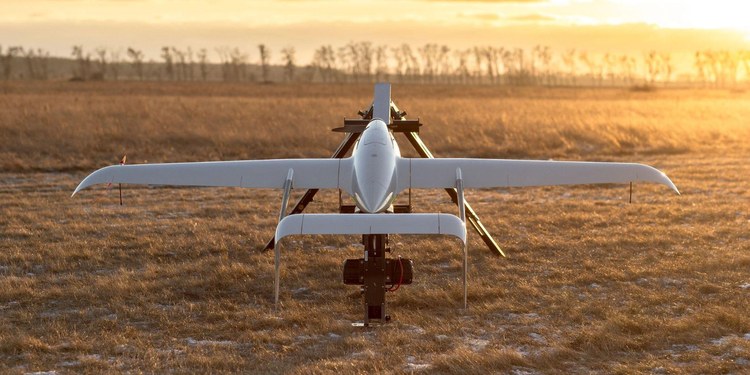
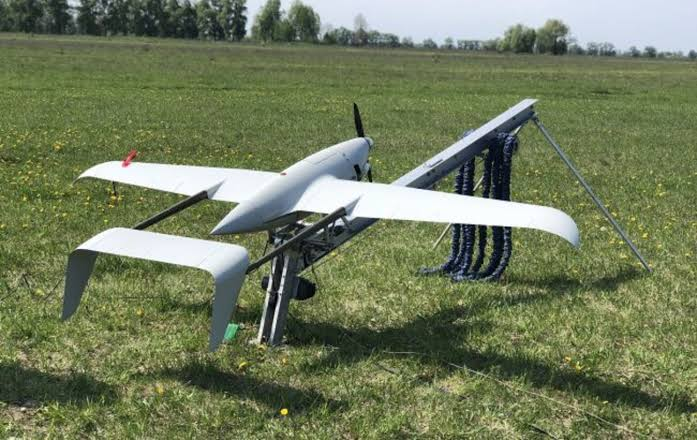
Raybird needs no runway: a catapult launches it, a parachute brings it home.
At ten o’clock on the morning of 6 September 2019, a small grey aircraft drifted down under a parachute onto Borodyanka airfield outside Kyiv. It weighed 21 kilograms. It had been in the air for 24 hours and 31 minutes and had flown more than 2,000 kilometers. Its tank still held enough fuel for another hour and a half. It came down only because the airspace was suddenly closed and every civilian aircraft was ordered to land.
Almost nobody outside Ukraine noticed. They should have.
The aircraft was the Raybird, built by a Kyiv company called Skyeton. This year Skyeton turns 20. Its drones have logged more than 350,000 flight hours, and its founder, Oleksandr Stepura, is pitching them for a job Europe badly needs done: watching over forests, coastlines and power grids for a full day at a time.
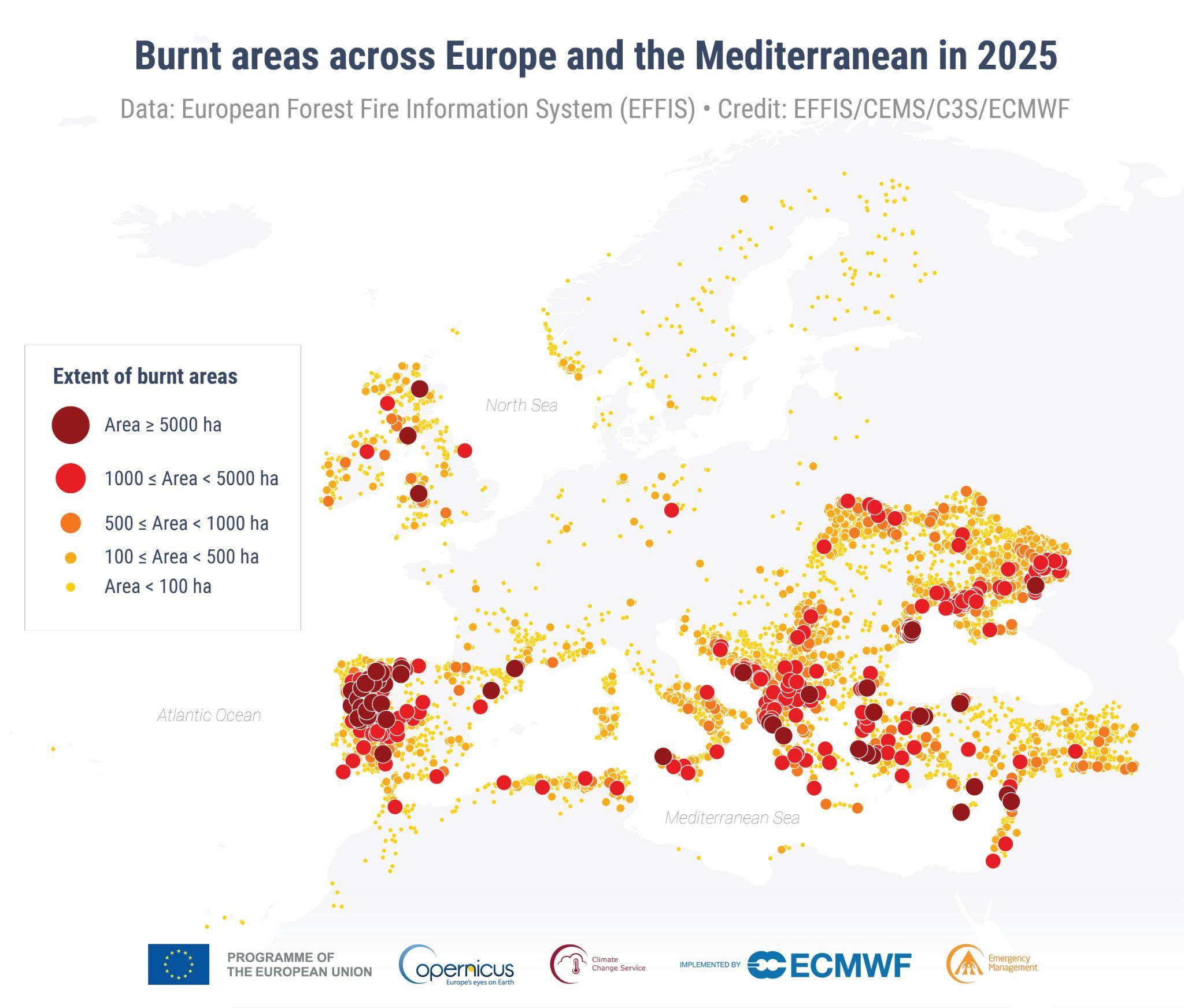
The timing is not an accident. Wildfires consumed about a million hectares across the European Union in 2025, the worst season since records began. In Spain and Portugal alone, 22 major fires sparked by a single August heat wave scorched more than 460,000 hectares. In March the European Commission answered with its first integrated wildfire strategy. Its headline purchase for the shared rescEU fleet is 12 firefighting planes and five helicopters. Drones do not appear in the Commission’s summary of the plan. That gap, between how much ground Europe must watch and how few eyes it has in the sky, is the market Stepura is aiming at.
Europe’s €7 billion question
Europe has been trying to build its own long-endurance drone for a decade. The Eurodrone programme, worth about €7 billion, was supposed to deliver a first capability in 2025. This summer its first prototype still had not been built, and the first flight had slipped to 2027 or 2028. “This drone is yesterday’s drone that could be obsolete tomorrow,” France’s air force chief, General Jérôme Bellanger, told senators last November.
Eurodrone is a ten-tonne machine, so the comparison has limits. The question it raises has none: how did one privately held company from Kyiv move so much faster than an entire continent?
The pilot who said no
Oleksandr Stepura, now in his early sixties, is not your typical drone founder. He is a scientist and engineer by training and a serial entrepreneur who has built about a dozen businesses, from reinforced security doors to smart ATMs. He still chairs a payments-technology company in Kyiv, and in Slovakia he runs a second venture that has nothing to do with aviation: Homers, a maker of modular houses. He is also a pilot, and that nearly kept him out of drones for good.
In 2006 he and a group of aviation engineers founded Skyeton to build real airplanes. Their first product, the K-10 Swift, was a two-seat light sport aircraft with a carbon-fiber fuselage and wings that two people can fold in five minutes. It sold to private flyers in Europe, North America and the Middle East.
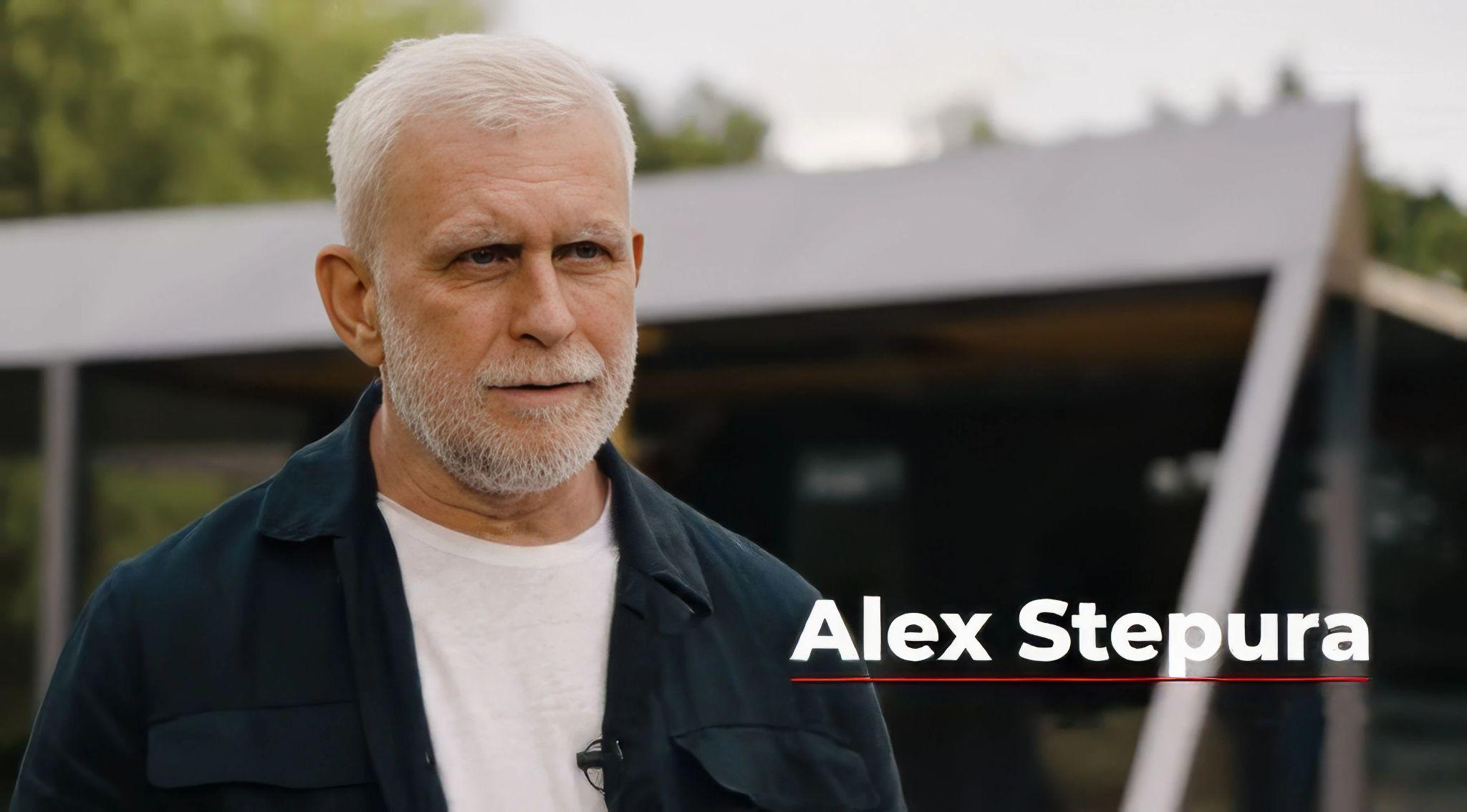
Around 2007, someone pitched him on drones. “I flatly rejected it,” he told Ukraine’s NV in August. “As a pilot, I couldn’t accept the idea that aviation would be replaced by machines I considered toys.”
Then came 2014. Russia seized Crimea and invaded the Donbas, and Stepura concluded that crewed aircraft would not survive in contested airspace. The hardest part, he says, was internal: “I had to overcome my own way of thinking as a pilot.”
He never entirely did. That turned out to be his first secret.
Secret No. 1: Build the pilot into the machine
“A pilot is an extraordinarily complex sensor system shaped by millions of years of evolution,” Stepura told NV. So Skyeton built one. Its synthetic navigation system fuses visual and inertial navigation with a range of physical and virtual sensors, letting the aircraft sense the world roughly the way a pilot does. When satellite navigation goes dark, Raybird keeps flying. That matters well beyond Ukraine: GPS jamming is now a routine headache for airline crews over the Baltic Sea.
Secret No. 2: Make it come back
“You can create an aircraft in a year, and it will fly,” Skyeton executive Roman Knyazhenko told the aviation publication The Air Current in May 2025. “But to make it come back after the flight, you need much more time.” By his count, the team spent five years, and then two or three more, “just sitting in the fields and testing, testing, testing … breaking it, repairing it again, breaking it again.” The record over Borodyanka was the payoff. By early 2022, Elan Head of The Air Current concluded, Raybird had become “a relatively mature and refined product.”
Secret No. 3: One airplane, made at home
Most drone makers pursue broad catalogues. Skyeton focused on a single airframe. “If you are producing so many different types, it means that you’re not concentrating on your platform, and you are not paying attention to small details,” Knyazhenko said. He compares Raybird to the F-16: one aircraft, many missions, and a new payload for each.
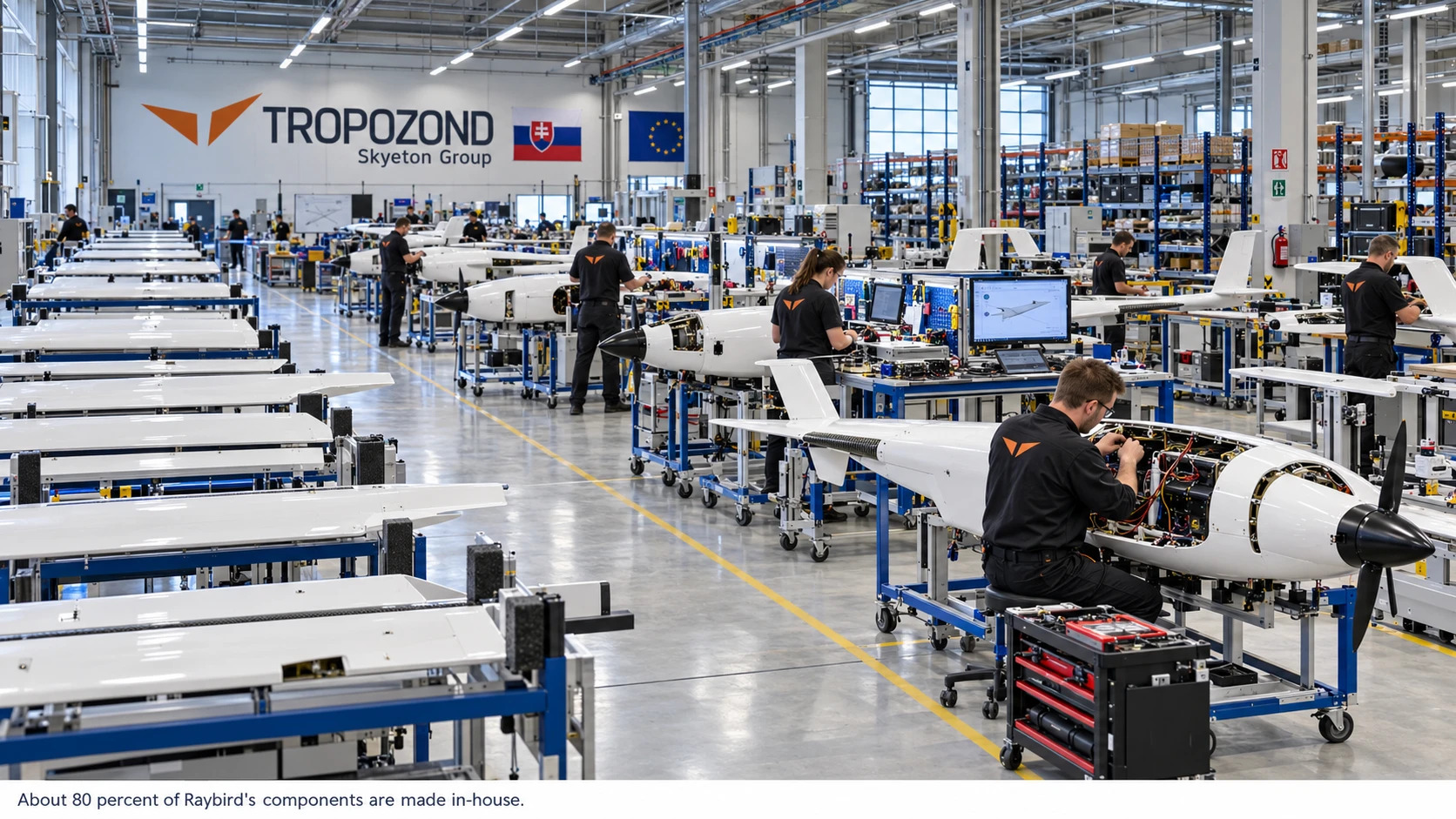
Skyeton also produces almost all of Raybird’s components in-house. A 2020 case study by Benoit Leleux and Marc Chauvet of IMD, a Swiss business school, identified another advantage. “Thanks to a local pool of aeronautical expertise inherited from the Soviet period,” they wrote, “Stepura rapidly reached product excellence, technically on par with global powerhouses such as Boeing.”
Secret No. 4: The harshest test lab on Earth
After February 2022, Raybird began flying dozens of missions a day across Ukraine, operating under intense electronic jamming. Operators fed back their experience around the clock. Changes that might have taken a peacetime programme a year of meetings reached the field within weeks. When the EU and Ukraine signed their Drone Deal in Kyiv this July, Ursula von der Leyen acknowledged that Europe lacked the field experience Ukraine’s industry had gained. No peacetime test programme could have provided it.
Secret No. 5: Expect the worst
In 2024, Skyeton opened a production line in Slovakia, within the European Union. “We created it in case they hit us in Ukraine,” Stepura said. In May 2026, a Russian strike hit Skyeton’s Kyiv office. Production continued because the company had already dispersed its operations.
The peacetime job
Stepura says the civilian market was always the bigger prize, a view outsiders shared. The IMD case study described Skyeton as a “civilian drone-manufacturing startup” serving government agencies such as “police, border patrol, coast guards.” Before the full-scale invasion, Skyeton was already supplying customers in Africa and Asia and reported “fantastic demand in Europe for systems that can fly long distances and cover large areas.”
His favourite example has nothing to do with war. A large Ukrainian mining company needed a detailed map of a vast quarry. A ground survey would have taken up to a year. In a week, Raybird covered more than 200 square kilometres and delivered an orthophoto map at 25 millimetres per pixel.
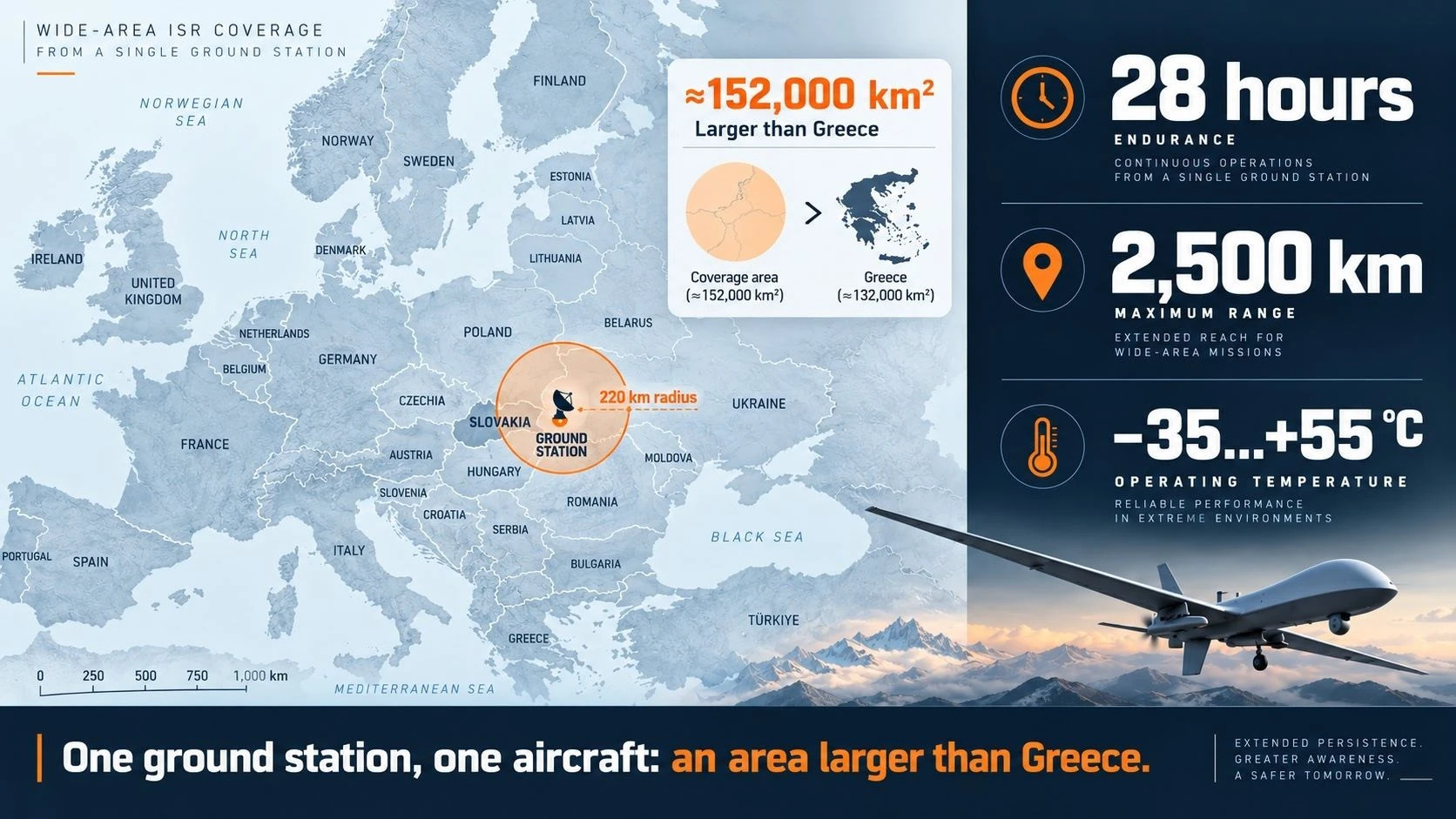
The aircraft itself is almost disarmingly simple. It weighs 23 kilograms, runs on ordinary petrol and needs no runway: a catapult launches it, and a parachute brings it home. Take-off and landing are fully autonomous. It is ready to fly in about 20 minutes and, depending on configuration, can stay airborne for up to 28 hours in temperatures from −25°C to +45°C. A single Raybird does the work of a succession of battery drones whose flight times are measured in minutes. Take-off and landing are the riskiest moments of any flight, so each one avoided means one fewer chance to lose the aircraft. “Interrupting a mission means losing context,” Stepura says.
Here is what that makes possible:
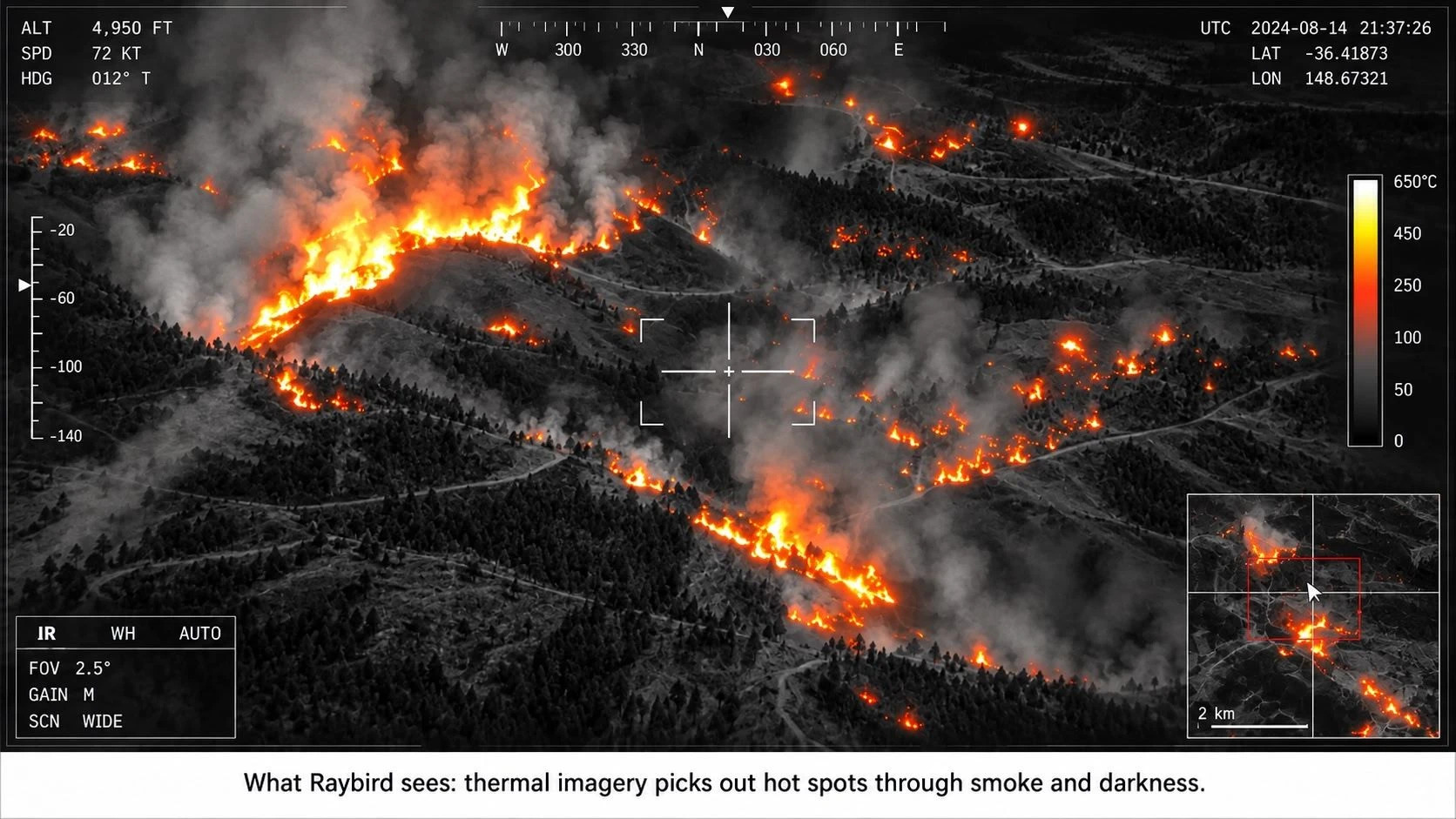
- Wildfires. Raybird drops no water; it serves as the incident commander’s eyes. Airborne within minutes of a callout, it stays on station for a full operational day, mapping the perimeter, hot spots and direction of spread while streaming live video to crews through the night. Where hills block the radio signal, a second Raybird relays it beyond 200 kilometers. Afterward, it maps the burn scar for insurers and rebuilders.
- Search and rescue. Thermal cameras detect body heat through darkness and smoke, and the aircraft keeps searching long after the helicopter has returned to refuel.
- Power lines and pipelines. These assets stretch for thousands of kilometers through forests, bogs and mountains. Repeated flights along the same route reveal sagging conductors, leaning towers and encroaching vegetation before anything fails. Thermal sensors are designed to detect leaks that a daylight camera cannot see.
- Roads, rail and bridges. It spots cracks and subsidence without closing a single lane.
- Coasts and borders. It can monitor oil spills, vessels in distress and protected areas for hours as conditions change.
The data arrives ready to use, as orthomosaics, 3D models and inspection reports that plug straight into ArcGIS and QGIS.
Skyeton’s British partner is making the same bet. Skyeton Prevail Solutions, a joint venture with London-based Prevail Partners, markets Raybird to companies with a purely civilian pitch: “From infrastructure inspection to environmental monitoring, logistics to agriculture, Raybird is transforming how industries capture, analyse, and act on aerial intelligence.” Its list of uses runs from detecting wildfires, tracking pollution and conserving wildlife to “locating missing persons in difficult terrain.”
Sharing the sky over a fire
Any firefighter who reads this far will ask the obvious question. A fire is some of the most crowded airspace in the world, full of water bombers and helicopters flying low and fast through smoke. In January 2025, an illegally flown drone punched a hole in the wing of a Super Scooper over the Palisades fire in Los Angeles, grounding the water bomber during one of the worst fires in the city’s history. Fire officials there said every stray drone forces them to stop all aircraft for 15 to 30 minutes.
The answer is coordination. In the U.S., the Federal Aviation Administration now runs protocols for deconflicting airspace over wildfires and says drones flown under them have proved their value “in providing persistent monitoring, mapping fire perimeters, and assessing infrastructure damage all while reducing risk to human life.” A drone that sits for a day at altitude above the tankers, on the air-operations plan and in contact with the coordinator, is a different proposition from a hobbyist’s quadcopter. Proving it can fit into Europe’s air plans, fire by fire, is the work in front of Skyeton.
Follow the money
Raybird can perform many of the same missions as crewed aircraft, making it a more cost-effective option for those tasks. Skyeton says it has more than 500 employees, including over 100 R&D engineers.
Skyeton is privately held and has not published revenue. Corporate registers show Stepura as the ultimate owner, through Skyeton Holding AS in Tallinn. The company attracted over €10 million ($11.6 million) in foreign investment for its Slovak plant. To lower the barrier for cash-strapped public agencies, Skyeton also rents Raybird as a turnkey service, handling everything from mission planning to delivery of the finished data.
The competition is real
Stepura is not alone in seeing the opportunity. This summer Portugal’s air force signed for long-endurance AR5 drones from Tekever, a Lisbon-based company valued at more than $1 billion. The AR5 will patrol the country’s maritime zone and support its rural firefighting operation. For Raybird, that is both a threat and proof that European governments will pay for persistent eyes over fire country. Its pitch is simplicity: the AR5 needs at least a short strip to take off, while Raybird needs none at all.
The man with the red flag
In peacetime, the toughest opponent is paperwork. Stepura recalls a Western country that, before granting flight permits, demanded his drone be escorted by a crewed airplane. He compares it to the 19th-century rule that made someone walk ahead of a motor car to warn pedestrians, the spirit of Britain’s infamous Red Flag Act. Approval for flights beyond visual line of sight is still the bottleneck across much of the West. Whoever clears it first wins the civilian market.
Skyeton is positioning itself on both sides of the Atlantic. Its Slovak subsidiary, Skyeton Slovakia, builds Raybird inside the EU. In Canada, a subsidiary incorporated in Ontario in 2019 is preparing Raybird’s market entry, aimed at provincial fire agencies, utilities and pipeline operators across the boreal forest; it is still waiting on approvals from Transport Canada. Skyeton now has offices in the United Kingdom, Estonia, Germany, Qatar, Slovakia, Ukraine and Switzerland, and has already flown a hydrogen-powered Raybird on real missions.
The toy that grew up
What happens when the guns finally go quiet? “Demand will grow,” Stepura told NV. “The war accelerated the development of unmanned systems, but their true potential lies in civilian applications.” Drones, he argues, will take over the routine and dangerous work of watching borders, seas, farmland and disaster zones. “The post-war future means a much bigger market.”
The pilot who once called drones toys now sums up twenty years in one line: the future of aviation is about “solving problems where a human should not be.”
Next August the heat will return to Europe’s hills, and the fires with it. The only question is whether Europe will be watching them from the ground or from an aircraft that refuses to land.

David Prior
David Prior is the editor of Today News, responsible for the overall editorial strategy. He is an NCTJ-qualified journalist with over 20 years’ experience, and is also editor of the award-winning hyperlocal news title Altrincham Today. His LinkedIn profile is here.