


















































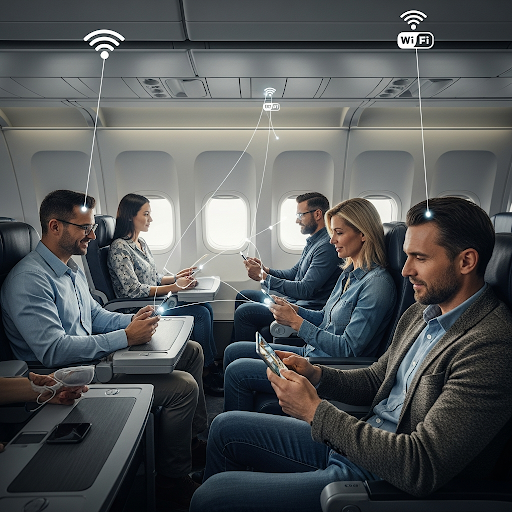
I remember the days when “in-flight entertainment” meant squinting at a communal screen at the front of the cabin, hoping the person in front of you didn’t have an exceptionally large head. If you were lucky, you might have had a choice between two films you had already seen or a grainy sitcom. When internet access first arrived in the skies, it was a bit of a revolution, but it was a frustrating one. You’d pay a small fortune for a connection that struggled to load a basic email, let alone anything remotely interactive.
Fast forward to mid-2026, and the conversation has shifted entirely. We aren’t just talking about being “online” at 35,000 feet anymore; we’re talking about parity with our home broadband. The aviation industry is currently in the middle of its biggest technological leap in decades, driven by a move away from clunky, distant satellites toward Low Earth Orbit (LEO) constellations. This change is doing more than just letting us scroll through social media; it’s redefining what it means to have a “live” experience while hurtling through the air at 500 miles per hour.


Technical Evolution: Moving from GEO to LEO technology
To understand why your flight’s Wi-Fi used to be so rubbish, you have to look at the physics of it. For years, airlines relied on Geostationary (GEO) satellites. These are massive, powerful bits of kit, but they sit incredibly far away, about 35,000 kilometres above the Earth. Because they rotate at the same speed as the planet, they stay fixed over one spot. Whilst that’s great for television broadcasts, it’s terrible for anything interactive.
The data has to travel from your laptop, up to the satellite, back down to a ground station, and then all the way back again. This creates “latency,” or what most of us call lag. In a GEO setup, you’re looking at a delay of at least 600 to 800 milliseconds. It doesn’t sound like much, but in the digital world, it’s an eternity.
This is where the transition to LEO infrastructure, like SpaceX’s Starlink, has changed the game. These satellites are much smaller and sit much closer to the ground, usually around 550 kilometres up. Because the distance is so much shorter, the latency drops to somewhere between 20 and 40 milliseconds. That is essentially the same as what you’d get on a standard fibre connection at home.
For passengers, this technical jargon translates to a very simple reality: things actually work. When we look at latency-sensitive applications, the contrast is night and day. On the old GEO systems, trying to engage in any real-time activity was an exercise in patience. If you tried to access a live casino online, for instance, the constant buffering and “reconnecting” messages would make the experience almost impossible. With LEO capabilities, that frustration is gone. You can interact with a live dealer or participate in a real-time game without the screen freezing at the crucial moment. It makes the sky feel less like a disconnected bubble and more like a continuation of our daily lives.
The Airline Arms Race: United, Air France, and the Gigabit Goal
Airlines have realised that high-quality Wi-Fi is no longer a luxury “extra”; it’s a deciding factor for passengers when they book their tickets. We’ve moved past the era where a bit of free messaging was enough to impress us. Now, we want the “Gigabit” experience.
United Airlines recently made waves by announcing a massive partnership to equip their entire fleet with Starlink. This isn’t just for their long-haul jets either; they’re looking at the domestic fleet too. The goal is to provide high-speed, low-latency internet to every passenger, free of charge. It’s a bold move that has forced other carriers to speed up their own plans.
Air France has been equally proactive. They’ve been rolling out ultra-high-speed connectivity across their fleet, aiming for a consistent experience regardless of whether you’re flying from Paris to New York or just a short hop over to London. The competition is fierce because the first airlines to truly master this will win the loyalty of the lucrative business travel market, as well as tech-savvy leisure travellers who wouldn’t dream of being “offline” for an eight-hour flight.
Then you have Virgin Atlantic, a brand that has always tried to stay ahead of the curve when it comes to the passenger experience. As they upgrade their fleet with the latest connectivity hardware, they’re leaning into the broader Virgin ecosystem. There’s a certain logic to it; if you’re a fan of the premium brand experience offered by Virgin, you want that to feel seamless. Many travellers find they can enjoy the same high-quality entertainment mid-flight through Virgin Games’ live casino offerings as they would in a ground-based lounge. It’s about brand consistency. When the tech works as it should, the transition from the airport lounge to the aircraft cabin is barely noticeable.
From Passive Consumption to Active Interactivity
For the longest time, In-Flight Entertainment (IFE) was a passive affair. You chose a movie, pressed play, and sat there until it finished. If you wanted to do anything else, you were out of luck. The new standard for IFE is “Active.” We’re seeing a shift where the seatback screen is becoming an extension of our personal devices, or even being bypassed entirely in favour of high-speed streaming.
Low-latency internet means we can now engage in real-time interactivity. This includes things like:
- Live Sports: Watching a match as it happens, with live stats and social media feeds updating in real time on the same screen.
- Video Conferencing: Joining a Zoom or Teams call for work without the awkward “can you hear me?” delays caused by old satellite tech.
- Interactive Gaming: Not just playing Tetris against the computer, but joining multiplayer environments with people on the ground.
- Live Shopping: Browsing and purchasing items in real time, often with the ability to have them waiting for you at your destination.
This shift is fundamentally changing the “vibe” of the aircraft cabin. It’s becoming more of a living room or a mobile office. I’ve noticed that people seem less restless when they have the freedom to choose how they spend their time, rather than being confined to a pre-selected library of content.
The ‘Live’ Test: How Does It Actually Hold Up?
It’s all well and good for an airline to promise “high-speed” internet, but the real test happens when 300 people on an Airbus A350 all try to stream 4K video at once. This is where the old systems used to fall over. The bandwidth simply wasn’t there to support a full cabin.
Recent tests of these new LEO-powered systems have been remarkably impressive. When you’re assessing performance for real-time streaming and interactive platforms, you’re looking for two things: stability and speed. In my experience, and based on industry reports, the new systems are holding up even during peak usage.
The “Live” test is particularly demanding for things like live-dealer games or real-time trading platforms. These require a constant, two-way flow of data. If the connection drops for even a second, the session can be lost. The fact that passengers can now reliably access a live casino online at 30,000 feet is a testament to how far the hardware has come. It’s no longer about just “catching up” on news; it’s about participating in live events as they happen.
Please remember that if you are choosing to use these platforms during your flight, it’s important to play responsibly. Set a budget before you log on, and treat it as a form of entertainment to pass the time. If you feel you might be losing control, most reputable platforms have tools to help you set limits.
Behind the Scenes: The Operational Impact
While we, as passengers, are busy watching Netflix or playing games, the aircraft itself is using this high-speed data for some very important “behind the scenes” work. This is the part of the story that doesn’t get as much headlines, but it’s arguably even more important for the future of aviation.
Modern aircraft generate a staggering amount of data. Every second, sensors on the engines, the airframe, and the avionics are recording information. Historically, much of this data was stored on black boxes or “quick access recorders” and only downloaded once the plane landed. If there was a minor fault mid-flight, the pilots might know about it, but the maintenance crews on the ground wouldn’t see the full data until the plane was at the gate.
With high-speed LEO connectivity, the plane can now stream this data to the ground in real time. This allows for:
- Predictive Maintenance: Engineers can see if a part is starting to show signs of wear while the plane is still over the Atlantic. They can have a replacement part and a crew ready to go the moment the wheels touch the tarmac, significantly reducing delays.
- Optimised Flight Paths: Pilots can receive real-time updates on weather and turbulence that are far more detailed than what they had before. This allows them to adjust their route more precisely, saving fuel and making the flight smoother for us in the back.
- Enhanced Fleet Monitoring: Airlines can track their entire fleet with incredible precision. This isn’t just about knowing where the plane is; it’s about knowing exactly how it’s performing at every moment.
This operational efficiency is one of the main reasons airlines are so keen to invest in this technology. It saves them money in the long run, and those savings—at least in theory—help keep ticket prices from skyrocketing.
The future of the aviation experience
We are standing at the threshold of a new era in aviation. The “dead time” of a long-haul flight is becoming a thing of the past. Whether you want to work, play, or simply stay connected with family on the ground, the barriers are falling away.
The transition to LEO satellites has been the “missing link” that the industry needed. By solving the latency problem, they’ve opened up a world of possibilities for both passengers and operators. It’s a bit of a cliché to say the sky is the limit, but in this case, it feels quite literal. As more airlines jump on board and the technology becomes even more robust, we’ll soon reach a point where we’d be as surprised by a slow connection on a plane as we would be in our own homes.
For those of us who travel frequently, this isn’t just about entertainment; it’s about freedom. The freedom to choose how we spend those hours in the air. And if that means a spot of live-dealer gaming or a seamless video call with a friend on the other side of the world, then I’m all for it. The high-speed skies are here, and they’re making the world feel just a little bit smaller and a lot more connected.