



















































Most creators do some homework before they try a growth service. They search the name, open a few articles, skim, and decide. The trouble is that skimming picks up the tone of a piece and misses the details that would actually help.
Two kinds of write-ups show up again and again in those searches. One is written by a creator who tried the service on a real channel. The other is written by someone who looks at services for a living. Both are useful, but they answer different questions, and reading them the same way is where a lot of people go wrong.


Start with your own question, not the article
Before opening anything, write down what you want to know. A creator with a new channel and little watch time has different worries from someone with a few thousand subscribers who wants a recent upload to pick up speed.
A short list helps:
- Which part of the channel do I want to support: views, likes, subscribers, or comments?
- Do I want a quick start on one video or steady support over several weeks?
- How much am I willing to spend on a first test?
- What would count as a good result for me?
With that list in hand, you read differently. You stop collecting general impressions and start looking for answers. An article that says a lot but answers none of your questions can be closed quickly.
What a creator’s own experience tells you
A write-up from a working YouTuber is the closest thing to what you’ll go through yourself. The person had a channel, picked a package, paid, and watched what happened.
Reading a YouTuber’s close look at one service gives you that view from the inside: what the ordering steps felt like, how the numbers moved, and what the creator made of it afterward.
When you read this kind of piece, look for these details:
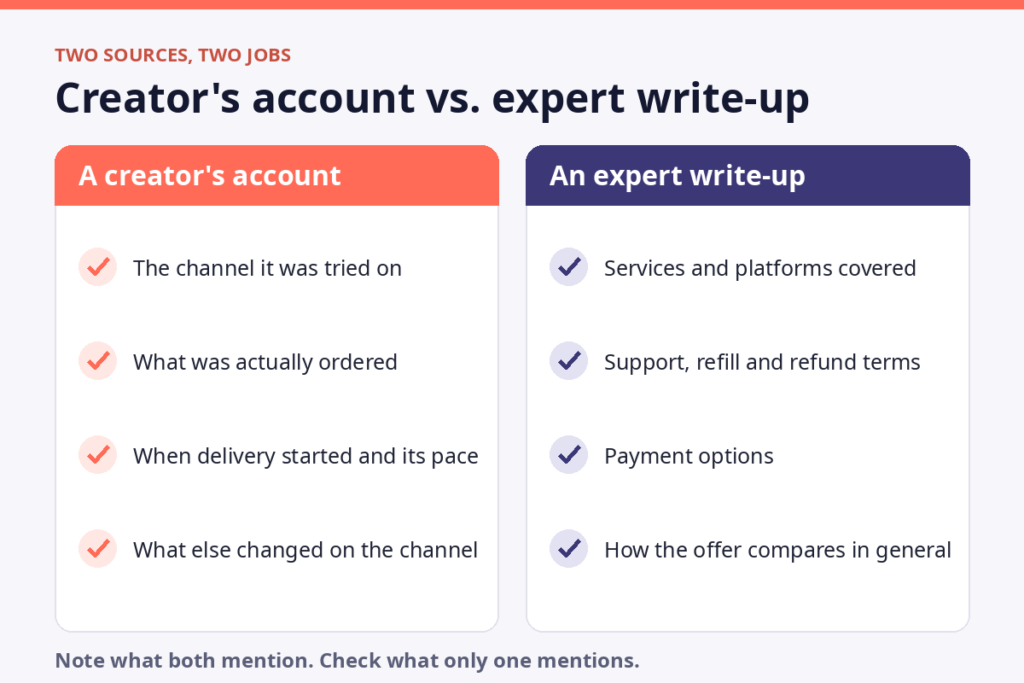
The channel context. What niche, how big, how active? A result on a gaming channel that uploads daily may not look the same on a cooking channel that posts twice a month.
What was ordered. The service type and the rough size of the order matter more than the verdict. “It worked” means little until you know what “it” was.
The timeline. Did the creator describe when delivery started and how it was paced? This is one of the most practical details for planning your own uploads.
What they did alongside it. Creators rarely change only one thing. If they also improved thumbnails or posted more often, keep that in mind when you read the results.
A creator’s write-up is strong on texture and thin on breadth. It covers one channel and usually one or two orders. Treat it as a detailed case, not a rule.
What an expert write-up adds
An editorial piece by a tech or marketing writer works from the other direction. It usually covers the whole service: which platforms are supported, how packages are organized, what payment and support options exist, and how the provider positions itself.
Reading an independent expert write-up is a fast way to get that map before you dig into the details.
The useful parts of an expert piece tend to be:
- A clear list of services and platforms, so you know what’s on offer beyond the one thing you came for.
- Notes on support, refills, and refund terms, which a single creator may never have needed.
- Context on how similar services are usually set up, which helps you judge whether an offer is ordinary or unusual.
What an expert piece often can’t give you is the feel of using the service on a channel like yours. That’s exactly what the creator’s write-up covers. Put the two together and you get both the map and a walk through one part of it.
Read the two side by side
The most practical habit is to read both kinds of write-up about the same service, one after the other, and keep notes in two columns.
In the first column, write what both sources mention. If the creator describes quick, friendly support and the expert piece also highlights support, that’s a detail you can lean on.
In the second column, write what only one source mentions. Those points aren’t wrong, but they need checking against the provider’s own pages before you rely on them.
This takes about twenty minutes and saves you from the most common mistake: choosing a service based on a single confident article.
Signals worth a closer look
A few things should make you slow down, whichever kind of write-up you have open:
- No mention of what was actually ordered or tested.
- Every point is praise, with nothing about limits or trade-offs.
- No date, or details that clearly describe an older version of the service.
- Claims about results that say nothing about the channel they came from.
None of these make an article useless. They mean it can’t carry a decision on its own.
Turn your reading into a small first test
Reading only gets you so far. Once your notes point to a service that fits your question, place a small order on one video and watch it closely. Pick an upload that already holds viewers reasonably well, so any extra attention lands on something people want to finish.
Then compare what happened with what you read. Did delivery start around when the write-ups suggested? Was the pace similar? Was support easy to reach when you had a question? Your own test is the third source, and for your channel it’s the one that counts most.
If the test goes well, scale up gradually and keep the rest of your channel work going. Growth services do their best work on top of regular uploads, clear titles, and thumbnails people want to click.
Check the provider’s current pages last
Packages, prices, and policies change over time. Whatever you read in an article, confirm it on the provider’s own site before ordering. Write-ups are good at explaining how a service works and what it felt like to use. The live site is where you confirm what it offers today.
FAQ
Should I trust a creator’s write-up more than an expert one?
Neither is more trustworthy by default. A creator shows you one real experience in detail, while an expert piece shows you the whole service. Reading both gives you the clearest picture.
How many write-ups do I need to read?
For most creators, one from a YouTuber and one from an expert source, plus the provider’s own pages, is enough to plan a small first test.
What if the two sources disagree?
Check what each one looked at. Differences often come from different service types, channel sizes, or the date the piece was written.

David Prior
David Prior is the editor of Today News, responsible for the overall editorial strategy. He is an NCTJ-qualified journalist with over 20 years’ experience, and is also editor of the award-winning hyperlocal news title Altrincham Today. His LinkedIn profile is here.