


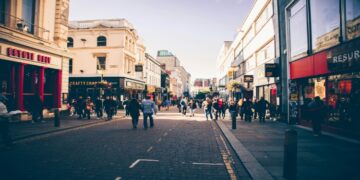
















































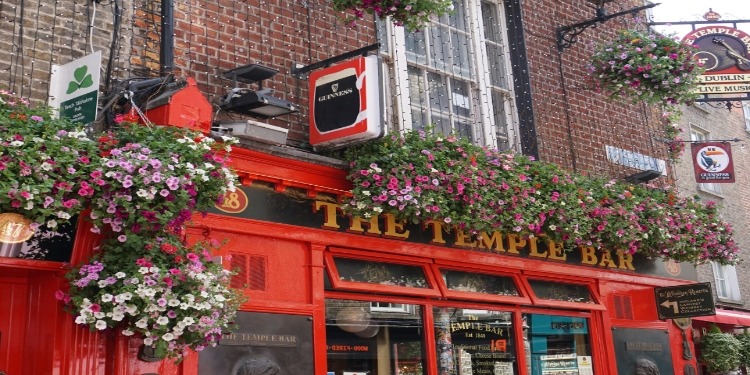
There are places in the world where a pub is simply an establishment. Tables, a bar, a drinks menu, perhaps a TV on the wall. Ireland is not like that. Here, a pub is something fundamentally different: an institution that has evolved over centuries and has become one of the central places where society recreates itself every day. Where gossip is born and dies, where disputes are settled, where the dead are mourned and the newborns celebrated, where strangers become acquaintances after their very first conversation.
The pub was at once a club, a market square and a courtroom – informal, but no less real for that. And today, many Irish people, sitting over a traditional pint, create an account via 1xbet Registration Ireland to place a bet on the match being shown on the telly in the corner.


If you want to understand Ireland – not the one in the tourist brochures, but the real one – start with a pub. It doesn’t have to be a big, famous one. Better a small one, where the bar is worn, where the landlord knows most of the regulars by name, and where, between pints, someone is bound to start telling a story.
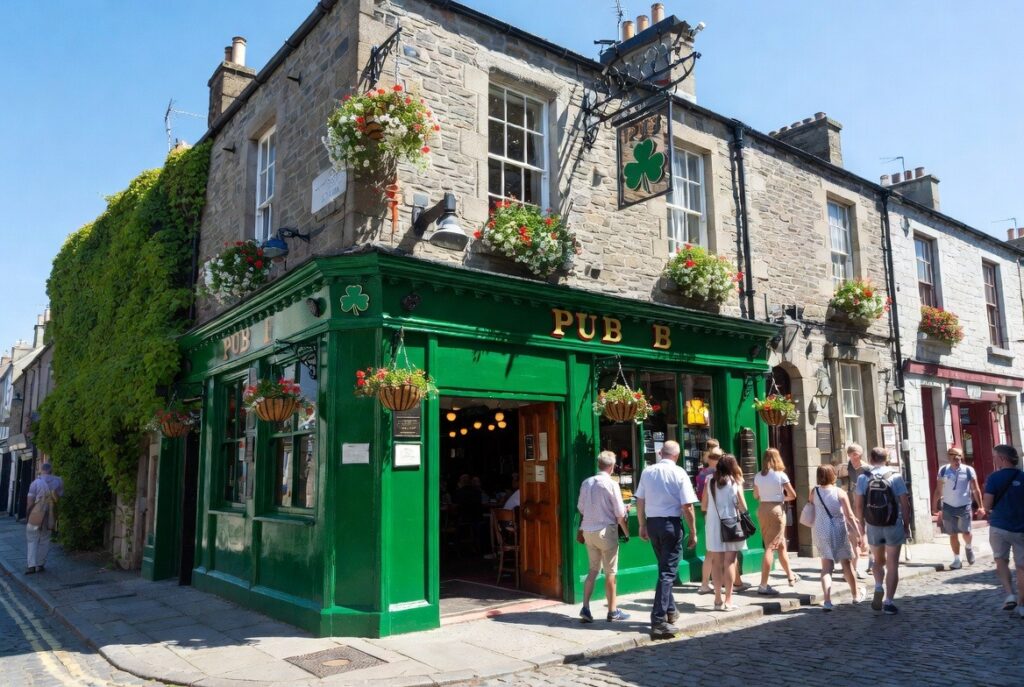
The pub as a social institution: a brief history of a long tradition
The Irish pub as we know it today took shape mainly in the 19th century, but its roots run much deeper. Even in medieval Ireland, there were so-called ‘bruiden’ — houses of hospitality where travellers could find food, lodging and company. The bard or storyteller at the court of the chieftain of the time performed a function that, in a sense, has survived to this day: he preserved the collective memory of the community, giving it form through words and rhythm.
Over time, these functions gradually shifted to the pub. In an era when most people lived in cramped and cold homes, the pub was the only public space offering warmth, light and company. It was here that news was discussed – long before newspapers, let alone the internet. It was here that deals were struck, conflicts were resolved and marriages were arranged.
The British colonial authorities repeatedly attempted to curtail the pub’s role in Irish society, recognising its significance as a place where a shared identity is forged and where ideas dangerous to the authorities might take root. This, perhaps, best illustrates just how significant this institution has always been.
The art of storytelling: from bards to barstools
Seanchaí — the keeper of the oral tradition
In Irish culture, there is a special word for a person who preserves and passes on oral traditions – seanchaí (pronounced roughly as ‘shanahi’). This is not simply a storyteller in the modern sense. The seanchaí was the keeper of family histories, local legends, folk tales and ancient lore. Their role was to keep the community’s memory alive – passing it down from generation to generation orally, with all the nuances, pauses and digressions that a written text can never fully capture.
This tradition is officially recognised by UNESCO as part of the intangible cultural heritage. But more importantly, it lives on. Not in museums or on stages, but precisely where it has always lived: in conversation. In pubs, where an older person sits in their usual corner and begins a sentence with the words ‘and once upon a time there was a story…’
In a sense, the modern Irish pub is the last refuge of this tradition. It has preserved what, in most cultures, has long been supplanted by television, social media and the general fast pace of everyday life – the art of live storytelling before a live audience.
Why are the Irish so good at telling stories?
This is neither a myth nor a stereotype inflated for tourists. The Irish do indeed have an unusual relationship with language and storytelling – and there are specific cultural reasons for this.
Firstly, under conditions of prolonged colonial oppression, when official institutions were hostile or inaccessible, oral culture became the primary means of preserving identity. Language and storytelling were a form of resistance – quiet, but consistent.
Secondly, the Irish educational tradition has always valued rhetoric and eloquence. Even in the poor rural schools of the nineteenth century, teachers known as ‘hedge school masters’ taught children to read, write and – crucially – speak persuasively.
Thirdly, there is something in the very structure of the Irish language that influences the way stories are told, even in English. Irish is a language that lacks the direct words ‘yes’ or ‘no’, where an answer always contains context and nuance. This approach seeps into the Irish way of speaking English and makes conversation more lively and indirect.
Traditional music in the pub: not a performance, but an event
Perhaps nothing shapes the atmosphere of an Irish pub quite like traditional music. But there is a significant difference between what most tourists see in Dublin or Killarney and what this music is really like.
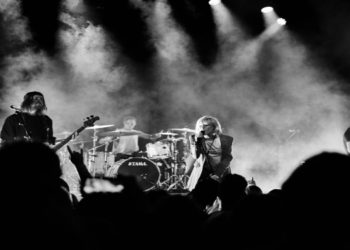
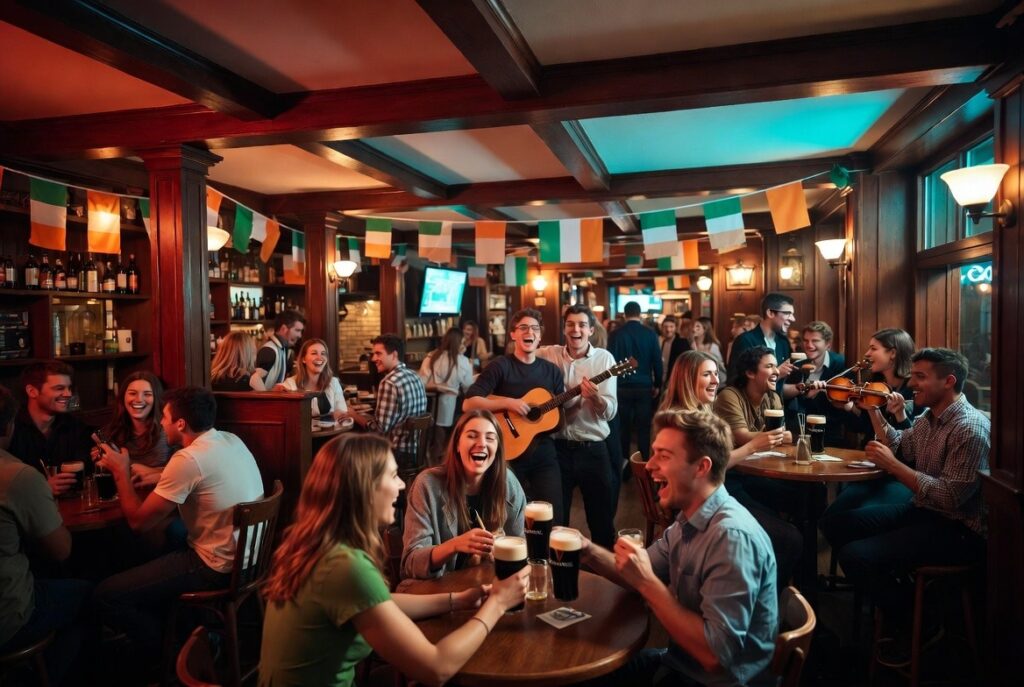
The advertised ‘traditional music night’ with a schedule, a stage and an entrance fee is a product designed for guests who don’t know the difference. A real session is a completely different phenomenon. It isn’t planned in advance, announced or advertised. A few musicians turn up at their usual pub at their usual time – not because they’ve been paid, but because they want to play. It starts with a single tune. Then someone else joins in with an instrument. Within an hour, there might be ten people sitting at the table, and the music develops of its own accord.
The audience, however, is not a passive spectator. They are part of the space. Someone taps out the beat. Someone knows the words and starts singing along quietly. Someone simply listens with a pint in hand and a smile that is hard to explain but easy to recognise.
The instruments that shape the sound of an Irish pub
| Instrument | Irish name | Role in the session |
| Violin | Fidil | The leading melodic instrument; the most common in sessions |
| Flute | Fliúit | Wooden transverse flute; warm, woody timbre |
| Tin whistle | Feadóg stáin | Metal flute; the first instrument for most beginners |
| Uilleann pipes | Uilleann píobaí | Irish bagpipes; complex, rich sound |
| Bodhrán | Bodhrán | Frame drum; the rhythmic foundation of the session |
| Banjo | Bansó | Borrowed, but fully assimilated into the tradition |
| Concertina | Consairtín | Free-reed instrument; particularly popular in Clare |
Each of these instruments has its own regional performance tradition. The Donegal style of fiddling differs from that of Clare or Sligo – different rhythm, different ornamentation, different emotional quality. These are not trivialities for connoisseurs: for people who have grown up in this tradition, regional differences in sound are part of their identity.
The pub as a public space: functions that no app can replace
A place where time flows differently
One of the most interesting features of the Irish pub is its relationship with time. People don’t rush here. Ordering a Guinness is a ritual in itself: a properly poured pint requires two stages and takes about two minutes. This isn’t slow service – it’s a signal that the rhythm here is different. People don’t come here to ‘pop in’, but to linger.
This is becoming increasingly rare in today’s world. Most public spaces these days are designed for speed – fast food, quick coffee, a quick check of your phone. The Irish pub, whether consciously or unconsciously, defies this trend. Here, you can sit for two hours over a single pint, have a quiet chat with friends and even complete 1xbet Registration Ireland, without feeling any time pressure.
The pub and community identity
In small towns and villages, the pub still fulfils a function that in other cultures has been taken over by various institutions – from the church to the town hall. This is where people get their news. This is where meetings are held. This is where people gather after funerals and weddings, after matches won and elections lost.
There are several social functions that the Irish pub still fulfils – and which have no direct equivalents in other cultural contexts:
- A place for informal mediation – disputes between neighbours, business disagreements and family tensions are often resolved over a pint, rather than in court or official institutions.
- A space for intergenerational communication – in an Irish pub, it is perfectly natural for people with a 40-year age gap to sit at the same table, and this surprises no one.
- A repository of local history – old pubs preserve photographs, artefacts and documents that are not preserved anywhere else.
- A place for first encounters – not in a romantic sense, but a social one: where new members of the community are introduced for the first time and where the process of acceptance begins.
Ireland’s most famous pubs and their characters
Dublin: between legend and everyday life
Dublin has pubs that are tourist attractions in their own right – and pubs where real local life takes place every day, with tourists merely on the sidelines of this process.
Mulligan’s on Poolbeg Street, founded in 1854, is one of the city’s oldest surviving pubs. There is no live music here, no special events. There’s a bar, a pint and a chat. The Long Hall on South Great George’s Street, with its Victorian interior and old clocks on the walls, is a place where you really feel that time flows differently.
Outside the capital
Those seeking an authentic experience often find it far from Dublin. Pubs in the small towns of Clare or Galway, in the fishing villages of Cork or Donegal – these are places where tourism has not yet supplanted authenticity.
Tig Keaney on Inishmore – a pub with no official address, where locals and visitors sit together on benches along the walls. O’Lochlains in Ballyvaughan in Clare – a tiny place where sessions go on well past midnight, and where the landlord himself joins in the music.
Why this culture is still alive – and why it matters
There is an obvious paradox in the fact that pub culture has survived in the age of smartphones, streaming and food delivery. In theory, everything a pub could offer – information, entertainment, social connection – is now available via a screen.
But people still go. Not because they have no alternatives – but because the pub offers something a screen simply cannot replicate. Presence. A live voice. Eye contact. The chance to hear someone nearby laugh and laugh along without delay and without an algorithm in the middle.
The Irish pub at its best is a place where a person ceases to be a consumer of content and becomes a participant in a live exchange. Where conversation is not a means to an end, but an end in itself. Many people can even, in the gaps between conversations, calmly go through 1xbet Registration Ireland, place a bet on a match and continue chatting in the warm circle of friends. Where music is played not for the record, but for those in the room right now.
This, perhaps, is the real answer to the question of why the Irish pub remains what it is. It is not nostalgia, nor is it a tourist attraction. It is a need – deeper than fashion and more enduring than technological change – to be among people and tell each other stories. And to listen in return.

David Prior
David Prior is the editor of Today News, responsible for the overall editorial strategy. He is an NCTJ-qualified journalist with over 20 years’ experience, and is also editor of the award-winning hyperlocal news title Altrincham Today. His LinkedIn profile is here.