


















































Imagine stepping directly into the Roaring Twenties. Not just watching a grainy, flickering film, but experiencing a bustling city street or a historic event with the depth and clarity of modern technology. The Apple Vision Pro offers this immersive potential, but the archival footage from that era wasn’t made for spatial computing. This is where AI becomes a powerful tool for historical restoration, breathing new life into century-old films.
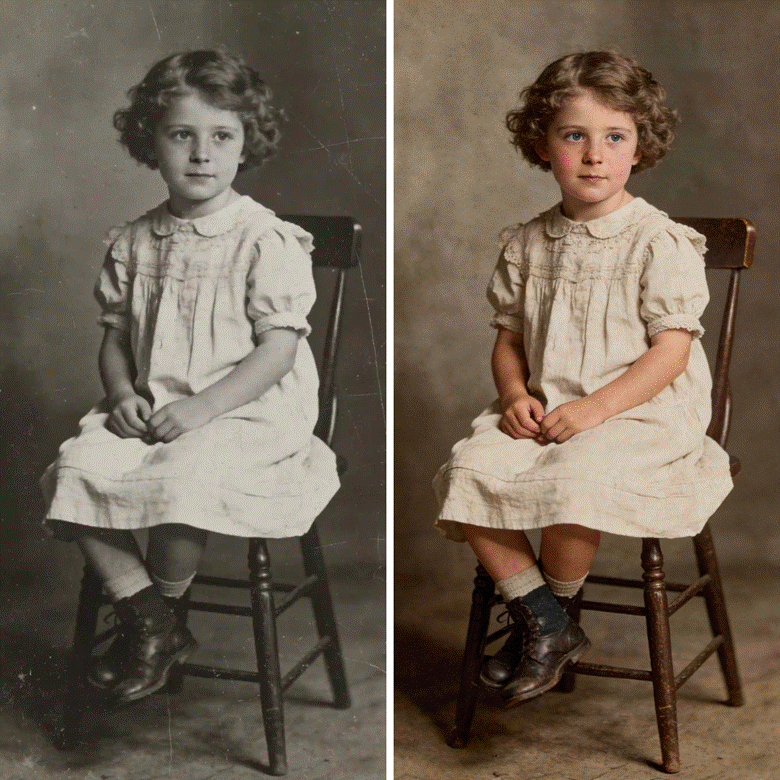
The primary challenge is clear. Footage from the 1920s suffers from low resolution, scratches, dust, and motion judder. Simply displaying it on a high-resolution device like the Vision Pro would amplify these flaws. AI-powered enhancement tools can intelligently analyze, repair, and upscale this content, transforming it into a format that feels present and real. This process opens up incredible opportunities for museums, filmmakers, and educators to create truly immersive historical experiences.


Real-World Scenarios for AI-Enhanced Footage
Use Case 1: Immersive Museum Exhibits
Museums and cultural institutions are constantly seeking new ways to engage visitors. Spatial computing offers a chance to move beyond static displays and create interactive, memorable experiences. By restoring 1920s archival footage, a museum can build an exhibit where visitors feel like they are standing in the past.
Imagine an exhibit on the Jazz Age. A visitor puts on a Vision Pro and is transported to a vibrant street in 1920s New York. The cars, the fashion, the architecture, all presented in stunning, upscaled 3D. This requires a meticulous process, starting with high-quality digital scans of the original film reels. From there, AI tools can address common issues. For instance, you can use an advanced tool to Unblur Image frames, sharpening details that were previously lost to poor focus or motion blur. This level of clarity makes the historical content feel immediate and tangible, allowing visitors to connect with the past on a much deeper level.
Use Case 2: Documentary Filmmaking Reimagined
Documentary filmmakers often rely on archival footage to tell their stories. However, the poor quality of old film can create a visual disconnect for audiences accustomed to 4K and HDR content. AI upscaling allows filmmakers to seamlessly integrate historical shots into modern productions without a jarring drop in quality.
For a documentary set in the 1920s, a director can now use previously unusable footage. AI algorithms can increase the resolution from standard definition to 4K or even 8K. They can also stabilize shaky shots and interpolate frames to create smooth, natural motion. A powerful Video Enhancer can analyze each frame to reduce noise and enhance textures, making the archival content look as if it were shot with much more advanced equipment. This allows for a more immersive and emotionally resonant storytelling experience, especially when viewed through a spatial device that emphasizes visual depth.
Use Case 3: Interactive Educational Content
History class can be transformed from a passive experience of reading textbooks to an active exploration of the past. Educational institutions can leverage AI-restored footage to create virtual field trips for students. Instead of just reading about the industrial boom of the 1920s, students could virtually tour a factory floor or witness the construction of a skyscraper.
This application makes history feel relevant and exciting. By converting the enhanced 2D footage into a 3D spatial format, educators can guide students through historical environments. They can point out details in the architecture, the clothing, or the technology of the era. This hands-on approach to learning improves comprehension and retention. It helps students build a stronger, more intuitive understanding of the historical context by allowing them to see it for themselves in a rich, detailed, and immersive format.
Benefits of AI Restoration for Spatial Playback
Each application of this technology brings unique advantages that redefine how we interact with historical media.
* For Museums: The primary benefit is a massive increase in visitor engagement. Immersive exhibits are more likely to attract new audiences and generate positive word-of-mouth. It also provides a new method for preserving fragile historical assets in a dynamic, accessible digital format.
* For Filmmakers: AI enhancement elevates the production value of historical documentaries. It unlocks creative potential by making a wider range of archival sources usable. This results in a more polished and professional final product that can captivate viewers on any platform, especially one as visually demanding as the Vision Pro.
* For Education: The main advantage is improved learning outcomes. Immersive content makes abstract historical concepts concrete and understandable. It fosters curiosity and critical thinking by allowing students to become virtual observers of the past, encouraging them to ask questions and explore on their own.
A Practical Workflow for Restoring 1920s Footage
Bringing century-old footage to the Apple Vision Pro involves a multi-step process that combines careful preservation with advanced technology. While the specific tools may vary, the core workflow remains consistent.
Step 1: Digitization of the Source Material
The process begins with the original film. The archival footage must be professionally scanned at the highest possible resolution. A high-quality scan captures as much detail as possible from the physical film, providing a better foundation for the AI enhancement process. This digital master copy is the raw material for all subsequent steps.
Step 2: Initial Cleaning and Preparation
Once digitized, the footage often requires a preliminary cleanup. This involves using software to remove large artifacts like dust, scratches, and film grain that could interfere with the AI algorithms. This manual or semi-automated step ensures the AI can focus on enhancing the actual content of the footage rather than trying to correct physical blemishes.
Step 3: AI-Powered Enhancement
This is the most critical stage. The cleaned footage is fed into AI models trained for specific tasks:
* Resolution Upscaling: The AI increases the pixel count of the video, intelligently adding new detail to create a sharper, clearer image.
* Frame Interpolation: To smooth out the low-frame-rate judder common in old films, the AI generates new frames to place between the original ones, resulting in fluid motion.
* Denoising and Sharpening: Algorithms analyze the footage to remove digital noise and selectively sharpen key elements like faces and text.
Step 4: Conversion to Spatial Video
After the 2D footage is fully restored and enhanced, it must be converted into a 3D spatial format. This can be achieved through advanced AI algorithms that analyze motion and depth cues in the 2D video to generate a stereoscopic view. This creates the illusion of depth necessary for an immersive experience on the Apple Vision Pro.
Step 5: Final Review and Integration
The final spatial video is reviewed for quality and accuracy. Once approved, it can be integrated into a museum exhibit app, a documentary film, or an educational program. The content is then ready for playback, offering viewers a unique and powerful window into the past.
Conclusion
The combination of AI restoration and the Apple Vision Pro is more than just a technological novelty. It represents a fundamental shift in how we preserve and experience history. By carefully upscaling archival footage from the 1920s, we can break down the barriers of time, allowing new generations to engage with the past in a way that is both educational and deeply personal. This technology transforms historical archives from forgotten relics into living, breathing worlds ready to be explored.