




















































The crypto payment landscape in 2026 has significantly matured into a competitive infrastructure layer that supports the acceptance of digital assets across e-commerce, SaaS, B2B billing, and global remittances. Cryptocurrency acceptance is no longer a fringe feature but a strategic payment channel for businesses seeking to reduce friction in cross-border transactions, engage crypto-native customers, and optimize settlement costs relative to traditional card rails.
A crypto payment gateway is middleware that connects blockchain networks to merchant billing systems and accounting flows, handling transaction validation, settlement, compliance screening, and reporting. The technology ecosystem has evolved from basic wallet integrations to enterprise-grade, API-first platforms that support automated conversions, risk controls, and flexible settlement choices. For many companies, the search for the best crypto payment processor is less about branding and more about infrastructure reliability.


This guide ranks the best crypto payment gateways in 2026 based on a mix of features, regulatory posture, merchant utility, and industry reputation. Each solution is evaluated against the criteria most important to business decision-makers, including integration simplicity, asset coverage, settlement fidelity, and risk management.
What Is a Crypto Payment Processor?
A crypto payment processor is a service provider that enables merchants to accept cryptocurrency payments and integrate them into existing financial workflows. It serves as an intermediary layer between blockchain networks and merchant systems, including checkout pages, billing software, and point-of-sale terminals.
At a technical level, the processor:
- Generates unique wallet addresses or payment requests
- Monitors blockchain confirmations
- Locks exchange rates during checkout (if conversion is enabled)
- Provides settlement options (crypto, stablecoin, or fiat)
- Supplies transaction reporting for reconciliation
Without a payment processor, a merchant would need to manage private keys, manually monitor blockchain transactions, calculate exchange rates, and handle volatility exposure. For most businesses, this is operationally inefficient and increases risk.
There are two main models:
- Custodial – The provider manages wallet custody and settlement.
- Non-custodial – The merchant retains control of wallet keys while using the processor for routing and monitoring.
In enterprise environments, custodial or hybrid models dominate because they simplify accounting and compliance. The processor effectively transforms blockchain transactions into structured financial records suitable for audit and reporting.
Why Crypto Payment Infrastructure Matters Today
Crypto infrastructure matters in 2026 because digital assets are increasingly used as settlement instruments rather than speculative holdings. Stablecoins such as USDT and USDC have become operational tools in international commerce, particularly in regions with banking friction or currency controls.
There are four structural reasons why infrastructure quality is critical:
1. Volatility management
Price fluctuations remain a risk for non-stablecoin assets. Automated conversion at checkout protects margins and ensures predictable revenue recognition.
2. Cross-border efficiency
Traditional international transfers can involve intermediary banks and delays. Crypto settlements, especially on high-throughput networks, can reduce transfer time to minutes. However, without automated reconciliation and reporting, this speed advantage creates back-office complexity.
3. Compliance expectations
Regulatory frameworks increasingly require transaction monitoring and AML controls. Businesses that accept crypto may face scrutiny if they lack adequate screening processes. Payment processors integrate blockchain analytics and risk scoring to mitigate this exposure.
4. Treasury integration
Modern finance teams require structured reporting, exportable transaction logs, and predictable settlement flows. Infrastructure determines whether crypto acceptance becomes a manageable revenue channel or an accounting burden.
In short, accepting crypto is not simply about adding a checkout option. It requires operational alignment between blockchain settlement, financial reporting, and compliance systems. The difference between a lightweight plugin and a robust payment processor becomes evident at scale.
Top 5 Crypto Payment Processors in 2026
The crypto payment market in 2026 includes providers serving very different segments: small online merchants, high-volume digital platforms, fintech companies, and regulated enterprises. Some platforms prioritize asset diversity and plug-and-play integrations. Others focus on compliance, treasury infrastructure, and institutional onboarding. As a result, defining the best payment processor for crypto depends largely on business model, transaction volume, and settlement requirements rather than brand visibility alone.
Below is a structured overview of five established crypto payment processors: Whitepay, NOWPayments, CoinsPaid, CoinGate, and BVNK. The descriptions are based on publicly available information about their products, positioning, and service scope.
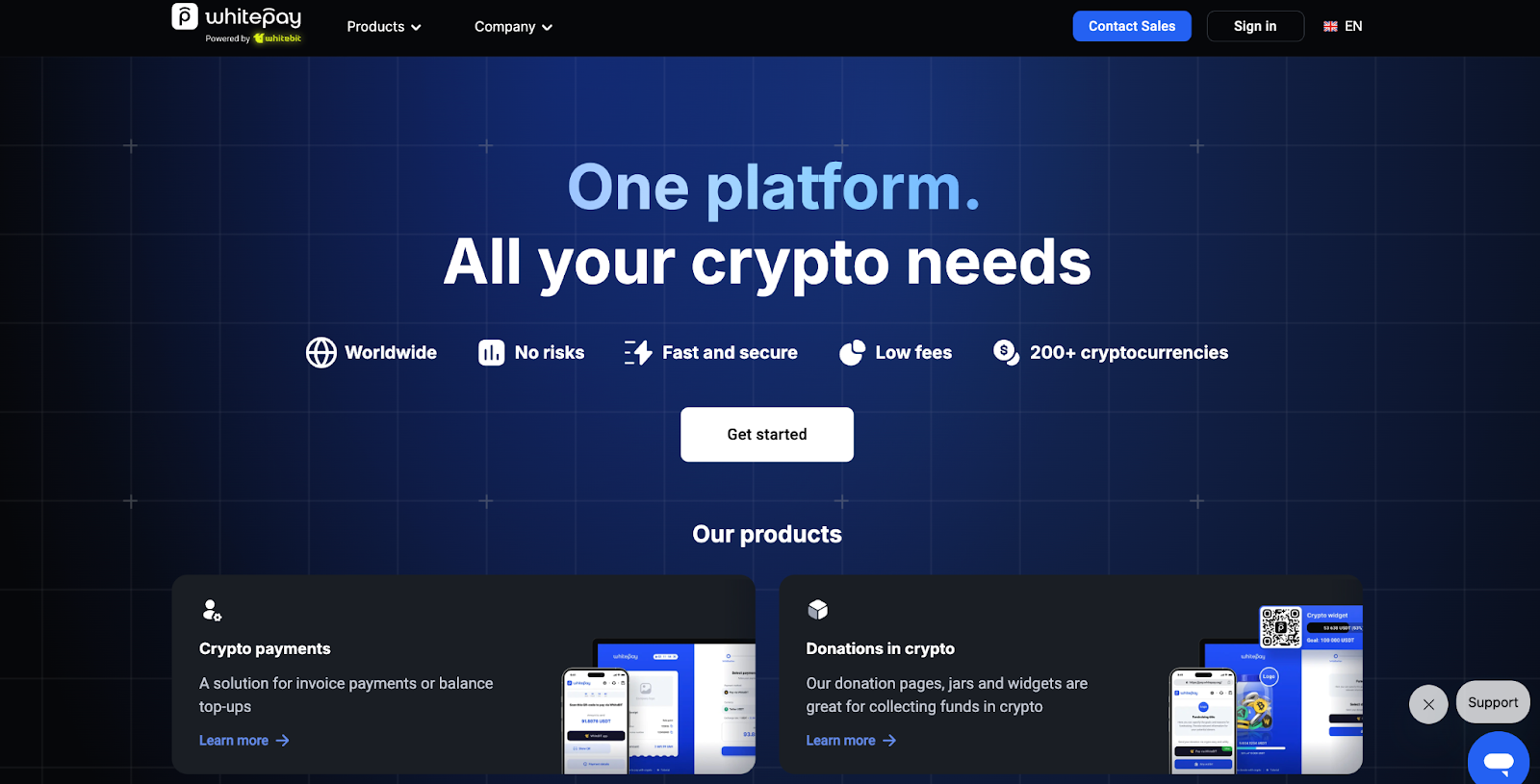
Whitepay is a crypto payment gateway launched within the WhiteBIT ecosystem. It enables merchants to accept cryptocurrency payments both online and offline and supports settlement in digital assets or fiat currencies. The company operates primarily in Europe and offers e-commerce integration tools and POS solutions for brick-and-mortar retailers.
Whitepay supports more than 140 cryptocurrencies, including major assets such as BTC, ETH, and leading stablecoins. Merchants can use payment links, API integrations, and ready-made solutions for online stores. One of its distinguishing features is the ability to automatically convert crypto payments into fiat (e.g., EUR) with direct bank settlement, which simplifies accounting and reduces exposure to volatility. The platform also offers donation tools and invoicing functionality.
Key features:
- Support for 200+ cryptocurrencies
- Automatic crypto-to-fiat conversion
- Online checkout and payment links
- POS terminals for offline retail
- Merchant dashboard with transaction history
- API-based integration
Limitations for enterprises:
- Primarily focused on payment acceptance rather than advanced treasury management
- Institutional liquidity tools are limited compared to crypto-native financial platforms
- Enterprise onboarding may require additional compliance procedures
Verdict:
Whitepay is best suited for merchants and retail businesses that require straightforward crypto acceptance and fiat settlement. It provides a practical bridge between digital asset payments and traditional accounting workflows, particularly for European businesses.
NOWPayments
NOWPayments is a crypto payment gateway designed for flexibility and broad asset coverage. It supports 300+ cryptocurrencies and offers integrations suitable for online stores, SaaS businesses, marketplaces, and donation platforms. The service emphasizes low fees and ease of deployment.
Merchants can integrate NOWPayments via API, hosted payment pages, or plugins for popular e-commerce platforms. The platform offers optional automatic conversion into stablecoins or other selected cryptocurrencies. NOWPayments also provides recurring billing functionality, which is relevant for subscription-based services. The standard service fee is publicly stated at 0.5% for basic crypto payments, with additional charges applying to conversions.
Key features:
- 300+ supported cryptocurrencies
- Auto-conversion options
- Recurring payment functionality
- E-commerce plugins and API
- Custodial and non-custodial models
- Transparent base fee structure
Limitations for enterprises:
- Primarily SMB-oriented
- Limited enterprise-grade treasury tooling
- Compliance infrastructure may require additional due diligence from merchants
Verdict:
NOWPayments is a strong option for digital-first businesses that value token diversity and integration simplicity. It is particularly attractive to SMEs and crypto-native companies seeking fast deployment without complex onboarding.
CoinsPaid
CoinsPaid is a crypto payment ecosystem that provides merchant processing, wallet infrastructure, and OTC services. The company is known for serving high-volume industries, including online gaming and digital services. Its infrastructure includes automated conversion, custodial wallet solutions, and business accounts designed for operational scalability.
CoinsPaid positions itself as a regulated and compliance-oriented provider in Europe. The platform offers settlement in crypto or fiat, along with merchant tools for transaction monitoring and reporting. Because of its institutional focus, onboarding processes can be more structured than plug-and-play gateways. The solution is typically better suited to businesses with high transaction volumes than to small online stores.
CoinGate
CoinGate is a Lithuania-based crypto payment processor that has operated since 2014. It enables businesses to accept cryptocurrencies and settle in crypto or fiat. CoinGate offers integrations for e-commerce platforms, billing tools, and payment buttons suitable for online merchants.
The platform supports a broad but curated selection of digital assets rather than hundreds of tokens. CoinGate is widely used by small and medium-sized online retailers who are new to crypto payments. While it provides reliable merchant tools and conversion options, its infrastructure is primarily designed for straightforward crypto acceptance rather than complex enterprise treasury management.
BVNK
BVNK is a crypto-native financial services provider that combines digital asset infrastructure with traditional payment systems. Unlike purely merchant-focused gateways, BVNK positions itself as a regulated financial institution, offering stablecoin accounts and cross-border payment solutions.
The platform enables businesses to hold, send, and receive stablecoins alongside fiat currencies. BVNK’s model is particularly relevant for fintech companies, payment service providers, and B2B platforms that require programmable financial flows and integrated settlement mechanisms. Its service scope extends beyond simple checkout to embedded finance and treasury operations, making it better suited to institutional clients than small retailers.
Key Attributes of a High-Performance Crypto Payment Solution
Choosing the best crypto payment gateways requires evaluating operational fundamentals rather than marketing claims. A reliable provider must combine technical security, cost clarity, and efficient settlement design. The goal is not simply to accept cryptocurrency, but to ensure that payments integrate smoothly into financial workflows.
Security Architecture and Risk Management
Security is foundational because blockchain transactions are irreversible. A robust platform should implement hot/cold wallet separation, multi-signature controls, and strong authentication mechanisms. Transaction monitoring and AML screening reduce exposure to fraudulent or sanctioned activity.
For custodial models, internal access governance and withdrawal controls are critical. In non-custodial setups, secure key management and API protection become the merchant’s responsibility. Businesses should review audit practices and incident response policies before onboarding.
Blockchain and Asset Coverage
Asset coverage determines how easily customers can complete payments. However, network reliability and liquidity matter more than the sheer number of supported tokens.
Merchants should prioritize:
- Major blockchains with strong ecosystem support
- Stablecoin availability
- Predictable confirmation times
A focused selection of widely adopted assets often delivers better operational stability than excessive token diversity.
Fee Structure Transparency
Cost analysis must go beyond headline processing fees. Conversion spreads, withdrawal charges, and payout thresholds all affect effective margin.
Finance teams should evaluate:
- Base transaction fees
- Crypto-to-fiat conversion rates
- Volume-based pricing tiers
Transparent pricing enables accurate forecasting and prevents hidden cost accumulation.
Settlement and Treasury Tools
Settlement efficiency determines whether crypto acceptance simplifies or complicates accounting. Automated conversion into fiat or stablecoins reduces volatility risk.
Strong solutions typically provide:
- Configurable payout schedules
- Exportable reconciliation reports
- API integration for accounting systems
For larger businesses, partial auto-conversion options can align crypto payments with treasury policy.
Comparing Crypto Payment Processors: Decision Framework
Selecting among the best crypto payment processors should follow a structured evaluation process aligned with your business model, risk tolerance, and geographic compliance environment. Rather than starting with features, companies should define internal constraints and transaction expectations.
Based on the Business Model
| Business Type | Priority Factors | Recommended Orientation |
| E-commerce SME | Easy integration, stablecoin support | Merchant-focused gateway |
| SaaS / Subscription | Recurring billing, API flexibility | Platform-oriented solution |
| High-volume marketplace | Liquidity depth, automated settlement | Enterprise processor |
| Fintech / PSP | Treasury tools, programmable flows | Infrastructure provider |
| Physical retail | POS capability, fast confirmations | Retail-ready gateway |
A small online store may prioritize quick setup and a diverse asset portfolio. A fintech company handling large transaction volumes may prioritize settlement infrastructure and regulatory alignment.
Based on Risk Tolerance
| Risk Profile | Preferred Model | Rationale |
| Low | Auto-convert to fiat | Eliminates cryptocurrency volatility |
| Medium | Settle in stablecoins | Reduces price risk while retaining blockchain speed |
| High | Retain crypto treasury | Potential upside, but increased exposure |
Risk appetite determines how a business manages incoming transactions. The choice of settlement strategy affects accounting complexity and balance sheet volatility.
Based on Geographic Compliance
| Regulatory Environment | Strategic Priority |
| Strict (EU, UK) | AML screening, licensed provider |
| Emerging markets | Stablecoin flexibility, cross-border efficiency |
| Multi-jurisdiction | Scalable reporting, audit trail integrity |
Compliance expectations vary significantly by jurisdiction. Businesses operating across borders should prioritize transparent reporting and structured transaction logs to support audits.
How to Choose the Right Solution for Your Business
Choosing the best crypto payment gateway should begin with a strategic assessment rather than a feature comparison. A business must clearly define its objective: expanding international reach, reducing cross-border settlement friction, lowering payment processing fees, or offering alternative options to customers. Without a defined goal, evaluating gateways becomes reactive instead of structured.
Operational scale is the next determining factor. Transaction volume, average order value, and geographic distribution influence infrastructure requirements. Small merchants typically prioritize rapid integration and predictable pricing, while high-volume platforms require scalable APIs, automated reconciliation, and consistent settlement timing. Custodial solutions reduce complexity and simplify reporting, whereas non-custodial models provide greater control but demand internal blockchain security expertise.
Finally, long-term adaptability matters. Regulatory standards evolve, blockchain usage shifts, and customer preferences change. Selecting a provider that can scale with business growth reduces future migration risk and protects operational continuity.
Why Businesses Opt for Whitepay Solutions
Businesses choosing Whitepay often seek a structured yet accessible bridge between blockchain payments and traditional finance. The platform supports both online checkout integration and POS-based cryptocurrency acceptance, enabling merchants to operate across both digital and physical retail environments within a single unified system.
Automated crypto-to-fiat conversion, including settlement in EUR, reduces volatility exposure and simplifies accounting workflows. Supporting over 140 digital assets ensures compatibility with a broad customer base while maintaining operational clarity. Whitepay’s positioning focuses on merchant usability rather than institutional financial services, making it particularly suitable for retailers and mid-sized enterprises seeking predictable settlement and straightforward integration.
Benefits of Accepting Crypto Payments
Accepting cryptocurrency can deliver tangible operational and strategic advantages when properly integrated into a payment stack. The value is not theoretical – it depends on how the business structures settlement, fees, and compliance processes. For businesses targeting global digital audiences, selecting the best payment processor for crypto directly impacts conversion rates and settlement efficiency.
1. Reduced Chargeback Risk
Blockchain transactions are irreversible once confirmed. Unlike card payments, they cannot be unilaterally reversed by customers or issuing banks. This significantly lowers exposure to fraudulent disputes, especially in cross-border and digital service industries.
2. Improved Cross-Border Efficiency
Traditional international payments often involve correspondent banks, FX spreads, and settlement delays. Cryptocurrency payments – particularly stablecoins – can settle within minutes, improving cash-flow predictability and reducing reliance on intermediaries.
3. Potential Fee Optimization
Depending on the provider and blockchain network, crypto transactions may incur lower processing fees than international card payments. While conversion spreads must be considered, many businesses benefit from lower effective costs in global transactions.
4. Expanded Customer Reach
Accepting cryptocurrency enables businesses to serve customers in underbanked or high-friction markets. For digitally native audiences, crypto acceptance can increase trust and improve checkout conversion rates.
Implementation Checklist for Businesses
Successful crypto payment integration requires structured planning across legal, financial, and technical domains. The following phased checklist helps minimize operational risk.
Phase 1: Strategic Definition
- Define settlement preference: full fiat conversion, stablecoin retention, or hybrid allocation.
- Assess expected transaction volume and geographic exposure.
- Align crypto acceptance with treasury and accounting policies.
Phase 2: Compliance & Provider Selection
- Conduct legal and tax review in all operating jurisdictions.
- Evaluate provider custody model (custodial vs non-custodial).
- Compare fee structure, conversion spreads, and payout conditions.
- Confirm AML screening and reporting capabilities.
Phase 3: Technical Integration
- Choose integration method: API, hosted checkout, or e-commerce plugin.
- Configure rate locking and confirmation parameters.
- Set payout schedules and reconciliation exports.
- Test transaction flows in the sandbox environment.
Phase 4: Deployment & Monitoring
- Train finance and customer support teams.
- Launch in controlled rollout (e.g., limited markets).
- Monitor transaction volume, fee impact, and settlement timing.
- Adjust treasury settings based on real performance data.
When executed methodically, cryptocurrency acceptance becomes a structured payment infrastructure rather than an experimental feature.
FAQ
What is the safest crypto payment processor?
The safest and often considered the best crypto payment processor combines strong custody controls, AML monitoring, and transparent operational policies. Security architecture and compliance alignment matter more than brand visibility.
Is custodial or non-custodial better for merchants?
Custodial solutions simplify operations and reporting. Non-custodial models provide greater control but require internal blockchain expertise.
Are crypto payments cheaper than credit cards?
They can be, particularly for cross-border transactions. However, the total cost depends on conversion spreads and withdrawal fees.
Can businesses automatically convert crypto to fiat?
Yes. Most major gateways offer auto-conversion features that reduce volatility exposure.
Do crypto gateways handle compliance screening?
Many providers implement AML and transaction-monitoring tools, but the ultimate compliance responsibility remains with the merchant.