


















































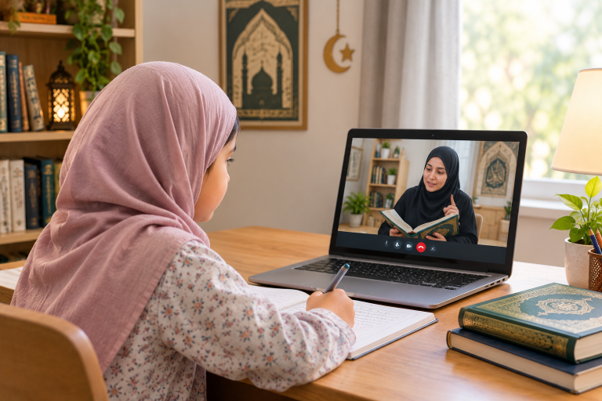
For many families in Britain, religious education has always been part of the weekly routine. Children attend classes at the local mosque, adults join study groups, and weekends often include time set aside for learning about their faith. These traditions are still going strong, but fitting them around modern life is not always easy.
Academies such as Online Quran Corner give families another way to arrange religious education without travelling to a classroom. For some, online lessons are a convenient alternative to local classes. For others, they make learning possible when attending in person simply does not work.


Why Families Are Choosing Online Quran Classes in the UK
Every family’s situation is different. In some cities, several mosques and Islamic centres are a short walk away. In smaller towns, choices can be thin, especially if you want a teacher with experience in a specific area.
Demand for flexible options is also growing alongside the community itself. The Office for National Statistics reported that 3.9 million people in England and Wales identified as Muslim in the 2021 Census, up from 2.7 million in 2011. More families means more routines, more locations, and more need for options that suit different lives.
Busy Schedules Leave Little Room for Travel
Picture a child who gets home from school, tackles homework, and still needs time to eat and unwind. If their Quran class means another journey across town, the evening can feel exhausting for the child and the parent.
An online lesson cuts out the commute. The child joins from home, and nobody has to plan transport around every session. Adults with full-time jobs benefit in the same way, particularly when evening classes nearby aren’t available.
It sounds like a small thing, but convenience often decides whether someone keeps showing up week after week.
More Choice When You Learn Quran Online with a Tutor
Few families find the right teacher on the first try. A local class might not offer much individual attention, or the timings may clash with school or work.
Learning online lets you look beyond your postcode. You can compare teaching styles and pick someone who suits the student, without distance getting in the way.
This matters most for recitation. Pronouncing Arabic correctly and applying tajweed rules takes patience and practice. A student needs a teacher who listens closely, spots mistakes, and explains how to fix them. Regular access to that kind of feedback makes lessons far more productive.
Online vs Mosque Classes: A Quick Comparison
Neither option is “better” across the board. This table shows where each one tends to work well.
| Factor | Online Quran Lessons | Local Mosque Classes |
| Travel | None, learn from home | Needs a journey each time |
| Scheduling | Often flexible, can fit around school and work | Usually fixed timetable |
| Teacher choice | Wide, not limited by location | Limited to what’s nearby |
| Individual attention | Easy to arrange one-to-one | Often group-based |
| Community feel | Limited | Strong, with friends and local events |
| Parental involvement | Easy to listen in and follow progress | Depends on the setting |
| Possible drawbacks | Screen fatigue, internet issues | Travel time, less flexibility |
Why Individual Online Quran Lessons Suit Some Students
A student who struggles to keep up in a group often feels more at ease one-to-one. They can ask questions the moment something is unclear, repeat a passage without feeling embarrassed, and spend extra time on tricky areas.
Teachers can also adjust as the student improves. Someone who needs more practice with a particular rule can work on it before moving on, while a confident learner can speed ahead.
That said, one-to-one isn’t right for everyone. Some children love learning alongside friends and thrive in a group. What matters is finding the approach that keeps the student interested and moving forward.
What Makes Online Religious Learning Useful?
A few practical advantages stand out:
- Easy demonstration. Teachers can share text on screen, point to specific words and read aloud while the student follows along.
- Better for Arabic and recitation. Students see the text, hear the teacher, then try the pronunciation themselves.
- Parents can stay involved. When a child studies at home, it’s easier to understand what’s being taught and ask about progress.
- Revision support. Some providers allow lesson recordings, as long as proper consent and privacy arrangements are in place.
- Privacy for adults. Someone who has never learned to read Arabic may feel nervous in a room full of experienced students. One-to-one tuition lets them start from the basics at their own pace.
For people who stopped studying years ago and want to begin again, this can make the first step feel far less daunting.
Online Classes Can’t Replace Everything
Convenience is only part of the picture. Religious education has a social side too. Children who attend a mosque make friends, join group activities and feel part of their local community. Adults gain from those relationships as well.
A video call can’t fully recreate learning together in the same room. For many families, going to the mosque and taking part in community life matters as much as the lessons.
There are practical hurdles, too:
- Younger children may struggle to focus on a screen for long.
- Internet problems can interrupt a lesson.
- Background noise at home can make listening harder.
- Some students simply prefer a teacher in the room.
So it doesn’t have to be all or nothing. Many families combine online tuition with local classes, mosque activities and learning at home, getting the flexibility of online lessons without losing the sense of community.
How to Choose a Safe Online Quran Tutor or Academy
Not every provider offers the same standard of teaching or supervision. Before enrolling a child, take a little time to find out how classes work and who will be teaching them.
The Department for Education publishes guidance for parents on out-of-school settings, including supplementary schools, tuition and religious education. It’s worth reading, especially where children are involved.
Here are the questions worth asking:
- Who will teach the lessons? Ask about qualifications, experience and teaching style.
- How are children kept safe? Find out what checks teachers go through, how safeguarding concerns are handled, and who you can contact if something goes wrong.
- Can parents observe a lesson? Open arrangements help build trust.
- Is there a trial lesson? It lets both sides see whether they click.
- How will progress be shared? Ask what feedback you’ll get and how areas needing work are spotted.
Watch how the provider answers. A reliable service should explain its teaching methods and safeguarding clearly, without vague replies or pressure to sign up straight away. Check the practical details too: timings, cancellation policy, fees and how you’ll communicate should all be clear before classes begin.
Tips to Help Students Get More from Online Lessons
Once classes start, a few simple habits make a big difference.
- Keep a regular slot. The same time each week makes it easier to fit around school, work and family life.
- Create a quiet space. A calm corner and a steady internet connection help with focus.
- Stay nearby with younger children. At least for the first few lessons, parents can help with tech issues and keep things on track.
- Practise between lessons. A few minutes of daily review sticks better than cramming before the next class.
- Keep it realistic. Build a routine that suits the learner’s age and ability.
Most importantly, learning shouldn’t become another source of stress. If a child is tired or finding a topic hard, talk to the teacher about easing the pace. And make time for faith away from the screen, whether that’s visiting the mosque, studying together at home or joining community events.
The Future of Online Religious Education in Britain
Online learning is unlikely to replace traditional classes, and most families wouldn’t want it to. Local mosques and learning centres offer something a screen can’t: the chance to learn alongside others and belong to a community.
What online tuition changes is the number of choices. A family can fit lessons around school and work, find a teacher outside their area, or add one-to-one tuition to what they already do. Adults who couldn’t find the time can return to study without a long journey several times a week.
The best option depends on the student. Some thrive in a classroom, some prefer home, and many do best with a mix of both. Whatever you pick, the priorities are the same: find a teacher who understands the student, check that safeguarding is in place, and choose a schedule you can realistically keep.
Online learning isn’t a replacement for every part of religious education. It’s another way to make time for it, and for families who’ve struggled to fit regular lessons into busy lives, that can make all the difference.
Frequently Asked Questions (FAQs)
1. Are online Quran classes suitable for children in the UK?
Yes, for many children they work well, especially when lessons are short, the teacher is experienced with young learners, and a parent is nearby to help at the start. Academies like Online Quran Corner offer lessons designed around a child’s age and pace.
2. Can adults learn the Quran online from scratch?
Absolutely. One-to-one lessons let beginners start with the basics of Arabic reading at their own speed, without the pressure of a group. Many adults find this far more comfortable than a classroom.
3. How do I know if an online Quran tutor is trustworthy?
Ask about qualifications, safeguarding checks and whether parents can observe lessons. A good provider will answer openly. Online Quran Corner, for example, is the kind of academy parents can approach with these questions before committing.
4. Is a trial lesson worth asking for?
Yes. A trial lets you see the teacher’s style, check the technology works at home, and judge whether your child feels comfortable before you pay for a full course.
5. Can online lessons replace the mosque?
Not entirely. Online classes are great for flexibility and individual attention, but mosques offer community and social connection. Most families do best combining the two.
Conclusion
Online religious education isn’t about replacing the mosque. It’s about giving families more ways to make learning fit real life. Between school, work, and everything in between, a flexible option can be the difference between lessons that stick and lessons that quietly fall away.
Online Quran lessons offer convenience, wider teacher choice, and one-to-one attention, which can be especially helpful for recitation, tajweed, and beginners who want to learn at their own pace. At the same time, local classes still offer something a screen can’t: friendships, community, and a shared sense of belonging. For most families, a mix of both works best.
If you’re considering online lessons, take your time. Ask about qualifications and safeguarding, book a trial lesson, and choose a schedule you can realistically keep. Providers like Online Quran Corner can be a good place to start, as long as the teaching style and safety arrangements feel right for your family.
Whichever route you choose, the goal stays the same: a steady, stress-free routine that helps the student grow in their faith.