

















































Selecting an electric bicycle for daily commuting requires prioritizing mechanical durability, certified electrical safety, and all-weather dependability over raw recreational speed.
A reliable daily commuter must withstand thousands of kilometers of repetitive tarmac vibrations, stop-and-go city traffic, unpredictable rain, and variable cargo payloads. While weekend leisure riders can compromise on integrated lights or weatherproofing, an everyday urban rider depends on a balanced drive system, a high-capacity certified battery, responsive hydraulic braking, and ergonomic frame geometry that ensures comfort on twice-daily trips.


Critical Specifications When Buying an Ebike for Daily Commuting
Evaluating core specifications before purchasing prevents riders from choosing a machine that feels sluggish under load or requires constant mechanical troubleshooting. Unlike lightweight acoustic road bikes, commuter electric bikes operate under continuous mechanical stress from motor torque and total vehicle mass.
Investing in a certified commuter ebike designed to meet European EN 15194 standards ensures the motor delivers dependable 25 km/h pedal assistance while maintaining legal access to city bike paths. In daily European commuting environments, continuous motor ratings of 250W provide ample acceleration from complete stops without violating local municipal vehicle codes or requiring commercial motorcycle registration.
When assessing the mechanical foundation of an electric commuter, riders should focus on three foundational engineering elements:
- Structural Frame Integrity: Certified 6061 heat-treated aluminum frames withstand dynamic road vibrations while supporting rear cargo racks loaded with work bags.
- Drivetrain Quality: Multi-speed mechanical gearing (such as Shimano 7-speed cassettes) ensures riders maintain comfortable pedaling cadences across varying gradients and headwind conditions.
- Electrical Ingress Protection: Look for ratings of IPX4 or higher on displays, motor casings, and battery connections to prevent electrical shorts during heavy downpours.
Commuter Ebike Battery Range and Real-World Capacity
Battery capacity determines how far an electric bicycle can travel on a single charge and dictates how frequently you must plug into a wall outlet. For everyday commuting, battery capacity is measured in Watt-hours (Wh), calculated by multiplying voltage (V) by amp-hours (Ah).
A standard 36V 13Ah battery pack delivers approximately 468Wh of total energy, which comfortably supports round-trip urban commutes of 25 to 45 kilometers under moderate pedal assistance. High-capacity configurations—such as 36V 18Ah (648Wh) or 48V systems using tier-one Samsung or LG lithium cells—extend practical riding buffers up to 60 or 80 kilometers per charge, reducing charging frequency to just once or twice per week.
When planning daily travel distances, apply the 30% buffer rule:
- Official Maximum Range vs. Daily Demands: Official range claims reflect lightweight riders on flat terrain in low-assist modes. Real-world conditions—such as cold winter temperatures, carrying heavy laptops, and fighting headwinds—routinely reduce usable mileage by 25% to 35%.
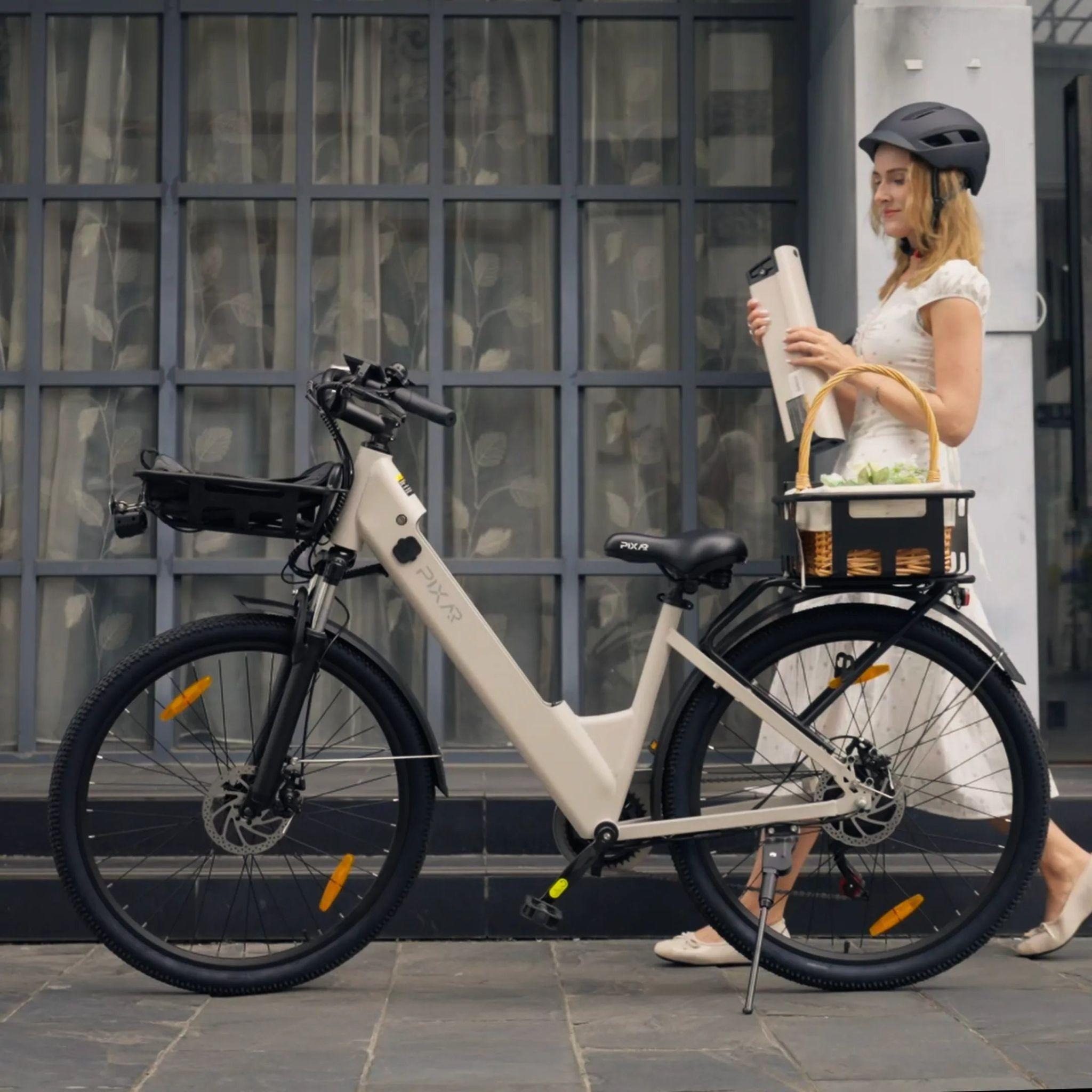
- Convenient Removable Battery Design: A key-locked removable battery allows urban riders living in apartment buildings or working in commercial offices to carry the battery pack indoors for safe room-temperature recharging without dragging the entire bicycle inside.
- Cell Longevity and Cycle Life: Branded lithium-ion cells with automated Battery Management Systems (BMS) preserve over 75% of original capacity after 600 full discharge cycles, translating to three to five years of dependable five-day workweek transportation.
Motor Power and Torque Sensor vs Cadence Sensor Performance
How an electric bicycle delivers power determines how confident you feel when accelerating into busy urban roundabouts and crowded intersections. Daily commuting requires predictable, responsive assistance rather than erratic power surges.
Rear geared hub motors remain the most cost-effective and low-maintenance choice for urban commuting. Positioned directly within the rear wheel assembly, hub motors deliver direct rotational power to the tire without placing additional mechanical strain or chain wear on the external gear cluster. For European city streets featuring moderate rolling terrain, a 250W rear hub motor delivering 45 Nm of torque accelerates smoothly to 25 km/h with virtually silent operation.
The choice of sensor technology represents the most critical differentiator in ride feel:
- Cadence Sensors (Rotation-Based): Cadence sensors measure whether the crank arms are rotating. After the pedals turn a quarter or half rotation, the motor controller delivers a predetermined burst of wattage based on your selected assist level. While simple and durable, cadence sensors can feel slightly abrupt during slow-speed maneuvers in pedestrian zones.
- Torque Sensors (Force-Based): Torque sensors actively measure the precise mechanical pressure applied to the pedals hundreds of times per second. Pushing harder from a dead stop signals the motor to deliver immediate, proportionate thrust, mimicking natural cycling effort while significantly conserving battery capacity.
Frame Geometry and Ergonomics for Daily City Riding
Commuter comfort is not a cosmetic luxury; an uncomfortable bicycle quickly discourages daily riding. A well-designed urban commuter promotes an upright riding stance that reduces strain on the lower back, neck, and wrists while positioning the rider’s line of sight high enough to scan city traffic over parked cars.
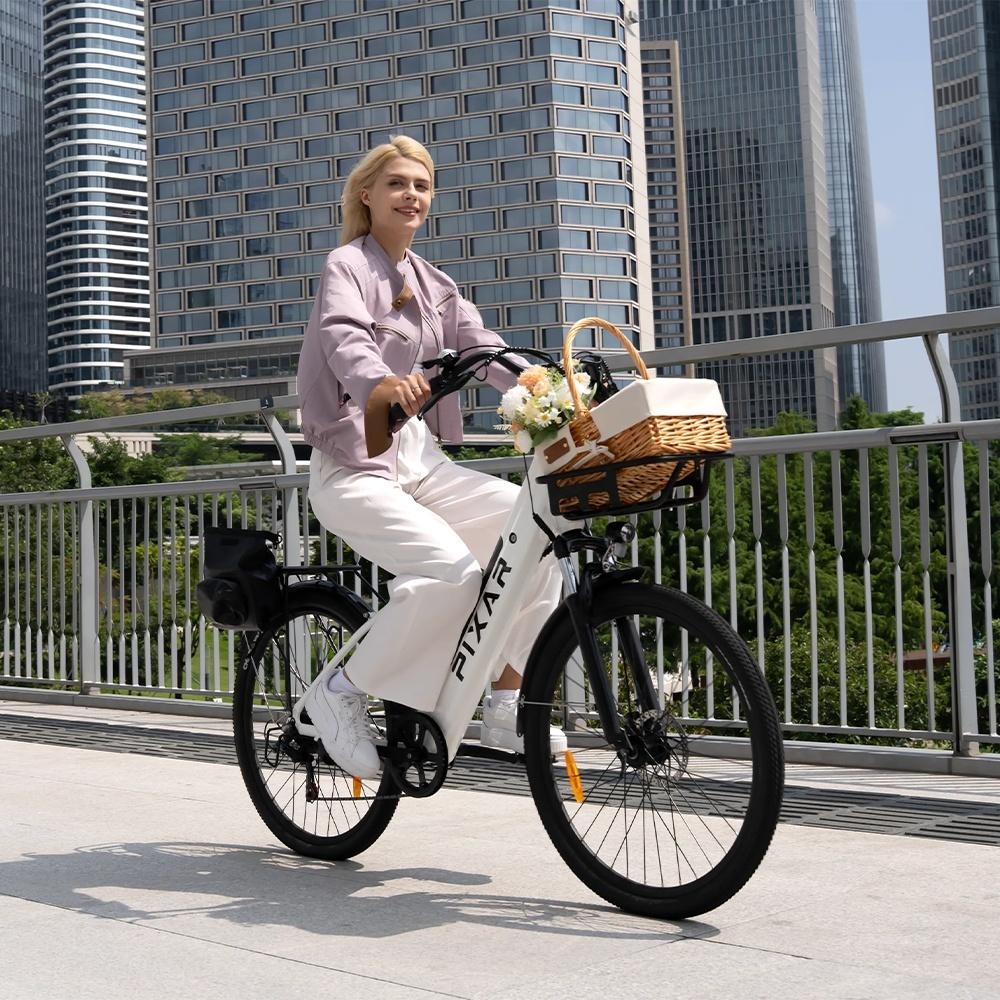
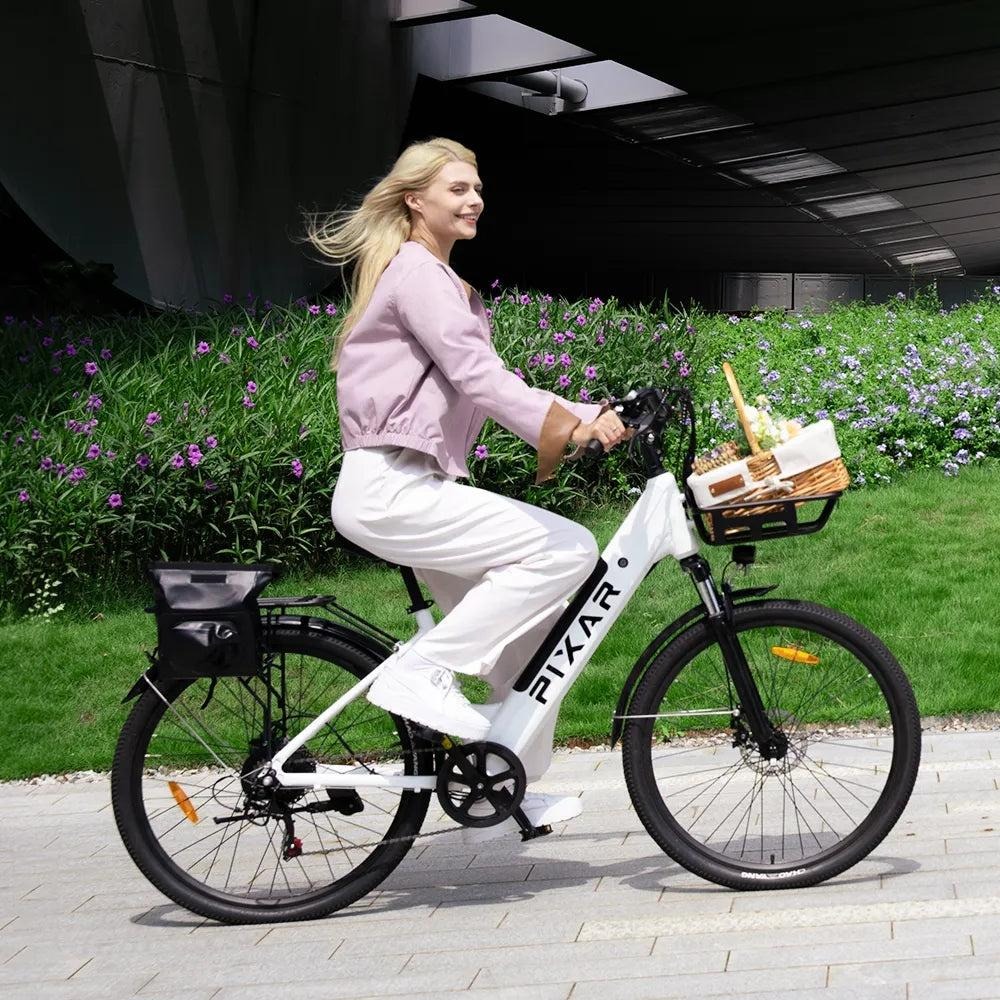
Choosing an upright city ebike engineered with a low-step frame allows riders to dismount smoothly at frequent traffic signals and ride comfortably in everyday office attire without straining the lower back. Step-through and low-crossbar geometries simplify mounting when carrying a loaded child seat or pannier bags over the rear wheel, preventing awkward tilting at curbsides.
Key ergonomic components to consider include:
- Wheel Diameter and Tire Volume: Large 27.5-inch wheels wrapped in 1.95-inch to 2.0-inch tires roll smoothly over tram tracks, expansion joints, and broken asphalt, offering superior momentum conservation compared to ultra-skinny road tires.
- Front Suspension Forks: Coil-spring or hydraulic suspension forks absorb jarring pothole impacts, dampening high-frequency vibrations before they reach hands and forearms.
- Adjustable Stems and Swept-Back Handlebars: Handlebars swept slightly backward promote a neutral wrist position, while tool-free adjustable handlebar stems allow fine-tuning the reach to match varying torso dimensions.
Hydraulic Disc Brakes and Urban Stopping Safety
Stopping distance is the single most vital safety metric on an electric bicycle. Because an electric commuter weighs between 22 and 28 kilograms—and travels at sustained cruising speeds of 25 km/h—its kinetic energy demands substantial, repeatable braking power in all weather conditions.
Hydraulic disc brakes provide definitive safety advantages over traditional rim brakes and mechanical cable-actuated disc systems. By utilizing closed mineral oil fluid lines, hydraulic systems deliver effortless lever modulation and immense clamping pressure at the caliper with light two-finger effort. In wet autumn rain or winter road slush, sealed hydraulic disc systems maintain consistent stopping friction where wet rubber rim pads lose up to 50% of their braking effectiveness.
Essential braking specifications for daily commuters include:
- Steel Rotor Sizing: Commuter bikes should feature at least 160 mm or 180 mm heat-dissipating stainless steel rotors to prevent brake fade on prolonged descents.
- Motor Inhibitor Sensors: Built-in electronic cut-off sensors embedded within the brake levers immediately cut electrical power to the drive motor the instant either lever is squeezed, preventing the motor from driving forward during emergency stops.
- Low-Maintenance Mineral Oil: Systems engineered with mineral oil resist moisture absorption over time, requiring routine bleeding only once every 12 to 18 months under normal commuter usage.
Essential Commuter Ebike Accessories Built for All-Weather Utility
A complete daily commuter must be road-ready straight from the factory. Aftermarket accessory additions frequently lead to loose rattling brackets and cumbersome separate charging cords.
Prioritizing a fully equipped bicycle ensures all-weather practicality on every commute:
- Full-Coverage Metal Fenders: Long fenders with extended mudflaps prevent road grime, puddle spray, and oily street runoff from soaking clothing and splashing the bottom bracket.
- Integrated Battery-Powered Lighting: High-lumen LED front headlights and rear safety taillights wired directly into the main ebike battery turn on via the handlebar display, eliminating the danger of dead USB rechargeable lights on dark evening commutes.
- Sturdy Rear Cargo Rack: An integrated rear rack rated for at least 25 kg accommodates quick-release waterproof panniers, keeping backpacks off sweaty backs and lowering the bike’s center of gravity.
- Puncture-Resistant Tires with Reflective Sidewalls: Commuting tires equipped with reinforced 3 mm to 5 mm puncture-resistant sub-tread belts significantly reduce roadside flats from road glass and debris, while 360-degree reflective sidewall strips ensure visibility to cross traffic.
- Fully Enclosed Chain Guard: A protective chain cover prevents grease marks on work trousers and shields the drivetrain from corrosive road salt and grime.
Commuter Ebike Feature Matrix and Pre-Purchase Inspection
Navigating technical specifications across different price points helps prospective buyers allocate their budget toward hardware that matters most for daily utility.
The following matrix outlines standard hardware configurations across commuter categories:
| Feature Category | Budget Entry Level (€500–€800) | Value Direct-to-Consumer (€800–€1,400) | Premium Urban Commuter (€1,500–€2,800) |
| Drive Motor | 250W generic rear hub motor | 250W branded hub motor (e.g. BAFANG) | 250W mid-drive motor (Bosch / Shimano) |
| Sensor System | Basic 12-magnet cadence sensor | Advanced cadence or integrated torque sensor | Precision dynamic torque sensor |
| Battery Capacity | 360Wh–400Wh unbranded cells | 468Wh–650Wh certified Samsung / LG cells | 500Wh–750Wh fully integrated smart battery |
| Braking Hardware | Mechanical cable disc brakes (160mm) | Dual hydraulic disc brakes (160mm/180mm) | Quad-piston hydraulic disc brakes (180mm) |
| Frame & Drivetrain | Basic alloy frame, generic 7-speed | 6061 low-step alloy, Shimano 7-speed | Hydroformed alloy, internal hub / belt drive |
| Factory Accessories | Partial fenders, battery-operated lights | Full-coverage fenders, integrated lights, rack | Premium integrated lights, rack, built-in lock |
| Expected Lifespan | 2 to 3 years | 5 to 7 years | 7+ years |
Before finalizing an ebike purchase, verify these essential pre-purchase inspection checkpoints:
- Documented CE and EN 15194 Markings: Confirm the bicycle frame and electrical system display official European pedelec compliance labels.
- Local Spare Parts Availability: Check whether the manufacturer stocks replacement battery packs, chargers, display units, and brake pads locally in Europe.
- Warranty and Battery Replacement Terms: Ensure the manufacturer provides at least a comprehensive two-year warranty covering frame, motor, and battery electronics.
- Payload Capacity: Verify the total maximum permissible weight (typically 120 kg to 150 kg) accommodates rider mass plus heavy commuter luggage.
Frequently Asked Questions
How many watt-hours (Wh) do I need for an everyday commuter ebike?
A capacity of 400Wh to 650Wh is ideal for most daily commutes. A 468Wh battery provides a realistic 35 to 50 kilometers of assisted riding across mixed city terrain, while a 648Wh battery delivers 60 to 80 kilometers, allowing multiple days of commuting between charges.
Is a torque sensor necessary for daily urban commuting?
A torque sensor is not mandatory, but it significantly improves ride quality. While a reliable cadence sensor provides steady, predictable power for flat commuting, a torque sensor responds instantly to pedal pressure, making stop-and-go city riding smoother and extending battery range by 15% to 20%.
Can you leave a commuter ebike battery charging overnight at work or home?
Yes, provided the battery is certified and equipped with a smart Battery Management System (BMS). Modern BMS circuits automatically cut off power when cells reach 100% capacity to prevent overcharging. Always use the manufacturer-supplied charger and recharge at normal room temperature.
What is the difference between a city ebike and a regular electric bike?
A dedicated city ebike is designed specifically for paved urban utility, featuring an upright riding posture, a low-step frame for easy mounting, full-coverage fenders, an integrated luggage rack, and smooth pavement-oriented tires. General electric bikes may include aggressive mountain geometries, knobby off-road tires, and lack commuter-specific racks or lighting.
Do commuter ebikes require special maintenance compared to standard bicycles?
Commuter ebikes require standard bicycle maintenance—such as periodic chain lubrication, tire pressure checks, and brake pad inspections—alongside basic battery care. Because ebikes are heavier and travel faster, brake pads and drivetrain chains wear slightly faster and should be inspected every 1,000 to 1,500 kilometers.
Final Words
Investing in an electric bicycle for daily commuting transforms your daily routine by eliminating traffic gridlock, parking stress, and volatile public transit delays. Finding the right machine requires looking past flashy top-speed claims to evaluate the practical components that ensure long-term reliability.
Prioritizing a road-legal 250W motor, a certified high-capacity removable battery, responsive hydraulic disc brakes, and factory-integrated commuter accessories guarantees a safe, comfortable, and cost-effective commute through every season. By choosing a well-engineered commuter built around dependable hardware, you secure a practical vehicle that pays for itself in saved fuel, reduced transit expenses, and daily peace of mind.