




















































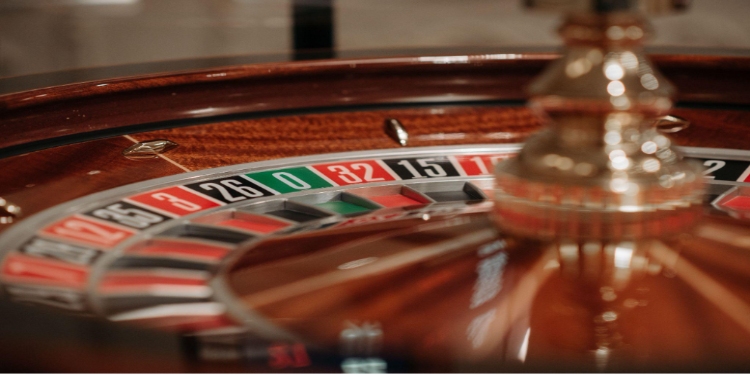
An automatic roulette wheel can be surprisingly hypnotic the first time you watch one on a casino floor: the rotor turns, a real ball races around the rim and the winning number appears on a nearby terminal, yet no dealer ever reaches forward to start the spin. The game looks familiar, but something under the bowl is quietly doing all the work.
From the player’s seat, the experience still feels like ordinary roulette you learnt about at roulette77.co.uk – while the more interesting story begins below the visible surface. Motors, sensors, air lines and electromagnetic actuators work together so smoothly that most players never notice how much engineering is involved.


Automatic Roulette Is Still a Physical Game
The easiest mistake is to assume that an electronic betting screen means the game itself is digital. In automatic physical roulette, the terminal handles the bets, but the result still comes from a real ball falling into a real numbered pocket. That makes it fundamentally different from a conventional RNG roulette game, where software generates the outcome.
| Feature | Dealer Roulette | Automatic Physical Roulette | RNG Roulette |
| Physical wheel | Yes | Yes | Usually no |
| Physical ball | Yes | Yes | No |
| Spin initiated by | Dealer | Mechanical system | Software |
| Winning result | Physical pocket | Physical pocket | RNG calculation |
| Result detection | Dealer and/or sensors | Sensors | Software |
| Typical betting | Chips or terminal | Electronic terminal | Electronic screen |
A Solenoid Is Simpler Than It Sounds
The word solenoid sounds like something pulled from an engineering manual, but the basic idea is straightforward. A coil of wire creates a magnetic field when electrical current passes through it, and that field moves a metal plunger over a short distance. The result is a quick push or pull that can be repeated with very precise timing.
A motor is useful when something needs to keep rotating, while a solenoid is better suited to short bursts of movement. In that sense, a solenoid behaves more like an electric finger than an electric motor. Give it a pulse and it can strike, release, open or close something almost instantly.
What Is Hidden Beneath the Bowl?
There is no single internal layout shared by every automatic roulette wheel. Different manufacturers solve the same problems in different ways, but several components appear again and again. Each has a narrow job, and the system only works when those jobs happen in the right order.
| Component | What it may do |
| Motor | Controls rotor movement |
| Solenoid striker | Gives the ball a mechanical push |
| Solenoid valve | Opens or closes an air line |
| Air jets | Propel or sustain ball movement |
| Optical sensors | Detect rotor and ball position |
| Controller | Times the different components |
| Ball-return mechanism | Prepares the next round |
Most of this activity happens where the player cannot see it. A valve may open for a fraction of a second, a sensor may count the rotor position, and the controller may wait for one signal before triggering the next component. Above the bowl, all the player sees is a ball beginning another lap.
What Happens When the Next Spin Starts?
Automatic wheels do not all follow one universal sequence, but the general logic is easy to understand. One system may use compressed air, another may rely more heavily on mechanical movement, and a third can combine both approaches. What matters is that the machine must finish one physical result before it can reliably begin the next.
A simplified cycle can look like this:
- Sensors confirm where the previous ball has stopped.
- The winning result is sent to the betting terminals.
- The ball is positioned or prepared for another launch.
- The rotor begins or adjusts its movement.
- A striker or air system launches the ball.
- The ball travels around the outer track.
- The driving force ends and the ball starts losing speed.
- Sensors identify the next pocket once the ball settles.
Solenoids Can Play Two Completely Different Roles
This is where the engineering becomes more interesting. A solenoid can be the part that physically moves the ball, or it can simply control the system that provides the force. Those are two very different jobs, even though both rely on the same basic electromagnetic movement.
In a direct-striker setup, activating the solenoid drives a plunger forward and the plunger gives the ball its initial push. In an air-driven setup, the solenoid instead opens a valve so that compressed air can pass through a nozzle. The ball may never touch the solenoid at all.
| System | Role of the solenoid | Force moving the ball | Main idea |
| Direct striker | Moves a plunger | Mechanical impact | Solenoid acts directly |
| Air-jet system | Operates a valve | Compressed air | Solenoid controls airflow |
| Rotor-assisted system | Helps control air stage | Rotor + airflow | Several mechanisms cooperate |
That is why saying “the solenoid spins the ball” is often too simple. In some machines, it is close to the truth, while in others the solenoid merely opens the door for compressed air to do the real work. The same visible spin can therefore come from very different mechanisms underneath.
The Sensors Do the Quietly Clever Work
Launching the ball is only half the problem because the machine also has to understand where it finished. An automatic wheel cannot rely on a croupier leaning over the table and calling the result, so it needs another way to identify both the ball and the rotor. Optical sensing is one common solution.
Different designs can use separate sensing channels to track a reference position, count wheel movement and detect the pocket containing the ball. The controller combines those signals and matches the physical position with the correct number on the betting terminals. What looks like an instant electronic result is actually the final step in a chain of physical observations.
If the solenoid is one of the machine’s muscles, the sensors are its eyes. They turn the movement of a physical object into data that the betting system can understand. Without that layer, the wheel could spin perfectly but the terminals would have no reliable way to know who had won.
Does the Machine Choose the Winning Number?
In a physical automatic roulette wheel, the system does not simply select a winning number and then make the ball land there. It controls the start of the spin – such as launch direction, rotor speed, airflow or timing – but the ball still travels around a real track and settles into a physical pocket.
Once released, the ball loses speed, interacts with the wheel’s deflectors and drops toward the rotating rotor. A European wheel has 37 pockets, while the American version adds 00 for a total of 38 pockets. Automation handles the launch, result detection and reset process, but the final outcome still comes from the physical movement of the ball and wheel rather than from an RNG choosing a number on screen.
Why Casinos Use Automatic Wheels
The practical advantage becomes clearer when you look at the whole installation rather than the wheel alone. One physical wheel can supply results to several betting terminals at the same time, allowing multiple players to follow the same spin from individual screens. The casino gets a physical game without needing a dealer to repeat every manual action between rounds.
Automation also makes the rhythm of the game easier to standardise. Betting windows, launches, result detection and transitions between rounds can follow a consistent programmed sequence. That consistency is useful when one wheel is serving many terminals and every player needs the same result at the same moment.
Not every installation removes the dealer completely. Some systems operate fully automatically, while others keep a croupier involved in parts of the process, such as starting the sequence or managing the betting period. That flexibility is one reason automated roulette appears in several forms instead of one fixed design.

David Prior
David Prior is the editor of Today News, responsible for the overall editorial strategy. He is an NCTJ-qualified journalist with over 20 years’ experience, and is also editor of the award-winning hyperlocal news title Altrincham Today. His LinkedIn profile is here.