



















































A finance director I spoke to last year described the ritual around her company’s quarterly report. Weeks of pulling numbers, reconciling figures, drafting the commentary, then a design pass to make it presentable. It went out to the board, the wider leadership team, and a list of stakeholders who had asked to be kept informed. A week later, in a meeting, someone asked a question the report had answered in full on page nine. She realised then that the document had been received by everyone and read closely by almost no one. The work was sound. The format was where it went to be skimmed.
This is a familiar problem in finance and business reporting. A great deal of effort goes into producing the definitive written record, the quarterly update, the annual review, the investor summary, and then that record is delivered in the one format a busy audience is least likely to finish. The analysis is genuinely useful. The PDF is where it goes to be filed.


Received by everyone, finished by almost no one
A dense financial document asks a senior reader to sit down and work through tables and commentary, and senior readers rarely do. They check the headline figures, look for the number that touches their area, and move on. What gets lost is the reasoning, the part that explains why the quarter went the way it did, which a spoken version could carry in a couple of minutes. Teams do not usually produce that version because it has always been a separate job. A fresh script, a recording, an edit, none of it connected to the report that already holds the substance. So the update ships as a document, and the video sits on a list nobody has time for.
A summary the software builds from the report
The change comes from treating the finished report as the source rather than starting again. You hand over the document, and the drafting happens from what is already on the page.
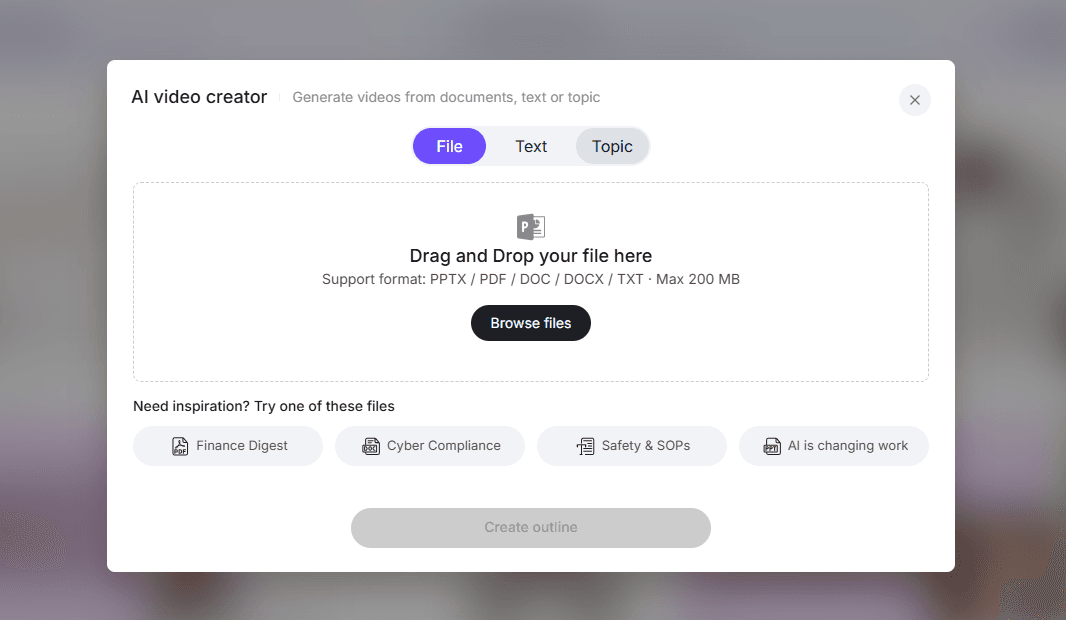
A document to video converter such as Leadde is built for precisely this. You give it a Word file, a PDF, a slide deck, or pasted text, and it reads the report, sets a running order, writes the narration, and assembles the scenes. You choose a narrative style, decide how much detail to keep, and name who the summary is for, so a cut aimed at the board comes out differently from one written for staff or outside stakeholders. Because the input is the report you already produced, the video is a by-product of work you were doing anyway rather than another entry on the calendar.
The markets angle, and the number that tells you it worked
Two things earn their place in a reporting context. A company that operates across several markets can localise a results summary by translating the finished video into another of the 88 supported languages, rather than commissioning a fresh production for every region. And once it is out, the completion rate shows how far people actually watched, which says more about whether the message reached its audience than a distribution list ever could. For a results update, knowing viewers reached the outlook section is worth more than knowing the file was opened.
The uses follow from there. A finance team turns the quarterly update into a five-minute summary leadership watches before the review meeting. An investor-relations function gives shareholders a short version of the annual review they will finish when they would never open the full document. A sustainability team makes an environmental report watchable for the wider workforce instead of hoping people scroll. A regional business puts a market update in front of teams who work in another language.
The limits worth stating plainly
Plain speaking is more credible than polish, which is the whole point of a good report. Generated presenters have improved but still read as slightly synthetic under close attention, so where a named executive’s authority carries the point, a chairman’s statement being the obvious case, put a real person on camera. Precise, data-heavy exhibits, a full set of accounts or a detailed benchmark table, land better as a document to study than a scene to watch past. Anything with figures that need audit or legal sign-off should clear the same checks it would as written work. And a video can only be as clear as the report behind it. Muddled analysis produces a muddled summary, so the thinking still does the real work.
One report, one reporting cycle, one test
There is no need to convert a whole reporting cycle at once. Take the single report with the widest gap between how many people receive it and how many actually read it, generate a short summary from that one document on a free tier, and send it alongside the usual PDF. Then watch engagement across one reporting cycle. If the watchable version measurably widens how far your message travels, it is worth building into every major update, and the report everyone receives stops being the report almost nobody reads.