





















































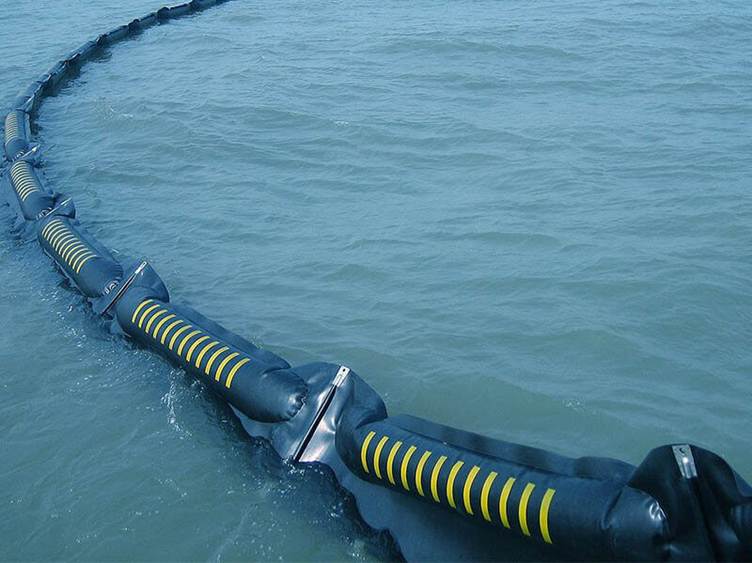
Oil spills can have large negative effects on both ecosystems and the economy. Speed is of the essence to contain damages as much as possible. One tool to help contain oil spills is called an oil containment boom.
Oil containment booms are barriers used to control the movement of oil spills. They guide oil spills toward recovery locations.


One of the major advantages of including an OceanClean Oil Containment Booms in a spill response plan is the ability to quickly contain spills and direct them towards recovery.
An oil containment boom is a floating barrier designed to control the movement of oil and other hydrocarbons on the surface of water.
The primary barrier is made up of a floating portion and a skirt. The skirt provides a barrier to oil spills below the boom. Many designs incorporate weighted components or ballast. This helps offset the buoyancy of the boom and stabilize it in the water.
Oil containment booms can be used in many settings. Some of these include:
- ports
- yards
- industrial facilities
- harbors
- rivers
- lakes
- offshore
- other waterways
Oil spills are massive and difficult to control. Oil Containment Booms are designed to slow down the spreading of oil, as well as concentrate it in a smaller area. This makes the recovery process easier.
Why Are Oil Containment Booms Important?
When oil spreads on water, it becomes nearly impossible to recover it and clean it up. There is also the worrying factor of the oil spreading to sensitive areas like wetlands or shores.
An oil containment boom will help create a physical barrier where the spill will remain contained.
Oil containment booms can help deploy a barrier around a leaking vessel or equipment that has been damaged. They can also be deployed around drains or water intakes of sensitive areas.
A containment boom will help control the situation and lessen the impact of a spill while making the recovery process easier.
1. Permanent Oil Containment Booms
These booms are made for constant containment. They are usually deployed at sites where the threat of an oil spill is imminent.
These booms can be found around the loading docks of a facility. They can also be found along a port or terminal where fuel is handled.
Because these booms are designed to be left out for prolonged periods of time, they are strong and durable.
Permanent booms can help lessen the threat of an oil spill without having to deploy booms for emergencies.
However, these booms do require constant maintenance to make sure they contain the oil.
2. Temporary Oil Containment Booms
Temporary booms are made for short intervals when the threat is unexpected. They are used during emergency responses to the threat of spills.
They can be stored. This allows organizations with emergency response plans to keep them on-site and ready to deploy.
When compared to permanent booms, temporary booms are typically lighter and therefore easier to transport and deploy.
They also have a range of applications. They can deploy after a ship collision or accidental fuel spill.
Their biggest strength may be their ability to be moved. Booms can be repositioned as the location of the spill changes.
Rather than being rigid and inflexible, booms can inflate and deflate and collapse for easy storage and transport.
This design makes them an excellent solution for areas with space constraints.
They can deploy quickly and be used for larger spill response operations.
They have good stability in changing water conditions, but they do require an air provide and must be checked for air leaks and damage.
If a boom has not been properly inflated, performance may not meet expectation.
They cannot deploy easily. Unlike inflatable booms, these booms do not require inflation before deployment.
They are constructed with flexible flotation chambers and can be used in calm water and in some more challenging conditions.
Reliability and easy of use make these booms desirable. They also can be stored ready for rapid deployment.
5. Solid Flotation Booms
Solid flotation booms consist of booms with fixed flotation materials instead of inflatable chambers.
They also are capable of being easily deployed. Further, their construction provides durability.
These booms are highly effective in calm water. They also can be built for difficult conditions.
The correct solid flotation boom will always depend on water conditions and spill probability.
6. Fence Booms
Fence booms have flat skirts that go below the water.
These booms are also lightweight and easy to handle. Thus, they are ideal for quick response operations.
Fence booms are best for calm waters. Strong currents, however, can soon render them useless.
They can be used in coastal areas as well as lakes and ponds, rivers and harbors.
Their design gives them utility for most spill response operations.
7. Curtain Booms
Curtain booms have a deeper skirt than most fence boom designs.
The deeper skirt can contain oil movement under the boom.
Curtain booms are offered in a range of sizes. The correct skirt depth is determined by water depth and conditions.
They find utility in marine spill response. They also provide utility for industrial and coastal spill response.
Skirts get longer, the drag increases if you are in fast flowing water. So some thought is necessary when choosing the length of your skirts.
8. Oil containment booms that are fire resistant
There are some types of oil spillage where there is a fire risk.Type of boom material used in those circumstances may become ineffective.
Fire resistant oil containment booms function up to 200 degrees C. They can be deployed in situations where burning oil is present or in periods of expected thermal exposure.
They are most commonly utilized in specialized marine response operations.
They are well suited to contain spilled oil in order to enable deliberate burning, or remediation of other kinds. Fire related spill response operations will however, need specialized planning and personnel.
How to Select a Boom for Containing Oil
The type of location is the first consideration. A boom used in a still pond will be totally inadequate in open coastal waters.
Next, the state of the water is important; perform a consideration of currents, tides, waves and winds.
Light petroleum products will behave in a totally different manner to heavy oil.
From the standpoint of storage and deployment, the emergency response team requires equipment which can be deployed quickly without undue complications.
Durability is a critical factor. Often a boom which is used a number of times requires a stronger construction than one which is designed for infrequent emergency use.
Organisations interested in specialized equipment can [click here] to explore some suitable spill containment solutions. Businesses considering marine protection equipment for which reliable oil containment is crucial can look at OceanClean Oil Containment Booms.
Deployment of the Oil Boom Matters
Effective spill response hinges on more than the purchase of the right boom.
Deployment of booms also matters.
If deployment is not done properly, it can lead to oil escaping between or around booms. Oil that is collected by booms can also be dislodge by strong currents.
Before emergencies, staff should learn the deployment principles of the equipment. After training and exercising, it is imperative that the equipment is inspected.
Maintenance and Storage of Oil Containment Booms
Regular maintenance of oil containment booms helps increase the length of time they can be used.
Regular checks should be done to determine if the boom has been compromised. This can be determined by looking for:
- damaged connectors
- worn ropes
- holes or tears
Leakage checks should be performed on inflatable systems. Mechanical systems should also be checked.
Booms should be cleaned according to instructions provided by the manufacturer, be dried, and stored properly.
Poor storage practices will damage equipment over a period of time and reduce their effectiveness.
Additional Considerations to Oil Containment Booms
Oil containment booms are a cornerstone of most spill response plans. They control the spread of oil into areas impacted by spills.
There are a multitude of booms from which to choose. Booms can be:
- permanent or temporary
- inflatable, foam-filled, or constructed from fire retardant materials
- fencing booms or curtains
The many trade-offs in the use of boom types, including deployment time and construction relative to the duration of boom deployment, must be considered along with the type of oil and the nature of the current, water, and boom storage.
An oil spill response plan should include many aspects, not just the equipment. You need to consider:
- staff training
- equipment inspections
- deployment
- maintenance
If an organization has appropriate equipment and planning, it can respond better to spills and reduce the probability of more extensive environmental damage and costly cleanup operations.