



















































For UK and European merchants, the United States can look like the most logical next market.
The audience is large. The language barrier is often lower than in other regions. Customers are used to buying online, paying for subscriptions, booking services digitally and purchasing specialist products from international brands.


The opportunity is real. The US Census Bureau estimated that US retail eCommerce sales reached approximately $326.7 billion in the first quarter of 2026, adjusted for seasonal variation.
But entering the US market is not only a sales decision. For many online businesses, it is also a payment-readiness challenge.
This is especially true for higher-risk and higher-scrutiny merchants. CBD, hemp, nutra, medical cannabis, dating, subscription platforms, travel, digital goods, fintech and other online models may be commercially legitimate, but they often face more detailed review from payment partners.
A UK or European merchant may already have a working payment setup at home. That does not automatically mean the business is ready for US payment processing.
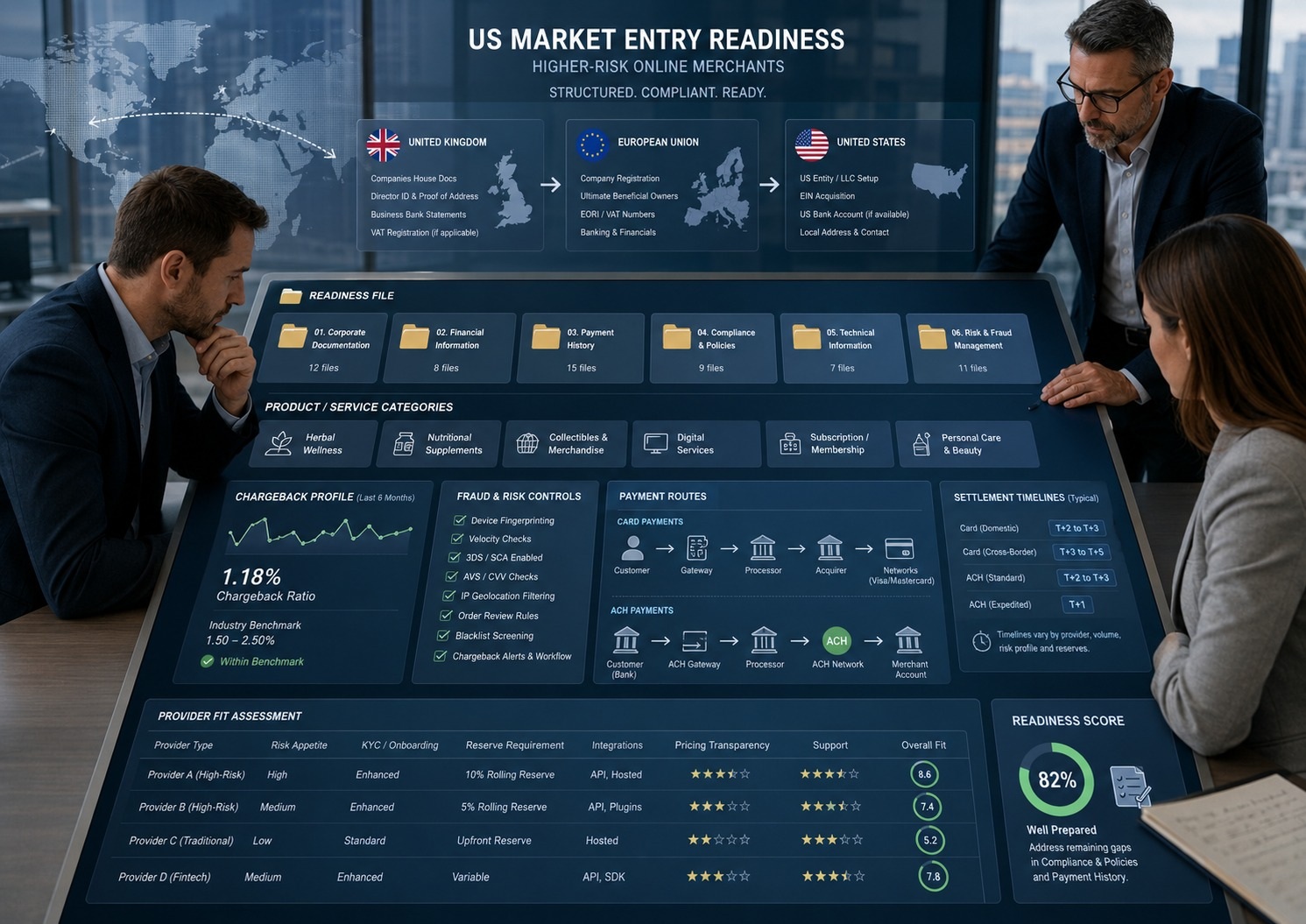
Before applying, merchants should prepare a structured readiness file.
What is a US payment processing readiness file?
A US payment processing readiness file is a practical package of information that explains the merchant’s business model before a payment partner has to ask for it.
It is not just a folder of company documents.
It should show what the business sells, who the customers are, how payments are taken, how refunds are handled, how disputes are managed, how fraud is monitored, what documentation supports the product category and which payment routes the merchant needs.
For higher-risk merchants, this file can make the difference between a confused onboarding process and a more credible provider discussion.
Payment partners want to understand risk. A readiness file helps the merchant explain risk before assumptions are made.
Why US payment partners ask different questions
US payment processing can involve different expectations from UK or European setups.
A merchant may need to explain whether it needs card processing, ACH, pay-by-bank options, recurring billing support, marketplace payouts, domestic settlement, cross-border acquiring or backup payment routes.
ACH is especially important because it is a major part of US payments infrastructure. Nacha reported that the ACH Network processed 35.2 billion payments in 2025 with a total value of $93 trillion. Same Day ACH volume reached 1.4 billion payments worth $3.9 trillion.
For some merchants, ACH or bank-based payments may be relevant for subscriptions, B2B collections, invoice payments, memberships, high-value transactions or account-based relationships. For others, cards remain the main rail.
The point is not that every merchant needs every payment method. The point is that US payment planning should be based on the operating model, not guesswork.
The product and sector evidence section
The first part of the readiness file should explain what the business actually sells.
This sounds simple, but it is often where higher-risk applications become unclear.
A wellness brand may use broad product language. A nutra merchant may make claims that create review questions. A CBD or hemp business may operate in a category where product details, claims, ingredients, lab reports, market coverage and refund policies all matter. A medical cannabis-related business may face even more scrutiny around licensing context, permitted activity, product geography and provider appetite.
The US Food and Drug Administration maintains public information on the regulation of cannabis and cannabis-derived products, including CBD. This does not mean every payment partner applies the same rulebook, but it does show why cannabis-related and CBD-related businesses need clear documentation.
Dating and relationship-focused subscription platforms also need careful explanation. The issue is not only the category. It is the billing model, customer communication, cancellation flow, recurring billing terms, descriptors and support process.
Travel, booking, digital goods and fintech businesses may face different questions. These can include delayed fulfilment, refund exposure, digital delivery evidence, chargeback handling, client verification, payout structure or licensing context.
A useful product and sector section should include:
- product or service description;
- target customer profile;
- restricted or regulated product categories;
- product documentation where relevant;
- claims review for wellness, CBD, hemp, nutra or medical cannabis activity;
- subscription terms where applicable;
- refund and cancellation policy;
- fulfilment or delivery timeline;
- customer-support details.
The goal is not to hide complexity. The goal is to explain it clearly.
The website and disclosure section
A US payment partner will usually review the merchant’s website or customer-facing sales flow.
For higher-risk merchants, the website should not create avoidable ambiguity.
Customers should be able to understand what they are buying, who is charging them, when payment is taken, how recurring billing works, how cancellation works, how refunds work and how to contact support.
This is especially important for subscription, dating, digital goods, travel and wellness businesses. Many disputes begin not because the product is fraudulent, but because the customer does not recognise the charge, cannot cancel easily, does not understand the renewal, cannot access the service or is unclear about the refund process.
The readiness file should therefore include screenshots or links showing:
- checkout flow;
- pricing page;
- subscription terms;
- cancellation instructions;
- refund policy;
- privacy policy;
- terms and conditions;
- customer-support contact points;
- billing descriptor explanation;
- fulfilment or access instructions.
A payment partner should not have to guess how the customer journey works.
The fraud and chargeback section
Chargebacks are not just a cost. They are a signal.
Visa’s Visa Acquirer Monitoring Program fact sheet explains that Visa monitors fraud, dispute and enumeration levels and identifies acquirers or merchants that exceed programme thresholds.
For higher-risk merchants entering the US, this makes chargeback planning part of market-entry preparation.
A readiness file should include historical dispute data where available. If the merchant has already processed in the UK or Europe, it should prepare information about chargeback ratios, fraud levels, refund rates, dispute reasons and steps taken to reduce avoidable claims.
If the merchant is new to the US, it should still explain its prevention process.
This may include:
- fraud-screening tools;
- manual review rules;
- velocity checks;
- customer verification;
- refund-before-dispute process;
- chargeback alert workflows;
- representment evidence;
- subscription reminder logic;
- delivery confirmation;
- customer-support escalation;
- monitoring after launch.
For CBD, hemp, nutra and medical cannabis merchants, disputes may relate to claims, delivery, customer expectations or refund requests. For dating and subscription platforms, disputes may relate to recurring billing, cancellation, descriptors or customer dissatisfaction. For travel and booking businesses, disputes may relate to cancellations, delayed services or documentation. For digital goods, disputes may relate to access, delivery evidence or customer recognition.
A payment partner will want to see that the merchant understands these patterns.
The settlement and reserve section
Many merchants focus on approval first and settlement later. That is a mistake.
Settlement timing, reserve requirements, rolling reserves, payout frequency and funding currency can materially affect cash flow.
This is particularly important for merchants with delayed fulfilment, high refund exposure, seasonal demand, subscription rebills, travel bookings, pre-orders, cross-border sales or larger transaction values.
The readiness file should explain:
- expected monthly processing volume;
- average transaction value;
- refund rate;
- settlement currency;
- payout timing expectations;
- reserve tolerance;
- refund funding process;
- expected chargeback exposure;
- whether ACH or card rails are required;
- whether backup processing is needed.
A reserve is not always avoidable in higher-risk sectors. But merchants should understand the likely cash-flow effect before scaling US marketing.
The ACH and bank-payment section
Some UK and European merchants enter the US thinking only about card processing. That can be too narrow.
ACH and bank-based payments may matter for B2B services, SaaS subscriptions, memberships, invoice payments, online education, logistics, professional services and larger customer accounts.
But ACH is not a shortcut around risk.
Nacha’s 2026 risk-management updates introduced new fraud-monitoring requirements for certain ACH participants and originators. Nacha describes these rules as part of risk-based processes for identifying ACH entries initiated due to fraud.
For merchants, this means ACH should be treated as a controlled payment rail.
The readiness file should explain:
- why ACH is needed;
- which customer types will use it;
- how authorisation is captured;
- how bank-account ownership is verified;
- how failed payments are handled;
- how returns and refunds are processed;
- how reconciliation works;
- what fraud controls apply.
A merchant should be able to explain when card payments are appropriate and when bank-based payments are more suitable.
The customer geography and US-entry section
US payment partners may ask where the merchant expects customers to come from.
For higher-risk sectors, geography can matter. Medical cannabis, hemp-derived products, CBD activity, financial services, travel services and certain digital models may be reviewed differently depending on product rules, customer location or licensing context.
A readiness file should not simply say “United States.”
It should explain:
- whether the merchant is testing or scaling;
- expected US customer states or regions;
- traffic sources;
- advertising channels;
- expected launch volume;
- planned growth curve;
- customer-support hours;
- refund and fulfilment arrangements;
- whether US-specific policies are in place.
A merchant that plans to launch paid advertising into the US without payment-readiness preparation may create risk before the provider relationship is stable.
The provider-fit matrix
Not every payment provider is right for every merchant.
Some providers work well for standard eCommerce. Others understand higher-risk categories, subscription billing, ACH, marketplace flows, fintech, travel, digital goods, wellness or international merchants entering the US.
A readiness file should include a provider-fit matrix. This does not have to name every provider. It should define what kind of payment support the merchant needs.
For example:
- card acquiring;
- ACH or bank payments;
- recurring billing;
- subscription management;
- chargeback alerts;
- fraud monitoring;
- multi-currency support;
- US settlement;
- backup processing;
- reporting and reconciliation;
- higher-risk underwriting experience;
- support for the merchant’s sector.
This helps the merchant avoid applying to unsuitable providers and then treating rejection as a surprise.
Why the file should be prepared before applying
Many merchants prepare documents only after a payment partner asks for them. That creates delays and weakens the presentation of the business.
A better approach is to prepare the readiness file before outreach.
This allows the merchant to:
- identify gaps early;
- correct website disclosure problems;
- review refund and cancellation policies;
- prepare product documentation;
- understand chargeback exposure;
- clarify settlement needs;
- decide whether ACH is relevant;
- match the business to appropriate payment partners;
- avoid wasting time with unsuitable providers.
For higher-risk merchants, preparation is not bureaucracy. It is part of risk communication.
A merchant that can explain its model clearly is easier to assess.
How WiseAlt supports US payment readiness
For UK, European and international merchants entering the American market, payment readiness should begin before the application.
WiseAlt helps merchants prepare US payment processing readiness for higher-risk merchants by reviewing provider suitability, documentation gaps, payment route needs, fraud exposure, chargeback controls, settlement questions and onboarding preparation.
This can be relevant for CBD, hemp, nutra, medical cannabis, dating, subscriptions, travel, digital goods, fintech and other higher-scrutiny online business models preparing for US expansion.
WiseAlt is not a PSP, acquiring bank, payment gateway, card processor, money transmitter, law firm or approval guarantor. Its role is to help merchants prepare their payment setup and coordinate discussions with relevant payment-solution partners where appropriate.
Final checklist: what should be in the readiness file?
Before applying for US payment processing, higher-risk merchants should prepare:
- company and ownership documents;
- business model explanation;
- product or service description;
- target US customer profile;
- expected processing volume;
- average transaction value;
- current processing history;
- refund and cancellation policies;
- subscription terms where relevant;
- product documentation for CBD, hemp, nutra or medical cannabis activity;
- claims review where relevant;
- licensing context where relevant;
- customer-support process;
- checkout screenshots;
- billing descriptor details;
- fraud controls;
- chargeback history;
- dispute evidence process;
- settlement requirements;
- ACH or bank-payment needs;
- provider-fit requirements;
- backup payment options.
The file should be clear, consistent and realistic.
Final operating principle
US payment processing is not only an application form.
For higher-risk UK and European merchants, it is a test of whether the business model can be explained clearly to payment partners. The merchant must show what it sells, who it serves, how payments work, how disputes are controlled, how refunds are handled and what payment routes are needed for the US market.
A strong readiness file does not guarantee approval. But it can reduce confusion, improve provider-fit discussions and help merchants enter the US with fewer avoidable payment problems.
For higher-risk merchants, the question is not only “Which provider should we use?”
The better question is: “Are we ready to show the model?”