



















































An AI agent is a software system that uses a large language model to plan, reason, and act autonomously to complete multi-step tasks.
Unlike a standard LLM that responds to a single prompt, an agent operates in a loop: it receives a goal, breaks it down, calls tools, stores results in memory, and repeats until the task is done. Four components make this possible: the LLM core, memory, tools, and the planner.


In this guide, we’ll break down each component, how they interact, and what the architecture looks like in production systems today.
TL;DR:
- AI agents use an LLM core to reason, a planner to sequence steps, memory to retain context, and tools to act on external systems
- Three planning approaches dominate in 2026: ReAct, Plan-Execute, and hierarchical planning
- MCP and A2A are the two standard protocols connecting agents to tools and to each other
- As agents reshape how content gets retrieved, Backlinko’s AI visibility checking tool helps teams track how their content performs inside these systems
What Is AI Agent Architecture?
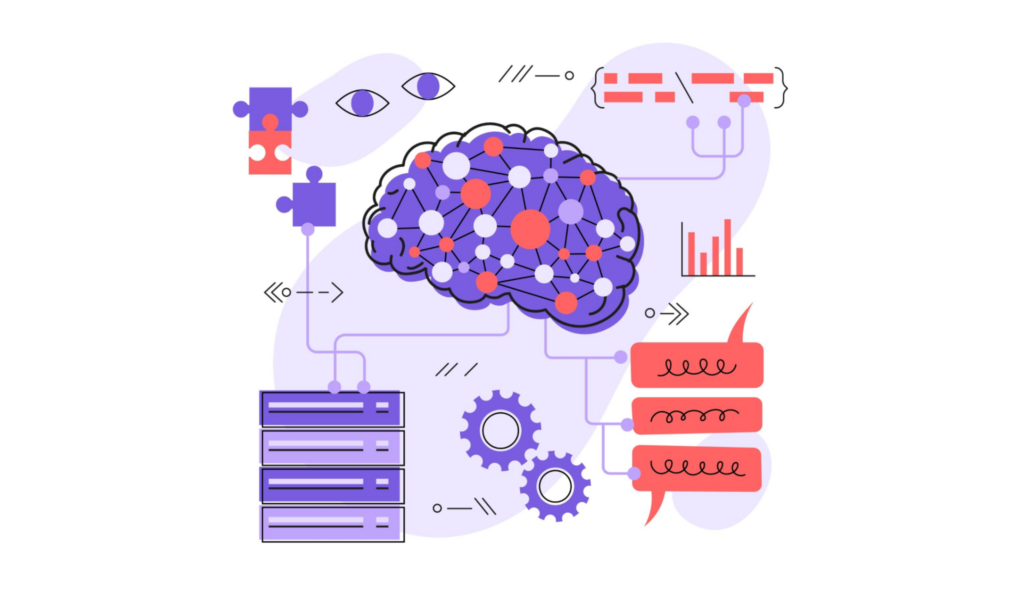
AI agent architecture is the structural design of an autonomous AI system. It defines how the system perceives inputs, makes decisions, stores information, and executes actions to complete a goal. The architecture connects four components into a working loop rather than a single prompt and response exchange.
Each component handles a specific function:
- LLM core — processes language, reasons about the task, and decides what to do next
- Memory — stores context from current and past sessions
- Tools — connect the agent to external systems, APIs, and data sources
- Planner — breaks goals into ordered steps and adjusts when something changes
As agents become embedded in more software, understanding how they work also matters for content visibility. Backlinko’s AI visibility checking tool helps teams track whether their content gets picked up and cited by these systems.
1. The LLM Core
The LLM core is the reasoning engine of an AI agent. It receives a goal, interprets the input, and decides what action to take next. Models like GPT-4 and Claude process natural language instructions and generate structured outputs that the rest of the agent system acts on.
The core does not store memory or call tools directly. It delegates those tasks to other components based on what the current reasoning step requires.
A practical example: a user asks an agent to compare Carfax alternatives like Zilocar for a used car purchase. The LLM core interprets the request, identifies what data it needs, then routes the task to the planner and tool layer to retrieve and compare vehicle history records from the relevant sources.
The quality of reasoning at this layer sets the ceiling for everything the agent can do.
2. Memory Types and How Agents Use Them
Memory controls what information an agent can access during and between tasks. Without it, every session starts from zero with no context from previous interactions.
Agents use three distinct memory types:
- Short-term memory — holds the current conversation and task context within a single session
- Episodic memory — logs specific past events, actions taken, and their outcomes across steps
- Long-term memory — stores persistent knowledge retrieved via vector search or knowledge graphs across sessions
The agent writes to and reads from these layers dynamically as the task progresses. Vector databases like Pinecone and Weaviate handle long-term retrieval, while the active context window manages short-term state.
In 2026, memory is benchmarked and tested independently as a core architectural component, not treated as an afterthought.
Source: Magnific
3. Tools and How Agents Act on the World
Tools are the interfaces that connect an agent to external systems. Without them, an agent can only generate text. With them, it can query databases, call APIs, browse the web, execute code, and retrieve real-time data.
Agents access tools through two main protocols:
- MCP (Model Context Protocol) — standardizes how an agent connects to external tools and data sources
- A2A (Agent-to-Agent) — enables multiple agents to discover each other, delegate tasks, and collaborate
The planner decides which tool to call and when. The LLM core interprets the result and continues reasoning.
In production systems, tool reliability and latency directly affect overall agent performance. A well-designed tool layer handles failures, retries, and timeouts without interrupting the reasoning loop.
4. The Planner
The planner breaks a high-level goal into ordered, executable steps. It sits between the LLM core and the tool layer, deciding what to do next, in what sequence, and when to revise the plan based on new information.
Three planning approaches are used in production systems:
- ReAct (Reason + Act) — alternates between reasoning steps and tool calls in a dynamic loop, best for unpredictable tasks
- Plan-Execute — generates a full plan upfront then executes it sequentially, best for stable, structured tasks and reduces token usage by up to 30%
- Hierarchical planning — splits complex goals into a tree of sub-tasks, sometimes delegated to specialized sub-agents
Dynamic planning outperforms static planning in most real-world scenarios because tasks rarely unfold exactly as anticipated. The planner adjusts mid-execution when a tool returns unexpected results or a step fails.
Final Thoughts
AI agent architecture is a system of four components working together: the LLM core reasons about the task, memory preserves context across steps, tools connect the agent to external systems, and the planner sequences everything into executable actions.
No single component works in isolation. A well-designed architecture balances all four:
- LLM core — sets the ceiling for reasoning quality
- Memory — determines how much context the agent retains
- Tools — define what the agent can actually do
- Planner — controls how reliably the agent reaches the goal
In 2026, agent systems handle multi-hour autonomous workflows across enterprise environments. Understanding how each layer functions is the foundation for building, evaluating, or working alongside these systems effectively.
FAQs
What is the difference between an LLM and an AI agent?
An LLM is a language model that responds to a single prompt in isolation. An AI agent wraps an LLM with memory, tools, and a planner, enabling it to pursue multi-step goals autonomously. The LLM handles reasoning; the agent architecture handles everything else.
What programming frameworks support AI agent development?
LangChain, LlamaIndex, and AutoGen are the most widely adopted frameworks for building LLM-based agents. They provide modular components for memory, tool integration, and planning out of the box. CrewAI and LangGraph support multi-agent orchestration specifically.
How does agent memory differ from a standard context window?
A context window holds only the current session’s input and output within a token limit. Agent memory extends this with episodic logs, vector databases, and knowledge graphs that persist across sessions. Systems like Mem0 and Letta manage this retrieval dynamically during task execution.
What tools can an AI agent use?
Agents access web search, code execution environments, REST APIs, SQL and vector databases, file systems, and external services like calendar or CRM platforms. The Model Context Protocol standardizes how agents discover and call these tools through a consistent interface.
What is the ReAct pattern in AI agents?
ReAct stands for Reason and Act. The agent alternates between writing a reasoning step and executing a tool call, then observes the result before continuing. This loop makes agent decisions transparent and debuggable at every step.
How do multi-agent systems work?
Multi-agent systems split complex tasks across specialized agents that communicate using the Agent-to-Agent protocol. One agent acts as an orchestrator, delegating sub-tasks to worker agents based on their declared capabilities. Each agent publishes an Agent Card that describes what it can do and how to reach it.

David Prior
David Prior is the editor of Today News, responsible for the overall editorial strategy. He is an NCTJ-qualified journalist with over 20 years’ experience, and is also editor of the award-winning hyperlocal news title Altrincham Today. His LinkedIn profile is here.