




















































A business owner in Johor Bahru once told me, “My competitor has 400 backlinks. I just want 401.” It sounds logical. It’s also the quickest way to waste a budget.
So, how many backlinks do you need to rank in Malaysia? There’s no fixed number, and anyone who quotes you one without looking at your keyword and your competitors is guessing. What you can do is measure the gap between your page and the pages already ranking, then close it with the right kind of links.


How Many Backlinks Do You Need to Rank in Malaysia?
There’s no universal number. The amount depends on how competitive your keyword is, how much authority your site already has, and the quality of the links your competitors hold. A niche local search may need only a handful of relevant links, while competitive sectors like finance or insurance usually need far more.
The useful question isn’t “how many?” It’s “how many compared with who’s already on page one?”
Why There’s No Magic Number
Google ranks pages, not link counts. Backlinks are one signal alongside content quality, search intent match, site speed and overall trust. A page with 15 links from relevant, respected sites can outrank a page with 150 links from random blogs and directories.
That’s why quality, relevance and context matter more than the raw total. A link from a respected Malaysian industry publication, sitting naturally inside a useful article, says something real about your business. A link from a page with no readers and no topic connection says almost nothing.
What Changes the Number
Different situations call for very different link volumes. Here’s how the main factors shift things:
| Factor | Needs fewer links | Needs more links |
| Keyword competition | Niche, long-tail or local terms | Broad national terms |
| Your site’s authority | Established site with existing mentions | New domain with no history |
| Competitor link profiles | Few referring domains | Many strong, relevant ones |
| Content and intent match | Your page answers the query better | Your page is thin or off-target |
| Type of search | Local results (“near me” style) | National organic results |
If you’re a new site chasing a competitive keyword, expect a longer road. If you’re an established business going after a specific service phrase in one city, the gap may be much smaller than you fear.
How to Estimate Your Own Target
Here’s a simple process you can run in an afternoon.
- Search your target keyword on Google Malaysia and note the top five ranking pages.
- Check referring domains for each page (not just the domain as a whole) using a backlink tool such as Ahrefs or Semrush. Referring domains, meaning unique websites linking to the page, tell you more than total link counts.
- Filter out the junk. Throw away spammy directories, scraped pages and obviously bought links. They won’t be what’s holding those pages up.
- Compare with your page. Your gap is the difference between your referring domains and what the top results have, adjusted for link quality.
- Check why they rank. Sometimes a page ranks mainly on brand strength or excellent content, with few links. In that case, improving your content may matter more than chasing links.
Treat the result as a working target, not a promise. Revisit it every few months as competitors add links too.
Malaysia-Specific Factors
Ranking locally comes with quirks that general global advice tends to skip.
- The pool of relevant sites is smaller. There are fewer Malaysian publications, blogs and industry sites to earn links from than in the US or UK, so each good local link carries real weight.
- Language matters. Malaysian audiences search in English, Bahasa Malaysia and Chinese. Links from sites in the same language as your audience tend to be more relevant than a random overseas mention.
- Regional links can help, if relevant. A link from a respected Singapore or Southeast Asian site in your industry still makes sense. Relevance beats geography, but local ties help.
- Local services have extra signals. If you serve customers in a specific city, your Google Business Profile, consistent business listings and local citations work alongside your backlinks.
Quality Beats Quantity: What a Good Link Looks Like
When you’re reviewing a potential link, ask:
- Does the site cover a topic related to yours?
- Does it have real readers, not just a domain name?
- Is the link placed naturally inside useful content?
- Does the linking page sit on a site you’d be comfortable being associated with?
And what to stay away from: private blog networks, link farms, mass-bought packages and anything promising hundreds of links for a small fee. Google’s spam policies treat buying or exchanging links to manipulate rankings as a violation. The short-term gain isn’t worth the risk of a manual action or a quiet loss of rankings.
A client’s backlink total can help explain an audit, but it should not become a universal buying target.
Rankpage Case Study: How Rankpage Gave Listing.my Clearer Pages to Rank
Rankpage mapped Listing.my’s topics to directory categories and guides, wrote clear titles and headings, and linked supporting content to relevant categories. The team reviewed category and guide performance separately when deciding what to improve.
This gave the site a page-by-page strategy, rather than a single backlink target. It also made incoming visitors easier to serve: a category supports browsing, while a guide answers a more specific question.
Ahrefs recorded the marketing category at position 4 for “digital marketing malaysia” on 27 September 2026. The separate referring-domain export contained 950 rows, including 125 with a dofollow link. Those figures describe the site; they are not a quota another business must reach.
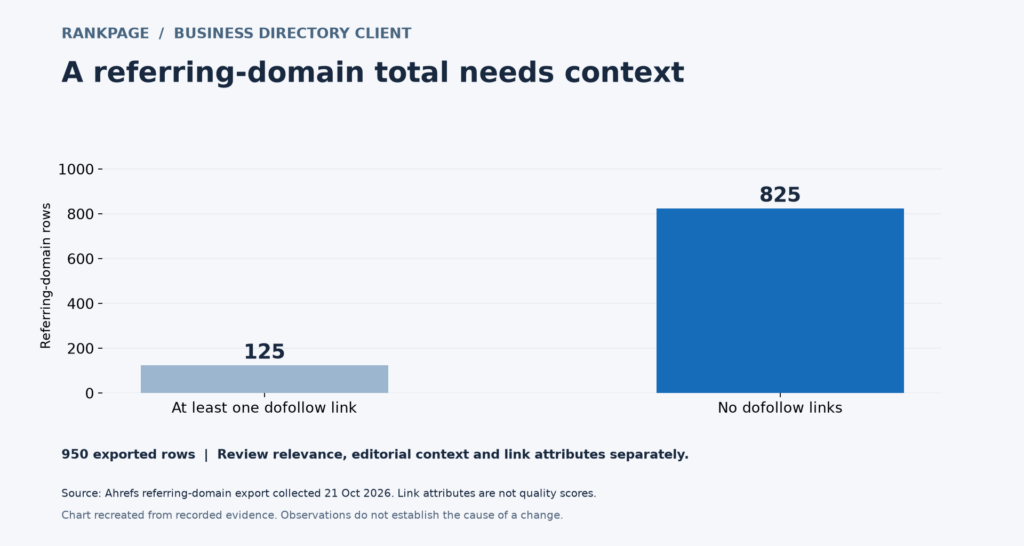
Figure: Referring-domain rows grouped by whether the export records at least one dofollow link.
Source: Rankpage client evidence: Ahrefs referring-domain and organic-keyword exports collected 21 October 2026; ranking observation dated 27 September.
Practical Ways to Earn Backlinks
You don’t need exotic tactics. These approaches are reliable:
- Guest articles on relevant industry sites where you add something readers can use.
- Digital PR and brand mentions, such as expert comments, company news or original findings that journalists may reference.
- Niche edits, where your link is added to an existing, relevant article that already has traffic.
- Linkable assets, like original research, calculators, templates or guides people want to cite.
- Local citations in trusted business directories.
- Reclaiming unlinked mentions when someone has already named your brand without linking.
Doing this well takes time. You’ll need to audit what you already have, study competitors, pitch editors and follow up. If you don’t have the capacity, working with a specialist team that offers link building can cover the backlink audit, competitor analysis and placements, while you focus on running the business.
How Long Until You See Results?
Not overnight. Search engines need to find the new links, evaluate them and factor them in alongside everything else on your site. Most campaigns take a few months to show clear movement, and competitive keywords take longer. Be wary of anyone promising page-one rankings within weeks.
Common Mistakes to Avoid
- Chasing totals. Ten relevant links beat a hundred irrelevant ones.
- Sending every link to the homepage. If you want a service page to rank, that page needs links too.
- Using the same anchor text every time. Natural link profiles vary: brand names, plain URLs, descriptive phrases.
- Ignoring content. Links can’t rescue a page that doesn’t answer what people are searching for.
- Buying cheap bulk packages. If it sounds too good to be true, expect trouble later.
FAQ
How many backlinks do I need to get on page one in Malaysia?
It depends on your keyword. Check the referring domains of the pages currently ranking and use that as your benchmark. Some local searches need only a few links, while competitive national terms need many more.
Are 10 backlinks enough to rank?
Sometimes, for low-competition or local keywords, especially when the links are relevant and your content is strong. For competitive terms, ten links are rarely enough on their own.
Is it better to have more backlinks or better backlinks?
Better backlinks. Relevance, authority and natural placement matter more than volume. A few strong links from related sites usually do more than many weak ones.
Do Malaysian businesses need links from .com.my sites?
Not strictly. Local links help show relevance to a Malaysian audience, but a link from a respected, topically related site on any domain can still be valuable.
Can too many backlinks hurt my rankings?
Quantity alone won’t hurt you, but low-quality, irrelevant or paid links can. Rapid, unnatural link growth may also draw attention. Steady, relevant acquisition is safer.
The Short Version
So, how many backlinks do you need to rank in Malaysia? Enough to close the gap between your page and the ones already ranking, from sites that are relevant and trustworthy. Study your competitors’ referring domains, set a realistic target, and build links steadily rather than all at once.
If you’d like a second opinion on where your site stands, the team at Rankpage Malaysia offers a complimentary SEO audit consultation, which is a sensible starting point before you commit to any link strategy.