


















































If you spend even 2 hours on social media platforms like Instagram and TikTok, you know how quickly videos spread online. Especially if the videos are breaking news, trending memes, or anything related to a current event.
In this rapid spread, people ignore the importance of authenticity. As a result, a video with a fake narrative keeps spreading across the Internet.


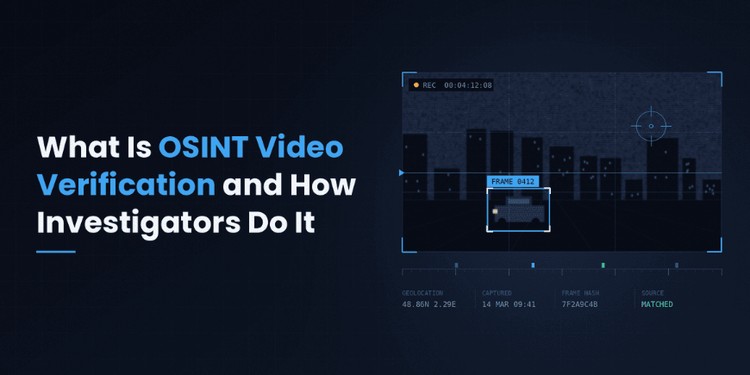
This is where the need and importance of OSINT video verification comes into the scene. Investigators (both individuals and professionals) use this technique to verify the source, context, date, location, and claims of a video.
But how do investigators actually do it? This is what we are going to discuss in this blog post. Here, you will learn what OSINT video verification is and how investigators do it.
Let’s start.
What is OSINT Video Verification?
OSINT video verification is the process of using Open Source Intelligence (OSINT) techniques to verify the video’s authenticity, source, context, date, and location. This methodology involves using publicly available information and tools to trace a video’s origin, investigate its claims, and cross-check its details with other reliable sources.
It is a very detailed research technique. The investigators do not just try to determine if a video is authentic or not. Their main goal is to analyze important information such as where and when it was recorded, who recorded it, where it was published, and what type of claims are attached to it.
Why is OSINT Video Verification Important?
OSINT video verification is important because it stops misinformation from spreading by investigating the context and claim behind the video.
The following points will help you understand why OSINT video verification is so important:
Preventing old videos from being shared as new
It has become very common for old videos to resurface during new events. People repost these videos as an argument for the new event. Some even go far enough to reshare old videos and claim them to be of the new events.
OSINT verification makes sure that shared videos have accurate information and aren’t being portrayed as new.
Confirming the location of the video
It’s normal for people to share a video of a location and claim it to be of another location. In simple words, a person can share a video of an incident in Paris and claim that it’s happening in Sydney.
OSINT techniques help investigators confirm the geolocation of where the video was recorded in order to prevent such false narratives from spreading.
Verifying the time or date of recording
OSINT video verification also helps with verifying when a video was recorded. By using publicly available sources, investigators trace the video’s history to determine whether its date matches when it was actually recorded. This investigation helps confirm the video timeline so that people can’t fake the date of events.
Tracing back to the original video source
Videos get stolen and reposted all the time. It makes it harder for people to know which is the original version and what the context was behind it.
With OSINT techniques, investigators conduct reverse video lookups to trace back to a video’s original source, find its owner, and confirm the context behind it.
How do investigators do OSINT Video Verification?
Investigators use a structured process to do OSINT video verification. This process includes everything from understanding the claim to determining what the available evidence supports in order to reach a final conclusion about the video.
This detailed procedure is covered in the steps discussed below:
Step #1. Understanding the claim
The first thing that researchers do is understand the claim made by the video. This claim is important to understand because it gives a clear roadmap of what researchers are supposed to research.
The claim could be related to different things, such as the location, date, event, people involved, or circumstances shown in the video.
For example, if a video claims to show a protest that took place in a specific city yesterday, the researcher will know that they have to verify things like the location, check the time of recording, trace earlier versions of the video, and see when it first appeared online in order to finalize the verification.
Step #2. Find the earliest video
The next thing researchers do is find the earliest version of the video.
They check where the footage was first published and who posted it. This is usually done with the help of a reverse video search technique. Investigators use different tools, such as Reverse-VideoSearch.com, to find the earliest videos
This research technique allows investigators to check all major online platforms and show where a video first appeared. It also gives other useful information such as the account that posted the video and the original title and caption.
In many cases, the earliest video isn’t necessarily the original version, but it helps narrow down the research to the original source and context of the footage.
Step #3. Verify the geolocation of the video
Verifying the geolocation of the video is an important part of the OSINT video verification. It helps researchers pinpoint the location where the footage was recorded.
Researchers use publicly available resources such as satellite images, maps, and business listings to find the exact location of the recording.
Step #4. Verify the chronolocation of the video
Verifying the chronolocation is a very complex part of this investigation. It is used when researchers have to find the exact time or place of recording by using clues like sun position, shadows, weather conditions, and seasonal changes.
Step #5. Verify the date and timeline
Investigators also conduct research to verify the date on which the video was recorded. They also verify the timeline, which includes when the video was first created, uploaded, shared, and reposted online.
One technique that is used during this process is analyzing video metadata. Video metadata gives a lot of important information about the footage, such as:
- Creation date and time
- File modification date
- Camera or device model
- File format and size
With this type of data, investigators can finally determine when the video was recorded and how it has been shared online over time.
Step #6. Compare with other sources
In most cases, focusing only on the single video and analyzing it is not enough to build a reliable conclusion. Investigators also have to compare it with other publicly available sources, such as:
- News reports
- Official websites and statements
- Social media posts
- Photos from the same event
This comparison basically tells if other resources are confirming the same claim.
For example, if a video claims that a football player has changed their club and other sources, like Facebook posts of football accounts, have also posted the news, the investigator has a reason to assume that the video’s claim is accurate.
Step #7. Finalizing the research
After conducting the OSINT analysis, investigators bring their findings together to build their final conclusion. In doing so, they gather all the data related to the video, such as its claim, location, date, timeline, etc.
If everything points towards the right direction, investigators conclude that the video’s claim is accurate. On the other hand, if there are inconsistencies in the findings, such as if the location or date does not match the original claim, investigators declare that the claim is misleading.
Investigators keep these points in mind while finalizing their analysis:
- They make sure that the evidence and sources have strong authenticity.
- Information that is supported by multiple sources is given more importance.
- They usually avoid making concrete conclusions based on a single clue.
- They make sure to separate confirmed information from assumptions.
- If there’s conflicting evidence, investigators conduct research more deeply to understand the reason for the conflict and determine which evidence is more reliable.
What OSINT Video Verification Cannot Confirm?
The OSINT video verification process is very efficient when it comes to analyzing a video’s source, context, location, and timeline. However, there are some things that this research methodology cannot confirm.
These things include:
- Checking if the video has been manipulated digitally at the technical level.
- Confirming if the video was generated by AI or deepfake technology.
- Checking whether the audio has been synthetically generated with tools.
- Identifying every single person in the video.
Factors that Affect OSINT Video Verification
There are different factors that can affect the accuracy and efficiency of the OSINT video verification procedure. They either slow down the research process or make reaching a reliable conclusion impossible. Some of these factors are mentioned below:
- Video quality: Low-quality videos make it hard to recognize things like people and landmarks.
- Available metadata: If the available metadata is not enough, investigators have a hard time analyzing the video’s background information.
- Heavily edited or reposted videos: If a video is heavily edited and reposted multiple times, it becomes difficult to trace its original or the earliest version.
- Indoor scenes: Videos recorded indoors make chronolocation analysis difficult.
- Lack of supporting sources: If there aren’t enough supporting sources (social media posts, blog posts, etc.) available, building a final conclusion becomes difficult.
Final Words
OSINT video verification is the process of using OSINT (open-source intelligence) search methodology to verify the claim, context, date, timeline, and location of a video. This technique helps with making sure that fake videos and false news don’t spread on the Internet and are dealt with carefully.
To conduct this research, investigators start by analyzing the video’s claim. They trace the earliest version of the video, verify the location, date, and timeline, and then compare it with other available data. After this analysis, they build the final conclusion to determine whether the video’s claim is right or wrong.
Frequently Asked Questions (FAQs):
Is OSINT video verification legal?
Yes. OSINT video verification is legal. However, investigators have to make sure that they use publicly available information ethically and do not use any private data without permission.
Why do investigators use OSINT video verification?
Investigators use OSINT video verification to verify the claim of a video and the context behind it. This technique is useful for verifying a video’s location, date, and timeline as well.
How do investigators verify a video’s location?
Investigators analyze visual clues like landmarks, buildings, roads, etc. Then, they compare these clues with satellite images and maps to verify the location.
Can OSINT verify if a video is AI-generated?
No. OSINT video verification techniques are not a suitable strategy for verifying if a video is AI-generated. It mainly focuses on verifying the video’s claims and context by analyzing date, timeline, location, and other publicly available information.
Can reverse video search help with the OSINT video verification procedure?
Reverse video search is a major part of this technique since it helps trace the earliest version of a video. However, it alone isn’t enough to give the required evidence to investigators to build a conclusion.