





















































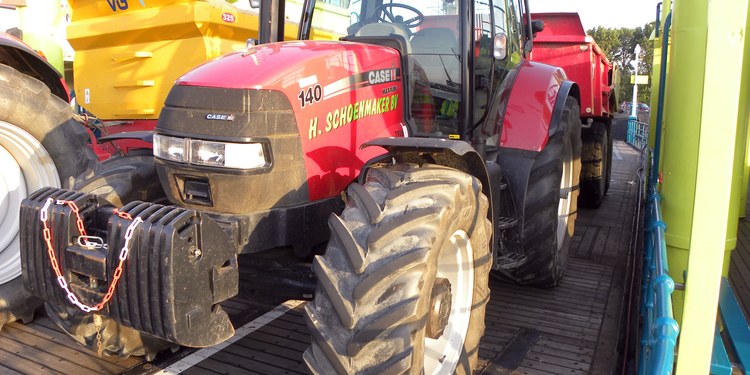
A heavy component can be added to a drawing quickly. In a design that is already well advanced, however, that still does not resolve where it will fit, how it will be secured, or how it will later reach its installation position. Technical ballast is therefore one of the issues that should be addressed during system design rather than left until detailed design. At this stage, what matters first is not the final shape of the weight, but the role it needs to perform within the wider assembly.
Photo: “Case IH 140” by Joost J. Bakker / Wikimedia Commons, CC BY 2.0. Unmodified.


Ballast Is Part of System Design
In the design of technical ballast and components, ballast serves a purpose that goes beyond simply adding mass. The weight has to be integrated at a suitable point into a specific vehicle, machine or test arrangement. Its position is therefore linked to adjacent assemblies, available space and the intended operating or testing conditions. If it is only considered after the basic layout has been finalised, decisions that have already been made may need to be revisited. That is not necessarily a design error, but it is a planning risk that can often be avoided.
The importance of early decisions in component design can also be seen during the concept phase of engineering development. The same applies to ballast: the key question should be discussed early on — what function is it expected to perform within the specific system? Only once that has been defined do meaningful requirements emerge for position, shape, attachment and handling. Treating a weight as an interchangeable block is too simplistic. Two components with the same intended mass may require very different design solutions if their installation position, fixing method or accessibility differ.
Which Interfaces Should Be Clarified Before Detailed Design
The starting point is the available installation space, including the areas that must remain clear for neighbouring components or work processes. Design teams should not limit themselves to asking whether a weight fits geometrically. Equally important is where its mass sits within the overall system and which assumptions apply to the relevant operating conditions. At this stage, such questions can first be recorded as requirements, without pre-empting the project-specific design solution.
Attention then shifts to the connection with the rest of the design. Where are suitable fixing points, which components are affected, and how will the weight be installed or removed again if necessary? An empty space in the finished model is of little help if the intended assembly route is blocked by other components. Transport and internal handling therefore also belong in the early discussion. Which routes are planned, which access points remain available, and at what stage do delivery condition and assembly sequence meet? The earlier these questions are made visible, the easier it becomes for the teams involved to align their assumptions.
Different Applications Place Different Demands
The functions of technical weights already differ across application areas. It is the later application that defines the design of the component, not a one-size-fits-all shape. A tractor weight, for example, has to fit the vehicle concept in question. Its installation position, connection method and intended handling should therefore be considered early on. The label “tractor weight” on its own does not yet provide a suitable installation solution.
A crane test weight exists in a different context. Here, the weight is part of a defined test procedure and has to be handled as part of that process. Questions of provision, access and integration into the test arrangement therefore come more strongly to the fore. In the case of technical weights used in machinery engineering, meanwhile, it is the specific system that determines which geometry and which interfaces are feasible at all. A compact installation space may point towards different decisions than a design with open access.
These examples show why an early description of requirements is more useful than a premature reference to a particular weight type. Function, location of use and handling need to be described together. Only then can design and manufacturing assess which configuration suits the project in question. Differences between applications are not an exception; they are the reason ballast should be treated as a project-specific system requirement.
How Early Coordination Can Be Organised in Practice
For an initial exchange, a relatively simple basis is often enough: a description of the ballast function, a provisional position within the overall system and a sketch of the relevant interfaces. The design team can mark which areas may be suitable for the weight and which neighbouring components are already planned there. It is important to record open assumptions as such. If position or attachment method has not yet been decided, that should not be obscured by an apparently final representation in the model.
It is then worth reviewing the issue from several perspectives. Design considers function and integration; manufacturing and assembly examine how the component can be produced, accessed and installed. Those planning transport and handling contribute questions about the route from delivery to installation position. Procurement can clarify at an early stage which information is needed for a technically clear enquiry. In this way, an abstract requirement for weight becomes a traceable description of the component needed, without any one team having to make every decision in advance.
The main benefit of this coordination is that dependencies become visible in good time. As with other technical components, changes in one area can affect other interfaces. For ballast, the same practical approach applies: after every significant change to installation space, layout or assembly sequence, it is worth checking whether the agreed assumptions about the weight still hold.
A documented decision status also helps prevent different parties from working with different versions of the same requirement. It does not need to be extensive. It is already useful to record which function has been agreed, which interfaces remain open and who will prepare the next decision. This reflects the basic principle of systematic development: requirements and design solutions are related to one another and reviewed over time, as NASA describes in its system design processes.
A Practical Next Step for Design Teams
Before the detailed design of a ballasted assembly begins, it is worth holding a short interface review. The aim is not to define every property once and for all. Instead, the parties involved should work through four points together: the purpose of the weight, the intended installation space, the possible means of attachment and the route the component will take to its installation position. For each point, the decisions already made and the open questions can be recorded.
It is especially useful to assign the open questions to clear responsibilities. Who checks the position of the weight in the system? Who reviews the assembly sequence? Who compares the assumed design with manufacturing capabilities? That keeps the design process where it belongs: with the responsible project team. Early consideration of ballast does not replace the team’s technical decisions. It creates the basis for making those decisions in the context of the overall design — before an unresolved interface turns into a problem during detailed design.

David Prior
David Prior is the editor of Today News, responsible for the overall editorial strategy. He is an NCTJ-qualified journalist with over 20 years’ experience, and is also editor of the award-winning hyperlocal news title Altrincham Today. His LinkedIn profile is here.