
















































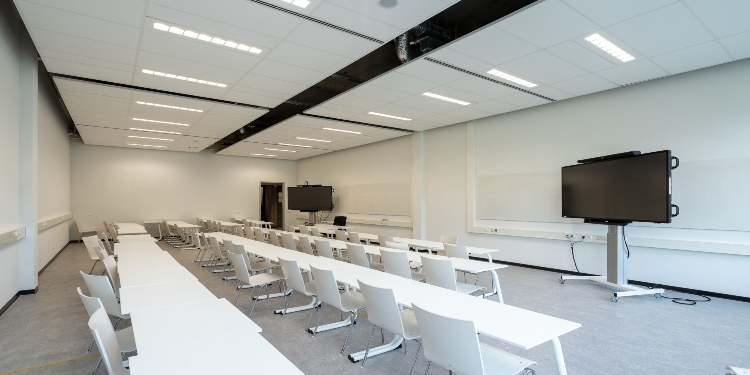
In today’s world, businesses are increasingly turning to displays to convey information, showcase products, and even provide a fun and interactive atmosphere for their customers. High-resolution LED technology ensures crisp visuals in various environments, ranging from corporate meeting rooms to retail showrooms. But when picking the right screen size, there’s more to look at than just the screen. Performance is affected by pixel pitch, image quality, installation requirements, content management, and maintenance. Knowing these factors allows companies to invest in display solutions that will assist them in their daily operations, enhance visual communication, and adjust to new and evolving business needs.
- Understanding High-Resolution Indoor LED Displays
Indoor LED displays are based on light-emitting diodes to create images, video, presentations, and digital messages. Modular LED systems differ from traditional display panels because they can be made up of several cabinets to form a large screen, resulting in virtually imperceptible seams. They are also flexible in their configurations and are suitable for conference rooms, shopping malls, control centres, exhibition halls, and entertainment venues.

One of the main factors for high-resolution performance is pixel pitch, which is the distance between adjacent pixels. The closer you look at the image, the lower the pixel pitch, the more detailed the image will be. The typical pitch for indoor displays is P0.9 to P2.5, but larger pitches are suitable for certain applications. This flexibility allows businesses to customize the visibility of the display according to the size of the area and where people are seated.
- Why Resolution Matters for Business Environments
Well-configured displays have familiar colours, legible text, and clear image information when dealing with various types of content. Brightness adjustment makes it easier to adjust for the ambient light without making presentations unnecessarily harsh. Businesses should consider these features as a whole, as high resolution cannot make up for poor calibration, improper brightness, or poor source material.
- Choosing the Right Indoor LED Screen for Your Needs
When choosing an Indoor Led Screen, the first consideration is the purpose of the display, distance, and space requirements. The specifications for a conference room with spreadsheets are different from a shopping mall with promotional videos. Smaller pixel pitches are better for up-close viewing, and larger pitches may be adequate for larger areas where there is no need for the investment.
Screen size, cabinet design, and ease of maintenance should also be taken into account by businesses. Slim cabinets make space-efficient installations possible, and modular designs allow for configuration and future expansion. Front-service systems work well if displays are against walls where there is no easy access to the rear of the display. Early assessment of those practical needs can help to avoid installation issues and ensure that the display will meet the intended need.
- Essential Features to Compare Before Purchasing
A display’s technical specifications determine how effectively it performs under everyday operating conditions. Comparing the following features helps businesses narrow their options.
Important Selection Factors
- Pixel pitch: P1.5 and P1.8 suit many close-viewing environments, while P2.5 can work well at greater distances.
- Brightness and contrast: Adjustable brightness supports comfortable viewing under different indoor lighting conditions.
- Refresh rate: Higher refresh rates can reduce visible flicker and improve camera recordings, depending on the camera and display settings.
- Cabinet design: Lightweight, modular cabinets simplify mounting, alignment, and installation planning.
- Control system: Compatible controllers enable content scheduling, screen splitting, and reliable signal distribution.
- Service access: Front or rear maintenance options influence installation flexibility and repair convenience.
These specifications should be assessed together rather than independently. A well-matched system balances image quality, operating requirements, installation constraints, and overall project cost.
- COB and SMD Technologies for Different Applications
There are two main methods of manufacturing indoor LED displays: chip-on-board (COB) and surface-mount device (SMD). SMD packages integrate the red, green, and blue LED elements in one package. It is an existing technology, can be adapted to a large variety of pixel pitches, and can be an economic choice for common commercial displays.
COB technology is the method of mounting the LED chips directly on a substrate and then with an encapsulating layer for protection of the display surface. This construction will enhance physical contact resistance and provide high contrast – great for fine pitch applications. But COB systems can have increased upfront costs and repair considerations. The selection will vary based on the specific viewing requirements, installation location, durability, and budget.
- Integrating Display Controls and Content Management
Consistent visuals across indoor LED installations are achieved by reliable control systems. NovaStar, Colorlight, Linsn, Huidu, and other manufacturers have controllers that meet varying needs and sizes of projects. The configuration will vary based on the screen resolution, receiving-card capacity, input sources, and the content workflow.
Screen-splitting features enable companies to present a presentation, video feed, announcement, or advertising in another section of the screen. Synchronous systems can be used for real-time video playback, and asynchronous systems can be used for scheduled video playback without a continually connected playback computer. Proper signal mapping and resolution matching prevent distorted images, interruptions, and synchronization issues. Businesses should also make arrangements for appropriate power distribution, ventilation, and access to the key elements of the system.
- Installation, Maintenance, and Long-Term Performance
Even though this has a high-resolution screen, it is critical that it is installed and maintained in order to maintain image quality. The design of the wall-mounted, recessed, suspended, and freestanding types varies. Before the system is commissioned, installers need to evaluate the weight of the cabinets, mounting strength, electrical capacity, ventilation, cable routing, and safe access. Normal maintenance involves dust removal and connection checks in accordance with the manufacturer’s maintenance methods, as well as the installation of compatible firmware updates as necessary, and checking ventilation. Apart from other LED solutions, manufacturers such as EXCEL LED (or LEGIDATECH) offer indoor display configurations. The factory-direct production, OEM/ODM services, and technical assistance can help enterprises arrange specifications, installation instructions, and follow-up services.
- Planning a Cost-Effective Display Investment
The cost of indoor LED display depends on the size of the screen, the pixel pitch, the LED technology, the materials of the cabinets, the number of controllers needed, and the complexity of the installation. Fine-pitch systems tend to be more expensive to manufacture and may be significantly more expensive than displays intended for more distant viewing. Other costs may involve mounting frameworks, electrical work, content apparatus, delivery, and substitution modules.
The total project cost, not the screen price, should be compared. The choice of unnecessarily high pixel pitch may lead to an increased cost without providing significant value to viewers at a distance. On the other hand, if the resolution is too low, it can make it difficult to read in close-up settings. Clear room measurements of size, type of content, hours of operation, and future requirements for expansion help make informed buying decisions.
Conclusion
The high-resolution indoor LED displays provide a flexible visual communication solution for modern commercial environments. Their effectiveness depends on the choice of the right pixel pitch, COB and SMD technologies, a secure control configuration, and meticulous planning of their installation. Balance the technical and operational requirements to guarantee displays are clear and perform well. Routine maintenance and careful budgeting further help to build value, and organizations can expect to have indoor visual systems that will serve their communication needs for years to come.