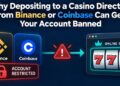






















































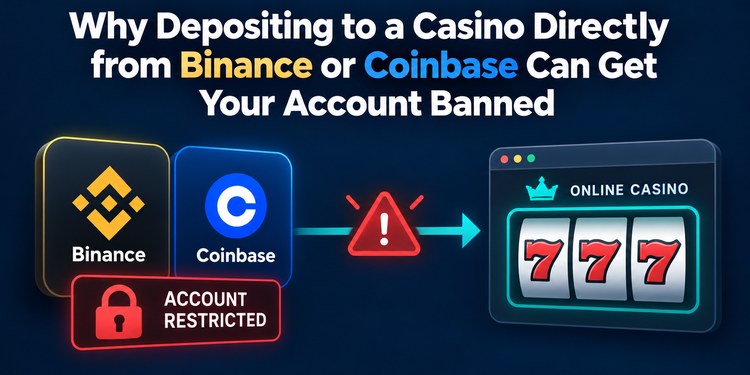
Seamless crypto integration. That’s a promise almost every casino promises today. In addition to allowing you to deposit and pay with crypto coins, they now allow users to connect their exchange accounts, like Binance and Coinbase, directly.
With this option, users can enjoy instant deposits and withdrawals when they hit it big. While this is a very compelling option, it may just get your exchange account banned.


If you spend five minutes browsing Bitcointalk forums or Reddit, you’ll see a number of gamblers who connect their accounts to a casino only to be hit with the terrifying "Your account is restricted" message. Let’s explain why this happens.
Why Exchanges Seem To Hate Online Casinos
Coinbase, Binance, and others do not care about your moral compass. Don’t get that wrong. While exchanges don’t care if you’re playing roulette or blackjack with your crypto, because they hate fun, their hatred for crypto casinos seems to stem from self-preservation.
Centralized exchanges (CEXs) operate under the crushing weight of traditional financial regulations. To do business in places like the United States, the UK, and Europe, they have to play by the rules dictated by the SEC, the FCA, and various other aggressive regulatory watchdogs.
AML and KYC
Under these strict frameworks, financial institutions are legally obligated to prevent illicit funds from flowing through their platforms. And unfortunately, in the eyes of regulators, unregulated or offshore crypto casinos are considered massive red flags.
The platforms are known to regulators as being money laundering channels. As long as Coinbase lets its customers easily transfer funds directly to the gambling site in Curacao, it’s an accomplice to the regulators. They could face fines of up to a billion dollars. They face the possibility of losing their licenses to run the business.
Binance literally just passed through a multi-billion-dollar compliance wringer in the regulatory arena. To shield themselves, they shift the blame for this on the casino user. They have dialed their compliance algorithms. As soon as they smell danger, they cut off from the user.
It’s easy to focus on the welcome offer when choosing a casino. Sites like CryptoCasinoPromo Codes can help you explore available promotions, but a bonus tells you nothing about whether your exchange permits the transfer. Before depositing, check both the casino’s payment terms and your exchange’s rules for gambling-related transactions.
Read the Fine Print: Prohibited Use Policies Explained
You probably didn’t read the Terms of Service when you signed up for your exchange account. Nobody does. But if you actually dig into the Coinbase Legal page, specifically under their "Prohibited Use" section, it’s spelled out in black and white.
They explicitly ban using their services for sports forecasting or odds making; lotteries; bidding fee auctions, sports leagues or fantasy sports leagues with a cash prize; internet gaming; contests; sweepstakes; games of chance.
Binance has almost word-for-word the same language in their terms of use. By ticking the box to agree to these terms, you are committing yourself to their terms.
Breach of these terms will result in the absolute right to prevent you from withdrawing any funds or closing your account at any time without notice. It’s not an option. This is a strict measure with automatic enforcement.
How They Track Your Deposits
"But how do they even know when crypto is supposed to be anonymous?” Bitcoin and most major altcoins operate on highly transparent, public ledgers. Every single transaction is permanently recorded for anyone to see.
Exchanges do not manually check where you send your money. They employ advanced blockchain analytics software, like Chainalysis, Elliptic, and CipherTrace, that maintain massive databases of known wallet addresses.
They know the deposit addresses for Stake, Roobet, BC.Game, TrustDice, and literally hundreds of other betting platforms. When you hit "withdraw" on Binance and paste in the casino’s address, the transaction gets scanned in milliseconds.
The Chainalysis software flags the destination address as a Known Gambling Entity. The system instantly flags your account. No human intervention required. An automated script immediately restricts your trading privileges and shoots off an email telling you that you’ve violated the terms of service.
You might get a chance to withdraw your remaining funds to a personal wallet, but your days of using that exchange are permanently over.
Is there a Way To Avoid Getting Banned?
Alright, let’s talk solutions. Because you obviously still want to play, and you still need a way to buy crypto with your bank account. The secret to keeping your exchange account safe is creating a buffer.
You have to break the direct on-chain link between the heavily regulated exchange and the casino. This can be done using apps such as Trust Wallet, Exodus, MetaMask or a hardware wallet like a Ledger or Trezor. The exact step-by-step blueprint to safely deposit:
Step 1: Buy your crypto on an exchange
Purchase your Bitcoin, Ethereum, or USDT on your any exchange.
Step 2: Send to your self-custodia wallet
Do not send the funds to the casino. Instead, withdraw the crypto from the exchange directly to your personal Exodus, Trust Wallet, or MetaMask address. Some of these casinos even allow direct connection with these wallets.
Step 3: Deposit to the casino
Once the crypto lands in your personal wallet, initiate a new transaction. Send the funds from your personal wallet to the casino’s deposit address.
This method works because when the exchange scans the transaction, all they see is you sending funds to an unhosted, personal wallet. That is a perfectly legal, normal activity. After the crypto is in your personal wallet, the exchange no longer has direct control over subsequent events.
Can You Withdraw Casino Winnings Directly to an Exchange?
Do not get careless when it is time to cash out. The exact same rules apply in reverse. If you hit a jackpot and try to withdraw your winnings directly from the casino back to your Coinbase account, you are going to get caught.
The software monitors exchanges use tracks incoming deposits just as strictly as outgoing withdrawals. If they see funds entering your account directly from a flagged gambling hot wallet, the system will lock your account just as fast.
They might even freeze the incoming funds, forcing you into a nightmare loop of customer support tickets where you have to try and prove the source of your wealth. Always use the buffer.
If you are looking to convert your winning from the casino into money, first transfer your winnings to your personal non-custodial wallet (Exodus, MetaMask). After that, you can transfer those funds from your personal wallet to Binance or Coinbase to cash them out to your bank account.
Closing Thoughts
Navigating the crypto gambling space requires a bit of operational security. The centralized exchanges are not your friends. They are heavily regulated financial gatekeepers terrified of government fines.
By simply spending an extra two minutes routing your funds through a personal, self-custody wallet, you completely eliminate the risk of an unexpected account ban. Keep your exchange account for buying and selling, keep your personal wallet for your actual transactions, and enjoy your gameplay without looking over your shoulder.

David Prior
David Prior is the editor of Today News, responsible for the overall editorial strategy. He is an NCTJ-qualified journalist with over 20 years’ experience, and is also editor of the award-winning hyperlocal news title Altrincham Today. His LinkedIn profile is here.