





















































For many UK adults, feeling more confident about money begins not with a share, currency pair or app, but with knowing what remains after bills and which losses the household could absorb. Amid uncertain markets and an endless stream of financial content, the financial confidence 2026 demands is the ability to make a deliberate decision, not certainty about the next price move.
What Financial Confidence Really Means
Financial confidence is closer to preparedness than optimism: understand the choice, check the source and set boundaries before committing money. The principle covers saving, investing and higher-risk trading, although each requires different limits.


Confidence Is a Process, Not a Prediction
Confident financial decision making follows a repeatable sequence: define the goal, compare credible information, decide what can be lost and review the result. Someone learning about forex might include theforexcomplex.com among their financial education resources, while recognising that community material is not regulated personal advice and cannot replace independent checks.
The Difference Between Confidence and Overconfidence
Confidence leaves room for error. Overconfidence treats a strong opinion, recent gain or attractive interface as evidence that risk has disappeared.
| Informed confidence | Overconfidence |
| Checks affordability before taking risk | Uses money needed for near-term expenses |
| Verifies the provider and product | Relies on a creator, testimonial or app badge |
| Starts small and reviews outcomes | Increases size quickly after a win |
| Accepts uncertainty and possible loss | Treats conviction as proof |
| Uses several credible sources | Seeks only information supporting the decision |
This is why investing confidence should be measured by the quality of the process, not by how certain someone sounds.
Why More People Want Greater Control in 2026
Taking control of finances is a practical response to uncertainty. Digital access has widened choice while leaving consumers to judge which products, providers and voices deserve attention.
Economic Uncertainty and the Search for Financial Resilience
The Bank of England’s July 2026 Financial Stability Report judged UK household balance sheets resilient in aggregate, with indebtedness low by historical standards. It also said some vulnerable, lower-income households remain more exposed. The distinction matters: personal resilience depends on cash flow, accessible savings and manageable debt, not the national average.
Easy Access to Investing and Trading Apps
“Beginner investing UK” searches can now lead directly to mobile platforms offering rapid account opening and small transactions. This can support participation, but access is not readiness. Notifications and one-tap dealing shorten the pause between impulse and action; a useful app clarifies costs, risk and records rather than merely encouraging activity.
The Growth of Online Financial Content
Social media can introduce useful concepts, but popularity does not establish competence. In April 2026, an FCA-led action against illegal finfluencer promotions produced 120 UK account-takedown requests covering 1,267 illegal adverts that had reached at least 2.3 million UK accounts. The finfluencer risk arises when entertainment, experience and paid promotion blur together, so viewers should identify the sponsor and verify claims at the original source.
Control Starts Before the First Investment
The first readiness test is whether taking a risk would weaken the household plan. Saving and investing serve different jobs; money needed soon should not be exposed merely because an app allows it.
Emergency Savings and Priority Debts
An accessible emergency fund protects against urgent repairs, income interruption or unexpected bills. Priority debts and arrears generally require attention before speculation. This separates resilience money from capital that can remain committed while markets fluctuate.
Time Horizon and Affordable Risk
Time horizon means when the money will be needed. A long-term goal may allow recovery time; next year’s rent deposit does not. MoneyHelper’s high-risk investment guidance stresses suitability and affordability. Investment risk for beginners should be expressed in pounds and consequences: if a loss would disrupt essentials or create debt, it is unaffordable.
How Everyday Investors Are Improving Their Decisions
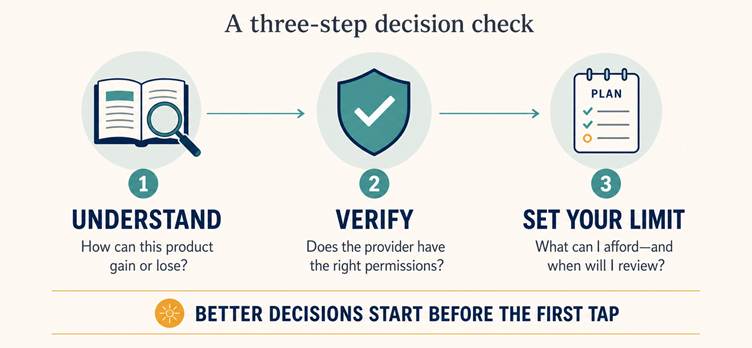
Better decisions often come from habits that slow commitment, expose costs and leave a record for review.
Learning the Product Before Buying It
A beginner should be able to explain what they own, how losses arise, how the position can be sold and every charge. If leverage magnifies the exposure, the downside deserves particular attention. The FCA describes CFDs as high-risk products unsuitable for some retail consumers. UK protections limit certain harms but cannot prevent an account balance from being lost; trading is not a substitute for saving.
Checking Regulation and Permissions
An FCA Register entry should match the legal name, website, contact details and service offered. Clone firms may imitate an authorised business while changing a phone number or address. Regulation identifies the entity, permissions and possible protections; it does not make every product suitable.
Using Written Rules and Smaller First Steps
Written rules turn a vague intention into something testable. Before acting, record:
- the purpose and intended holding period;
- the maximum amount that can be lost without affecting essentials;
- the condition that will trigger an exit, pause or scheduled review.
Starting modestly can limit the financial impact of early mistakes. Resources for retail traders UK-wide often include demo accounts, which can teach order mechanics but cannot reproduce every live-market condition.
The Role of Apps, Tools and Communities
Technology can improve visibility and access to education. It can also increase the number of prompts competing for attention. The relevant question is whether a tool supports an existing plan or quietly replaces it.
Useful Access versus Gamified Pressure
Budget alerts, fee summaries and portfolio records can strengthen control. Constant price notifications, celebratory animations and streak-like prompts can encourage checking and dealing without a clear reason.
A simple test is to disable non-essential notifications for a week. If decisions become calmer without losing necessary information, the alerts create urgency rather than insight.
How Educational Communities Can Help
Communities can translate unfamiliar terms, expose learners to different views and make it easier to ask basic questions. They are most useful when disagreement is welcome, losses are discussed honestly and members are directed towards primary or official sources.
Trading confidence becomes fragile when it depends on copying an administrator or group consensus. Education should leave the learner better able to decide independently. People seeking “financial literacy UK” guidance should favour communities that distinguish general education from regulated advice and explain when UK-specific rules matter.
How to Avoid False Confidence
False confidence often arrives before obvious misconduct. It can grow from a genuine winning period, repeated social approval or the simple convenience of an app. Recognising those triggers helps people interrupt them early.
Do Not Treat Recent Wins as Proof of Skill
A profitable month may reflect skill, favourable conditions or chance. Separate decision quality from outcome quality: a disciplined decision can lose, while a poorly researched gamble can win. Review whether the original rule was followed and whether the same choice would be defensible before knowing the result.
Question Guaranteed Returns and Social Proof
Guaranteed high returns are incompatible with genuine market uncertainty. Testimonials, follower counts and screenshots are easy to select and difficult to audit. Ask for the legal entity, full costs, risk information and independently verifiable evidence – not just a more persuasive success story.
Pause When a Decision Feels Urgent
Countdowns, “limited places” and claims that everyone else is already profiting are reasons to slow down. Introduce a cooling-off period for unfamiliar products and never send money while being coached through the payment by an unsolicited caller or direct message.
A Simple Financial-Confidence Checklist
The following four questions convert confidence into a readiness test. They work for an investment account, a trading platform or any unfamiliar higher-risk offer.
Can I Afford the Loss?
The amount should be separate from bills, emergency savings, priority-debt payments and near-term goals. Being comfortable with volatility is irrelevant if the household cannot absorb the financial consequences.
Do I Understand the Product and Costs?
Explain the product in plain English, including how money is made or lost, how it can be exited and what fees apply. If that explanation depends on repeating a creator’s slogan, more research is needed.
Have I Checked the Provider?
Verify the exact firm and its permissions through official records. Use contact details from the register rather than a link sent in a message, and check the FCA Warning List for unauthorised names.
Do I Have a Written Exit or Review Plan?
Decide in advance when the position will be reviewed and which change would justify selling, reducing risk or doing nothing. A written plan reduces the temptation to invent a new rule during a stressful price move.
If any answer is “no”, pausing is an informed decision – not a failure of confidence.
Final Thoughts: Control Comes from Better Decisions, Not More Trades
Financial confidence is not the absence of doubt. It is having enough household resilience, product knowledge and reliable information to decide without pressure. For the cautious starter, that may mean continuing to save. For a new investor, it may mean a smaller first step. For someone rebuilding after a poor decision, it may mean returning to written rules.
The practical takeaway is simple: protect essential money, understand the product, verify the provider and set the review point before committing capital. More activity cannot compensate for a weak foundation; a clear “not yet” can be one of the strongest signs of taking control.