




















































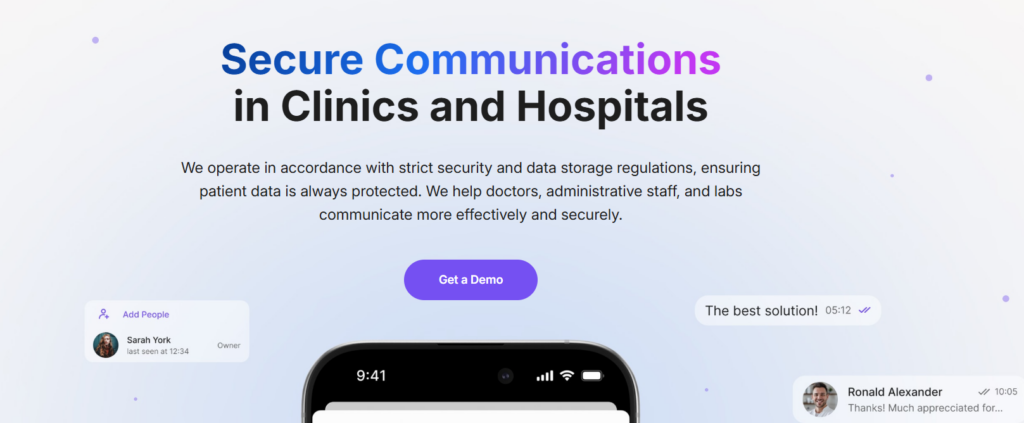
A single intercepted message containing a patient’s diagnosis, lab results, or treatment plan can trigger regulatory fines reaching hundreds of thousands of dollars, legal liability, and irreparable damage to institutional trust. Yet across healthcare systems worldwide, clinical teams continue to exchange protected health information through consumer messaging apps, personal email, and unsecured SMS. Secure messaging platforms built for healthcare address this gap by combining end-to-end encryption, access controls, audit logging, and regulatory compliance into a single communication environment designed for the unique demands of clinical workflows.
This guide examines what healthcare messaging security actually requires in 2026, why standard business tools and consumer apps fail to meet the standard, and what capabilities your organization needs to protect patient data while maintaining the speed and convenience that clinical teams depend on.


| 🏥 Healthcare data breaches are the most expensive of any industry. The average cost per breach reached $10.93 million in 2024 according to IBM, and has continued to climb in 2025 and 2026. HIPAA violation fines range from $100 to $50,000 per incident, with annual maximums reaching $2.1 million per violation category. Criminal penalties can include imprisonment of up to 10 years. |
Why Healthcare Messaging Has Unique Security Requirements
Healthcare communication is fundamentally different from corporate messaging in other industries. The information exchanged between clinicians, nurses, administrators, and patients carries both legal protection and ethical obligations that elevate the consequences of a security failure far beyond financial loss.
Protected Health Information Requires Special Handling
Under HIPAA, any individually identifiable health information transmitted or maintained electronically is classified as electronic Protected Health Information (ePHI). This includes patient names, diagnoses, treatment plans, lab results, imaging reports, medication lists, insurance details, and any clinical notes. Every message containing ePHI must be encrypted, access-controlled, logged, and stored in compliance with the HIPAA Security Rule. Consumer messaging apps satisfy none of these requirements.
Clinical Communication Is Time-Sensitive and High-Stakes
When a nurse needs to alert a physician about a deteriorating patient, when a radiologist needs to communicate critical findings, or when a care team needs to coordinate an emergency response, the messaging platform must deliver information instantly and reliably. Any friction in the communication flow, whether from security barriers, poor interface design, or unreliable delivery, can directly impact patient outcomes. This creates a tension that only purpose-built healthcare messaging platforms can resolve: maximum security with minimum friction.
Multiple Stakeholders, Multiple Devices, Multiple Locations
Healthcare communication involves physicians, nurses, specialists, pharmacists, lab technicians, administrative staff, and sometimes patients themselves. These stakeholders work from hospital workstations, mobile devices, home offices, and satellite clinics. The messaging platform must enforce consistent security policies across all devices and locations while providing seamless cross-platform access. A physician checking results on a personal smartphone must be subject to the same encryption and access controls as a nurse using a hospital workstation.
What HIPAA Actually Requires from a Messaging Platform
Many messaging vendors claim HIPAA compliance, but the term is frequently misused. HIPAA compliance for messaging involves specific technical, administrative, and contractual requirements that go well beyond end-to-end encryption.
Encryption at Rest and in Transit
All ePHI must be encrypted both during transmission (in transit) and when stored on servers or devices (at rest). The encryption must use industry-standard protocols such as TLS 1.3 for data in transit and AES-256 for data at rest. Importantly, the organization should control the encryption keys, not the messaging vendor. On-premise deployment is the most effective way to ensure this.
Access Controls and Authentication
Only authorized personnel should be able to access ePHI through the messaging platform. This requires role-based access controls that restrict visibility based on job function, multi-factor authentication to prevent unauthorized access, automatic session timeouts to protect unattended devices, and remote wipe capabilities for lost or stolen devices. Adaptive MFA that adjusts requirements based on risk context provides the strongest protection without burdening clinical workflows.
Comprehensive Audit Trails
HIPAA requires organizations to maintain detailed records of who accessed what information, when, and from which device. The messaging platform must generate tamper-proof audit logs that track message delivery, read receipts, file access, login attempts, and administrative actions. These logs must be searchable and exportable for compliance audits and incident investigations.
Business Associate Agreements
Any vendor that processes, stores, or transmits ePHI on behalf of a healthcare organization must execute a Business Associate Agreement (BAA). This legally binding contract makes the vendor responsible for protecting ePHI and liable for breaches. However, the most secure approach eliminates this dependency entirely: with on-premise deployment, the vendor has no ongoing access to patient data after installation, removing the need to rely on BAA compliance for data protection.
Data Retention and Destruction Policies
Healthcare organizations must define and enforce data retention policies that comply with federal and state regulations. The messaging platform must support configurable message retention periods, secure deletion of expired data, and the ability to produce communication records for legal discovery when required. Emergency data destruction capabilities provide an additional safeguard for organizations operating in high-risk environments.
Why Consumer and General Business Messaging Apps Fail in Healthcare
| HIPAA Requirement | ConsumerApps | Cloud BusinessTools | SovereignPlatform |
| E2E encryption (default) | ✓ | Partial | ✓ |
| On-premise deployment | ✗ | ✗ | ✓ |
| Role-based access control | ✗ | Basic | ✓ |
| Audit trail / logging | ✗ | Basic | ✓ |
| BAA support | ✗ | ✓ | ✓ or N/A |
| Remote device wipe | ✗ | ✗ | ✓ |
| Adaptive MFA | ✗ | Optional | ✓ |
| Screenshot prevention | ✗ | ✗ | ✓ |
| File forwarding control | ✗ | ✗ | ✓ |
| DLP / SIEM integration | ✗ | API | ✓ |
| Configurable retention | ✗ | Limited | ✓ |
| Air-gapped operation | ✗ | ✗ | ✓ |
| Video conf. (300+) | ✗ | ✓ | ✓ |
| Emergency data destruction | ✗ | ✗ | ✓ |
Consumer apps like WhatsApp, Telegram, and Signal were designed for personal use and offer no administrative controls, compliance logging, or data sovereignty. General business platforms like Microsoft Teams or Slack provide partial compliance features but rely on vendor-managed cloud infrastructure, limiting the organization’s control over where patient data is stored and who can access it. Sovereign enterprise platforms with on-premise deployment offer the only architecture that places complete ePHI control in the healthcare organization’s hands.
See how Gem Team protects healthcare communication
Encrypted · On-premise · Full audit trail · Air-gapped capable
Essential Capabilities of a Healthcare-Grade Messaging Platform
Encrypted Messaging with Granular Controls
All clinical communication, including text messages, media attachments, voice notes, and shared files, must be encrypted end-to-end. Beyond encryption, the platform must allow administrators to prevent text copying, restrict file forwarding to unauthorized recipients, block screenshots, and control download permissions. These controls prevent the casual data leaks that occur when a staff member forwards patient information to a personal device or shares it outside the care team.
Secure Video Conferencing for Telemedicine
Telemedicine has become a permanent feature of healthcare delivery. The messaging platform should include encrypted video conferencing with screen sharing, recording capabilities, and participant management. Gem Team supports video conferences with up to 300 participants, enabling grand rounds, case conferences, and educational sessions alongside individual patient consultations, all within the same secure environment.
Organizational Directory and Care Team Coordination
Hospitals and health systems are complex organizations with dozens of departments, hundreds of roles, and thousands of employees. The messaging platform should include a comprehensive organizational directory with department structures, individual profiles, and contact information. This enables new staff members to identify and reach the right colleague instantly, improving care coordination and reducing the delays caused by fragmented communication.
Company Channels for System-Wide Communication
Healthcare organizations need the ability to broadcast critical information, from policy updates and safety alerts to emergency notifications and operational changes, to specific departments or the entire organization. Channels provide a structured, auditable communication mechanism that replaces the chain emails, bulletin boards, and informal word-of-mouth that currently characterize most healthcare system-wide communication.
On-Premise Deployment for Maximum Data Control
For healthcare organizations subject to the strictest data residency requirements, on-premise deployment ensures that all patient communication data, including messages, files, recordings, and metadata, remains within the organization’s own infrastructure. No third party, including the platform vendor, can access ePHI after installation. This architecture provides the strongest possible compliance posture and eliminates the risks associated with cloud-based storage of patient data.
Cross-Platform Mobile Access
Clinical staff are inherently mobile. Physicians move between operating rooms, patient floors, and clinics. Nurses work across units. Specialists consult remotely. The messaging platform must provide native, optimized applications for iOS and Android that deliver the full feature set with consistent security policies. If the secure platform is not available on every device a clinician uses, they will revert to unsecured alternatives.
Clinical Scenarios: How Secure Messaging Protects Patient Data
Scenario: Emergency Consultation Across Departments
An emergency physician needs immediate input from a cardiologist and a surgeon regarding a critical patient. Through the secure messenger, they share encrypted lab results, imaging reports, and a brief clinical summary in a group chat restricted to the care team. The cardiologist reviews the data on their mobile device and provides guidance within minutes. Every message is logged with timestamps and participant verification. No patient data leaves the encrypted environment.
Scenario: Telemedicine Follow-Up with Remote Patient
A primary care physician conducts a follow-up video consultation with a patient recovering from surgery. The session is encrypted end-to-end, and the recording is stored on the hospital’s on-premise servers with access restricted to the treating team. The physician shares aftercare instructions through the secure chat, replacing the unencrypted email that would have been used previously.
Scenario: Staff Member Loses Their Phone
A nurse’s smartphone, which has the secure messaging app installed, is lost during a commute. The IT administrator immediately triggers a remote wipe of all application data through the centralized admin panel. All cached messages, files, and credentials are permanently deleted from the device within minutes. Because the platform requires adaptive MFA, even if the phone is found by an unauthorized person, they cannot access the messaging application without the nurse’s biometric or hardware token authentication.
Frequently Asked Questions
Can healthcare workers legally use WhatsApp for patient communication?
Using WhatsApp for communication involving ePHI violates HIPAA because WhatsApp does not execute Business Associate Agreements, does not provide audit logging or administrative controls required by the HIPAA Security Rule, stores data on third-party servers, and shares metadata with Meta. Healthcare organizations that permit WhatsApp use for clinical communication risk significant fines and legal liability.
What is the difference between HIPAA-compliant and HIPAA-certified messaging?
There is no official HIPAA certification for messaging platforms. The Department of Health and Human Services does not certify software as HIPAA-compliant. When vendors claim HIPAA compliance, they mean their platform includes the technical safeguards required by the HIPAA Security Rule. Organizations should evaluate specific capabilities, encryption standards, access controls, audit logging, and BAA availability, rather than relying on marketing labels.
Does end-to-end encryption alone make a messenger HIPAA-compliant?
No. Encryption is one of several required safeguards. HIPAA compliance also requires access controls, authentication mechanisms, audit trails, data retention policies, device management, a signed BAA with the vendor, and administrative procedures for handling ePHI. A platform that offers only encryption without these additional controls does not meet HIPAA requirements.
Why is on-premise deployment important for healthcare messaging?
On-premise deployment ensures that all patient communication data remains within the healthcare organization’s physical or virtual infrastructure. No third party can access, subpoena, or intercept ePHI. This provides the strongest compliance posture for organizations subject to HIPAA, state health privacy laws, and international patient data protection regulations. It also eliminates BAA dependency by removing the vendor’s access to patient data entirely.
Can a secure messenger replace a hospital’s paging system?
Yes. Modern secure messaging platforms provide delivery confirmation, escalation capabilities, and group notification features that match or exceed the functionality of traditional paging systems while adding encryption, audit logging, file sharing, and video conferencing. Many healthcare organizations are actively replacing pagers with secure messaging as part of their communication modernization efforts.
How does Gem Team address healthcare-specific requirements?
Gem Team provides end-to-end encryption with mTLS, on-premise deployment for complete data control, adaptive multi-factor authentication, granular access policies including screenshot prevention and file forwarding restrictions, video conferencing for up to 300 participants, organizational directories, company channels, and comprehensive audit logging. The platform is deployable on existing hospital IT infrastructure with minimal hardware requirements, starting from a processor frequency of 2.4 GHz.
Conclusion: Patient Data Deserves the Highest Standard of Communication Security
Healthcare organizations handle the most sensitive category of personal information that exists. The conversations between clinicians, the files shared across care teams, the video consultations with patients — all of this data carries legal protection, ethical obligation, and real human consequence. Securing it is not a regulatory checkbox. It is a fundamental duty of care.
In 2026, with healthcare data breaches at all-time highs, regulatory enforcement intensifying, and the attack surface expanding with every new telemedicine session and mobile device, the case for purpose-built secure messaging has never been clearer. Consumer apps were never designed for this responsibility. General business tools provide partial protection at best. Only platforms built with healthcare-grade security architecture, granular compliance controls, and on-premise deployment capability can meet the standard that patient data demands.
Gem Team was built for exactly this level of protection: seven years of development, proven enterprise and government deployments, and a comprehensive feature set designed to secure every form of clinical communication. For healthcare organizations ready to close the gap between their communication practices and their compliance obligations, the technology is here and ready to deploy.
Protect every patient conversation
Encrypted · Sovereign · HIPAA-ready · On-premise