


















































Two Annapurna Routes, Two Very Different Trekking Experiences
If you’ve started researching an Annapurna Trek, you’ve probably noticed that the Annapurna Base Camp Trek and the Annapurna Circuit Trek keep coming up in the same breath, almost as if they’re two flavors of the same walk. They’re not. Once you’re actually on the trail, they feel like entirely different journeys that happen to share a mountain range.
The Annapurna Base Camp Trek pulls you toward one specific destination — a high mountain sanctuary ringed by some of the tallest peaks on earth. The Annapurna Circuit Trek is a different animal altogether: a long loop around the Annapurna massif that takes you through shifting terrain, climate zones, and culture over a much bigger stretch of days. Neither one is objectively “better,” no matter what a listicle might tell you. The right choice comes down to how much time you have, how your body handles altitude, what kind of scenery pulls at you, and honestly, how much trekking you actually want to do.


Quick answer: if you’re after a shorter trek with a clear, dramatic finish line, ABC is the more direct route. If you want a longer trip with big landscape changes and a high mountain pass thrown in, the Circuit gives you a broader experience — just at the cost of more days and more logistics.
Annapurna Base Camp Trek vs Annapurna Circuit Trek at a Glance
| Factor | Annapurna Base Camp Trek | Annapurna Circuit Trek |
| Main objective | Reach Annapurna Base Camp | Loop around the Annapurna massif |
| Trek character | Focused mountain sanctuary journey | Long-distance Himalayan circuit |
| Typical duration | Shorter, itinerary-dependent | Usually longer than ABC |
| High point | Annapurna Base Camp, 4,130 m | Thorong La, 5,416 m |
| Main altitude concern | Rapid elevation gain near the end | Crossing a genuinely high pass |
| Landscape | Forests, villages, alpine bowl | Green valleys, high desert, alpine terrain |
| Main challenge | Steep climbs, altitude near the sanctuary | Distance, altitude, and Thorong La |
| Best suited to | Trekkers wanting a focused, shorter trip | Trekkers wanting variety and a longer journey |
One thing worth flagging before we go further: exact trek lengths aren’t fixed numbers you can trust blindly. Where you start, where you end, and how much of the route is now reachable by road can shrink or stretch the actual walking days quite a bit. Always check the specific itinerary rather than assuming an older write-up still matches what’s on the ground today.
What Makes the Annapurna Base Camp Trek Different?
The Route and Overall Experience
The Annapurna Base Camp Trek isn’t a circuit at all — it’s a there-and-back journey with a single, unmistakable goal. You walk up through villages and terraced farmland, then into rhododendron and bamboo forest, and gradually the trail tilts upward into alpine territory. The transformation happens in stages rather than all at once, which is part of what makes it feel so rewarding. Somewhere past Machhapuchhre Base Camp, the valley narrows and the mountains seem to close in around you, and that’s really when the “sanctuary” part of the name starts to make sense. It doesn’t feel like just another viewpoint at the end of a long walk — it feels like you’ve walked into a room made of mountains.
Who Is the Annapurna Base Camp Trek Better Suited To?
If your holiday time is limited, ABC is often the more realistic option. It suits people who like having a defined destination to aim for rather than an open-ended loop, and it delivers serious mountain scenery without demanding two or three weeks of your life. It also works well for trekkers who enjoy the mix of village life, forest trails, and alpine landscapes packed into a relatively compact route — as long as they’re willing to take altitude seriously, even on a trek that tops out “only” around 4,130 meters.
What Makes the Annapurna Circuit Trek Different?
A Trek Built Around Changing Landscapes
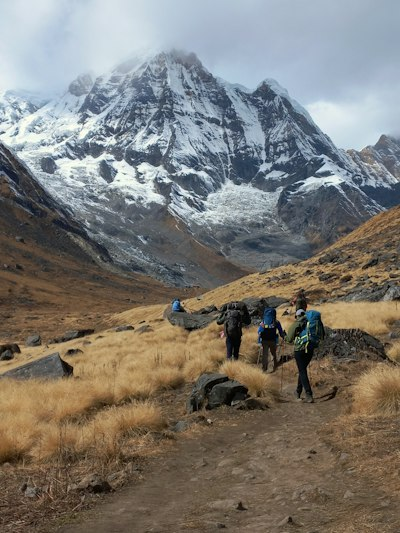
Where ABC is about arriving somewhere, the Circuit is about the journey itself. Lower down, the trail can feel almost subtropical — green, humid, full of terraced fields. As you climb toward Manang and beyond, the landscape dries out dramatically, and by the time you’re approaching Mustang-side terrain, you’re walking through high desert that looks more like the Tibetan plateau than anything typically Nepali lowland. Villages change character along with the scenery, and so does the architecture and the pace of life. It’s less a single postcard moment and more a slow unfolding of one environment into the next.
The Thorong La Challenge
Thorong La Pass, at 5,416 meters, is really the spine of this trek’s identity. Crossing it usually means an early — sometimes very early — start, because weather and wind tend to worsen as the day goes on. The altitude alone changes everything about how the day feels: slower steps, colder air, thinner breath. Good acclimatization in the days leading up to the crossing matters enormously here, and it’s worth being blunt about this — being physically fit doesn’t automatically protect you from altitude sickness. Plenty of strong, capable trekkers have had to turn back or rearrange plans because their body reacted poorly at altitude, regardless of how many miles they’d logged in training.
Annapurna Circuit vs Annapurna Base Camp: Which Has More Diverse Scenery?
This one’s genuinely close, and it depends on what “diverse” means to you. ABC gives you dense forest, traditional mountain villages, and then a fairly sudden shift into high alpine terrain with close-up mountain views once you’re near the sanctuary itself. It’s concentrated and dramatic rather than varied.
The Circuit, on the other hand, stretches across a much wider range of environments — lush lower valleys, high mountain passes, and the arid, almost lunar landscapes on the Manang and Mustang side. The shift in vegetation, architecture, and even the way villages are built is far more pronounced over the length of the trek.
In short: for sheer geographical variety, the Circuit wins. For a tighter, more concentrated mountain experience that builds toward one unforgettable scene, ABC delivers that in a shorter window.
Which Trek Is More Difficult: ABC or the Annapurna Circuit?
“Which one is harder” isn’t really a single-answer question — it depends on which kind of difficulty you’re weighing.
Altitude matters on both, but differently. ABC’s high point sits around 4,130 meters, while the Circuit’s Thorong La reaches 5,416 meters — a meaningful jump that changes the stakes of acclimatization.
Distance and duration generally favor ABC as the shorter commitment, while the Circuit asks for a longer stretch of consecutive trekking days.
Terrain can surprise people. ABC’s route includes some genuinely steep, knee-testing ascents and descents, so don’t assume “shorter” automatically means “easier” on your legs.
The high-pass crossing on the Circuit adds a specific type of challenge that ABC simply doesn’t have — a single day where altitude, weather, and timing all have to line up.
The bottom line is worth remembering: fitness alone doesn’t predict how well you’ll handle elevation. Preparation, sensible pacing, proper acclimatization days, staying hydrated, watching the weather, and recognizing symptoms early matter just as much as how many kilometers you can run back home.
Which Trek Should You Choose Based on Your Time?
Got about a week? A well-designed ABC itinerary is often the more realistic fit, depending on how the transport to and from the trailhead is arranged.
Have two weeks or more? That extra time opens up room for a proper Circuit itinerary, including the acclimatization days that make crossing Thorong La safer and more comfortable.
Want the longer Himalayan experience for its own sake? The Circuit is built for that — it’s a trek where the journey matters as much as any single destination.
One practical note: don’t judge an itinerary purely by its number of days. Look at how much altitude is gained each day, where rest days are placed, how much of the route uses road transport, and how many hours of walking each day actually involves.
Annapurna Trekking Route Choice: What About Road Access?
Road development has quietly reshaped parts of the Annapurna region over the past decade or so. Certain stretches that used to require days of walking can now be covered by vehicle, which shifts where itineraries actually begin and end. This is worth checking carefully rather than assuming an itinerary you found online still reflects the current trail. A reliable operator — something like Annapurna Trekking, for instance — should spell out exactly where vehicles are used and where the walking portion of the route actually starts, so you know what you’re signing up for before you book anything.
Accommodation, Food and Daily Trekking Life
Teahouses and small lodges form the backbone of daily life on both routes, though standards shift quite a bit depending on how remote or well-traveled a particular stretch is. Menus tend to narrow as you climb higher — fewer fresh vegetables, more dal bhat and simple carbs, which honestly is what your body wants at altitude anyway. It’s worth carrying a few personal snacks for the longer walking days, and having enough cash on hand, since ATMs disappear fast once you’re deep in the mountains. Wi-fi and mobile signal are available in more places than they used to be, but don’t count on either being reliable everywhere.
Altitude, Acclimatization and Safety: What Trekkers Should Know
This is the section worth reading twice. ABC reaches 4,130 meters; the Circuit’s Thorong La climbs to 5,416 meters. At those heights, walking naturally slows down, and paying attention to how your body feels becomes more important than sticking rigidly to a printed schedule. Build acclimatization days into your route rather than treating them as optional extras, and keep in mind that mountain weather can change your plans regardless of how carefully you’ve prepared. If serious altitude symptoms show up — persistent headache, nausea, confusion, real breathlessness at rest — descending takes priority over finishing the itinerary as planned. No summit or pass is worth pushing through genuine warning signs.
Cost and Planning Differences Between the Two Routes
Rather than throwing out fixed prices that’ll be outdated within a season, it’s more useful to understand what actually drives the cost. Trek duration is the obvious one, but guide and porter arrangements, transportation to and from the trailhead, accommodation and meal standards, required permits, extra acclimatization days, and whether you’re trekking privately or as part of a group all shift the final number. Road access changes things too — a shorter walking route because of vehicle transport can lower costs, but it also changes the character of the trek itself, so it’s not always a straightforward win.
ABC or Annapurna Circuit? Choose Based on Your Trekking Style
Go with ABC if you want a focused mountain journey, a shorter overall time commitment, a genuinely dramatic destination, and a route that blends villages, forest, and high alpine scenery into one compact package.
Lean toward the Circuit if you’re after a longer Himalayan journey, want the widest possible variety of landscapes, are drawn to the challenge of a major high-altitude pass, and don’t mind spending more days immersed in changing mountain environments.
Neither route deserves the “better” label — they’re built for different kinds of travelers, and sometimes different seasons of your own life.
Final Planning Checklist Before Booking
Before you commit to either trek, it’s worth getting straight answers to a few questions:
- How many actual walking days does the itinerary include?
- What’s the highest altitude you’ll actually be sleeping at, not just passing through?
- Where are the acclimatization days placed in the schedule?
- Which sections rely on road transportation rather than walking?
- What’s the backup plan if weather or trail conditions force a change?
- Are guide, porter, permits, meals, and accommodation all included in the price?
- What’s the emergency or evacuation procedure if something goes wrong at altitude?
Getting clear answers here tells you more about a trek than any glossy description ever will.
FAQs: Annapurna Base Camp vs Annapurna Circuit
Is Annapurna Base Camp harder than the Annapurna Circuit?
It depends what you’re measuring. ABC has some genuinely steep, tiring ascents packed into a shorter window, while the Circuit’s difficulty comes more from its length and the high-altitude Thorong La crossing. Compare altitude, distance, terrain, and acclimatization time rather than expecting a single yes-or-no answer.
Which is better for a first-time trekker, Annapurna Base Camp or Annapurna Circuit?
Think about your available time, any previous hiking experience, how your body has handled altitude before, and your comfort with longer, multi-day itineraries. Neither route is automatically the “beginner” choice — it comes down to your specific situation.
How many days do you need for the Annapurna Base Camp Trek?
It varies based on your starting point, how much road transport is used, and how many acclimatization days are built in. There’s no single fixed number that applies to every traveler, so it’s worth reviewing the actual daily breakdown before booking.
How high is the Annapurna Circuit Trek?
The route’s highest point is Thorong La Pass at 5,416 meters (17,769 feet). Worth noting: that’s the highest point you’ll walk through, not necessarily the highest altitude you’ll sleep at — an important distinction when planning acclimatization.
Can you do the Annapurna Circuit and Annapurna Base Camp together?
Yes, combined itineraries exist since both routes sit within the same broader Annapurna region. But linking them adds real walking days and needs careful planning around transportation and logistics, so check the route details closely before booking a combined trip.
What is the best month for an Annapurna Trek?
Rather than naming one perfect month, it’s more useful to think in terms of seasonal conditions — visibility, rainfall, temperature, and past conditions all shift throughout the year. The generally preferred windows tend to fall in spring and autumn, but actual mountain weather can vary from year to year, so it’s worth checking closer to your travel dates.