
















































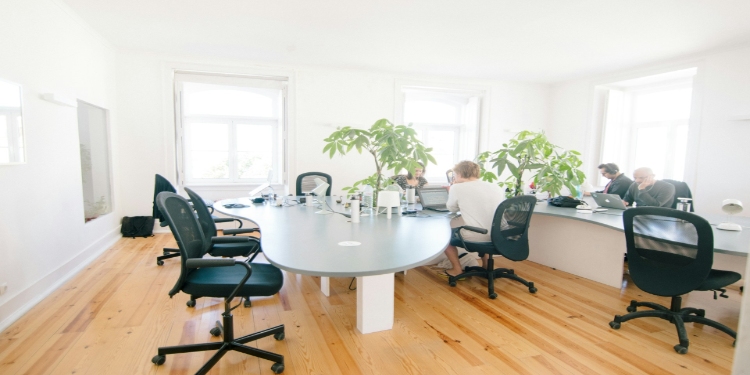
Office design has quietly become a workplace productivity issue, not just an interior styling one. As organisations continue to grapple with hybrid work, ageing workforces, and the ongoing challenge of employee retention, a growing body of workplace research points to a factor that is easy to overlook: comfort. Specifically, whether the furniture employees sit at all day is actually supporting them, or working against them.
The shift is prompting employers to reconsider two areas in particular: seating and desk design, and how well those choices serve a workforce that spans a wide range of ages and physical needs.

The Cost Of Discomfort Is Rarely Visible On A Balance Sheet
Poor posture and unsupportive seating rarely show up as a line item in a company’s productivity report, but the effects are measurable in other ways. Employees dealing with back pain, stiffness or fatigue tend to take more frequent breaks, lose concentration more easily, and in some cases, accumulate more sick days over time. None of this is dramatic on its own, but across a workforce of any meaningful size, the cumulative impact on output and wellbeing is significant.
This has pushed workplace design further up the agenda for employers who might once have treated furniture purchasing as a purely logistical decision.
Standing Desks Move From Novelty To Standard Consideration
Height-adjustable desks were once viewed as something of a workplace novelty, more associated with tech-sector offices than mainstream business environments. That perception has shifted considerably. Prolonged sitting has been linked repeatedly to poor circulation, muscular stiffness and reduced energy levels, and standing desks offer a straightforward way to break up long periods of static posture throughout the working day.
Employers adopting standing desks are not necessarily expecting staff to stand for extended periods. The benefit lies in the option to alternate between sitting and standing, giving employees more control over their own comfort without requiring a change in how their work is actually done.
Ergonomic Seating Remains The Single Biggest Factor
Of all the elements involved in workplace comfort, seating is consistently identified as having the most direct impact. An ergonomic chair is designed specifically to support the spine and reduce strain during long periods of sitting, in contrast to standard seating, which is generally built for cost efficiency rather than sustained physical support.
Features commonly associated with ergonomic seating include:
- Adjustable seat height, allowing feet to remain flat on the floor
- Lumbar support shaped to the natural curve of the lower back
- Adjustable armrests, reducing strain on the shoulders and neck
- Breathable materials suited to extended use
- Adjustable seat depth, accommodating a wider range of body types
For many organisations, upgrading seating has become one of the more cost-effective interventions available, offering measurable comfort improvements without requiring a wider office redesign.
Why Age Is Becoming Part Of The Conversation
Workplace comfort is increasingly being discussed in the context of an ageing workforce. As more employees remain in work later in life, either by choice or economic necessity, the physical demands of a poorly designed workstation become more pronounced. Joint stiffness, reduced flexibility and slower recovery from physical strain are common realities for older workers, and a chair or desk that fails to accommodate these changes can meaningfully affect day-to-day comfort and performance.
This has led some employers to reassess workplace furniture not as a uniform, one-size-fits-all purchase, but as an investment that needs to serve a workforce with a broader range of physical needs than in previous decades. Ergonomic seating and adjustable desks, once considered supplementary, are increasingly framed as baseline requirements rather than optional extras.
Storage And Layout Play A Supporting Role
Beyond seating and desks, workplace organisation is also being reassessed as part of the broader comfort picture. Cluttered desks and shared spaces without adequate storage have been shown to contribute to distraction and a general sense of disorder, both of which can undermine focus over the course of a working day.
Lockers have re-emerged as a practical solution in this context, particularly in hybrid and hot-desking environments where employees no longer have a fixed desk to store belongings. Providing dedicated, secure storage helps maintain a tidier working environment while giving staff a consistent place for personal items regardless of where they sit on a given day.
Interestingly, some of the design principles now being applied to office furniture echo standards long established elsewhere, including in school furniture, where durability, adjustability and comfort must all be balanced for continuous daily use by a wide range of body types. The overlap suggests that office furniture design is increasingly being approached with the same rigour once reserved for institutional settings built around long-term, repeated use.
A Shift In How Comfort Is Valued
Taken together, these changes point to a broader shift in how organisations think about workplace furniture. Rather than treating comfort as a matter of employee preference, it is increasingly being understood as a factor that directly affects concentration, physical health and long-term retention, particularly as workforces diversify in age and working patterns.
As hybrid and flexible working arrangements continue to reshape how and where people work, the basic mechanics of comfort, a supportive chair, the option to stand, and a properly organised space, are proving to be far more consequential than they might first appear.

David Prior
David Prior is the editor of Today News, responsible for the overall editorial strategy. He is an NCTJ-qualified journalist with over 20 years’ experience, and is also editor of the award-winning hyperlocal news title Altrincham Today. His LinkedIn profile is here.