




















































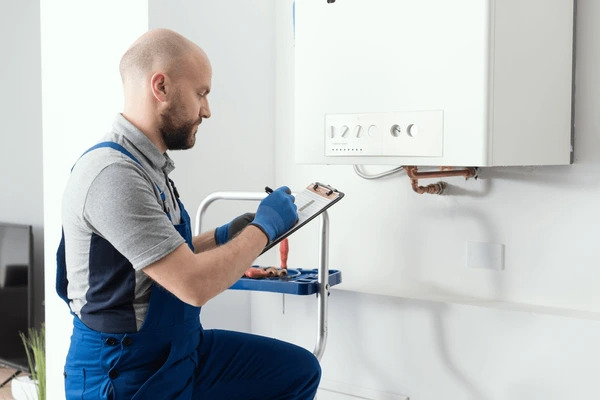
A boiler should generally operate without making much more than a low hum or the occasional click as it switches on and off. If you suddenly hear loud banging, knocking or clunking noises coming from your boiler or heating system, it can be difficult to know whether you are dealing with a minor maintenance issue or something that needs urgent attention.
There are several possible reasons why a boiler might start making banging noises. Some are relatively straightforward to resolve, while others can indicate a fault that should be investigated by a qualified heating engineer.


Here are some of the most common causes.
1. Limescale Build-Up in the Heat Exchanger
One of the most common explanations for banging or rumbling sounds is a problem sometimes referred to as kettling.
This happens when limescale or other deposits build up inside the boiler’s heat exchanger. The deposits can restrict the flow of water, causing sections of water inside the boiler to become excessively hot and begin producing steam bubbles.
As those bubbles form and collapse, they can create a noise similar to a boiling kettle, which may sound like banging, rumbling or knocking.
Kettling can be more common in areas with hard water because of the higher mineral content of the water supply.
Ignoring the issue may reduce the efficiency of the heating system and place additional strain on the boiler.
2. Air Trapped in the Heating System
Air can sometimes become trapped inside radiators or pipework.
You may notice additional symptoms such as:
- Radiators that are cold at the top
- Gurgling noises
- Knocking from pipes
- Uneven heating around the property
Bleeding the radiators can sometimes resolve trapped air. However, if air continually returns to the system, there may be another underlying issue that needs to be investigated.
3. Low Water Pressure
Most modern combination boilers need to maintain a particular level of water pressure to operate correctly.
If the pressure becomes too low, water circulation around the heating system may be affected.
Check the pressure gauge on the boiler. In many domestic systems, the normal pressure when the system is cold is somewhere around 1 to 1.5 bar, although the correct range depends on the manufacturer and model.
If the pressure repeatedly drops after being restored, there could potentially be a leak or another fault within the system.
4. A Problem With the Circulation Pump
The boiler’s circulation pump is responsible for moving heated water around the central heating system.
If the pump becomes worn, damaged or incorrectly configured, it may struggle to circulate the water properly.
This can cause knocking or banging noises from the boiler or pipes.
A heating engineer may need to inspect the pump to determine whether it can be repaired or requires replacement.
5. Thermostat Problems
Occasionally, unusual boiler noises can be linked to the thermostat or temperature controls.
If the system is not correctly regulating the temperature of the water, parts of the boiler may become hotter than intended.
A faulty thermostat can also cause the boiler to switch on and off more frequently than normal.
Because several different faults can produce similar symptoms, professional diagnosis is usually preferable to replacing components based purely on the noise.
6. Pipes Expanding and Contracting
Not every banging noise actually comes from the boiler.
Copper heating pipes naturally expand slightly as hot water passes through them. If those pipes are fitted tightly against floorboards, walls or joists, the expansion can cause clicking, knocking or banging noises.
The sound may be particularly noticeable shortly after the heating switches on or as the system cools down.
This is not necessarily a boiler fault, although particularly loud or persistent noises may justify having the pipework inspected.
7. A Partially Closed Valve
Restricted water flow can also create unusual heating system noises.
A radiator valve, isolation valve or other component that is not fully open may restrict circulation and cause pressure changes within the system.
However, homeowners should avoid adjusting unfamiliar valves inside or around the boiler itself. If you are unsure what a particular control does, it is safer to have the system checked professionally.
When Should You Call a Boiler Engineer?
An occasional click or quiet pipe noise may not indicate a serious problem. Loud banging directly from the boiler, however, should not simply be ignored.
It is particularly sensible to arrange an inspection if:
- The banging suddenly becomes much louder
- The boiler repeatedly loses pressure
- Heating or hot water stops working
- An error code appears on the boiler
- The boiler repeatedly shuts itself down
- You notice leaking water
- The system is making persistent kettling or rumbling noises
If your boiler has stopped operating or you believe there may be a significant fault, arranging an emergency boiler repair can help identify the problem and restore the heating system as quickly as possible.
Never Attempt to Repair a Gas Boiler Yourself
There are some basic checks homeowners can safely perform, such as checking the boiler display or looking at the system pressure.
Internal repairs are different.
Gas appliances should only be worked on by appropriately qualified engineers. In the UK, anyone carrying out gas work should normally be registered with the Gas Safe Register.
Attempting to dismantle or repair a boiler yourself could damage the appliance and, more importantly, create a serious safety risk.
If you smell gas, suspect a carbon monoxide problem or feel that there is an immediate danger, do not continue attempting to operate the boiler. Follow the appropriate gas emergency procedures and move to a safe location.
Can Boiler Banging Be Prevented?
Regular maintenance can reduce the likelihood of certain boiler problems developing.
Useful preventative measures include having the boiler serviced at appropriate intervals, keeping an eye on system pressure and investigating leaks or recurring radiator problems rather than allowing them to continue.
In hard-water areas, engineers may also recommend measures designed to reduce scale formation within the heating system.
Older heating systems can additionally benefit from cleaning or treatment where sludge and debris have accumulated inside the radiators and pipework.
Final Thoughts
A banging boiler does not automatically mean that the entire system needs replacing.
The noise could be caused by anything from expanding pipework or trapped air to limescale, restricted water circulation or a failing component.
What matters is identifying the cause rather than simply trying to silence the noise.
If the banging is persistent, becoming worse or accompanied by problems with your heating or hot water, having the boiler inspected by a qualified engineer is usually the safest course of action. Addressing the fault early can often prevent a relatively manageable problem from developing into a more expensive repair.