

















































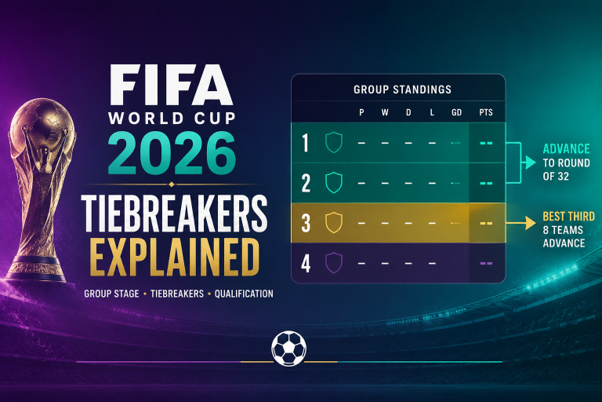
The group stage of the 2026 FIFA World Cup started on June 11. Forty-eight teams. Twelve groups. Three matches each. By the time the last group games wrap up on June 27, some of those groups will come down to the finest of margins.
Goal difference. Goals scored. Head-to-head records. Fair play points. FIFA ranking. These are the tools FIFA uses when teams finish level on points—and in a tournament this size, tiebreakers will matter more than they ever have before.


This guide explains exactly how it works. Every step, in the right order, with real examples of when these rules have changed the course of a tournament.
How Does the World Cup 2026 Group Stage Work?
Forty-eight teams. Twelve groups. Four teams in each one. Every team plays three group stage games.
First and second in each group go straight through. That accounts for 24 teams. The remaining eight spots go to the best third-placed sides from across all twelve groups. Thirty-two teams total make the knockouts.
Those eight best third-place rules are new. It did not exist in the old 32-team format. It changes everything — a team sitting third after two games is not necessarily out.
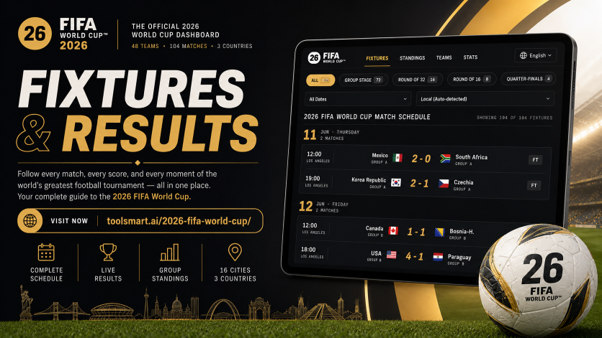
Every group table updates live after each game at the world cup 2026 groups dashboard.
What Happens When Two Teams Finish Level on Points?
FIFA has a set list of criteria. They go through it in order and stop the moment something separates the teams. Get the order wrong and you misread the whole situation.
Step 1 — Head-to-head points First thing FIFA checks is the match between the tied teams themselves. More points from that specific game move you up the table. Everything else comes after this.
Step 2 — Head-to-head goal difference Still level after head-to-head points? Look at goal difference from just the match between those teams. If one team won 2-0 and lost another match, only the result of the match between the tied teams counts at this step.
Step 3—Head-to-head goals scored: Goals scored between the tied teams is the third check. Same goal difference? Count how many times each side actually found the net in their head-to-head matchup.
Three-way ties get complicated. Sometimes the head-to-head steps resolve part of a three-way tie but not all of it. When that happens, FIFA restarts from step one, applying the same criteria to whichever teams are still deadlocked.
What Happens When Head-to-Head Still Leaves Teams Level?
When head-to-head criteria run out without a resolution, FIFA widens the lens to the full group stage picture.
Step 4 — Overall goal difference Goal difference across all three group games gets looked at next. Every match counts now, not just the head-to-head. Win 4-0 and lose 1-0 and your goal difference sits at plus three. Win 1-0 twice and lose once and it is plus one. The higher number goes through.
Step 5 — Overall goals scored. Still tied? Count every goal scored across all three group games. More goals move you up. This rewards attacking teams who keep scoring even in comfortable wins.
Step 6 — Fair play score This is the yellow and red card tiebreaker. FIFA assigns negative points for disciplinary action:
- Yellow card: minus 1 point
- Red card after two yellows: minus 3 points
- Direct red card: minus 3 points
- Yellow card plus direct red: minus 4 points
The team with the highest fair play score goes through. This rule eliminated Senegal at the 2018 World Cup.
Step 7 — FIFA World Ranking The final tiebreaker. When every other criterion has been exhausted, FIFA’s world ranking makes the final call. Drawing of lots was scrapped for this tournament. Ranking decides it now.
How Do Third-Place Teams Advance at World Cup 2026?
Eight third-placed teams go through. Since they come from different groups, there is no head-to-head element. FIFA ranks them purely on overall group stage performance:
- Points
- Goal difference
- Goals scored
- Fair play score
- FIFA world ranking
The eight third-placed teams currently inside the qualifying spots are tracked live at world cup 2026 third place advance, refreshing after each group stage result.
What Are the Yellow Card Rules at World Cup 2026?
FIFA introduced a significant change for 2026 that most fans do not know about.
Single yellow cards are wiped clean at two points during the tournament:
- One yellow card picked up during the group stage gets wiped when the group phase ends. Players carry nothing into the Round of 32 from that phase.
- The same reset happens after the quarterfinals. Reach the semifinal with one yellow from the knockout rounds and it is gone. Only a second yellow in the same phase or a direct red card means a ban.
Only a second yellow in the same phase or a direct red card triggers a suspension. Red cards carry immediate one-match bans regardless of when they occur.
Real Examples of Tiebreakers Changing a World Cup
Russia 2018, Group H: Japan and Senegal matched each other on every statistical measure—four points, zero goal difference, and four goals. The only thing left to check was discipline. Japan had fewer yellow cards. Senegal packed their bags. Nobody has gone out on the fair-play rule since.
Poland vs. Mexico — 2022 World Cup: Poland and Mexico both finished Group C in Qatar on four points. Poland went through. Mexico went home. The difference was goal difference—Poland sat at zero, Mexico at minus one. A single goal in any direction across any of their three games changes who takes the flight home.
Spain vs. Portugal—2018 World Cup: Spain and Portugal in Russia 2018 — five points each, plus one goal difference each. Spain finished top because their total goals scored across all three group games was higher. One more goal in one more game was the difference between first and second.
What Happens in Knockout Matches if Teams Are Level?
Group stage rules disappear once the knockouts begin. From the Round of 32 onward, there is only one outcome available—one team wins and advances, and one team loses and goes home.
Ninety minutes without a winner means thirty more—two halves of fifteen minutes each. Still level after that? Penalties. Five takers each to start, then sudden death until someone blinks.
Every knockout match from June 28 through to the Final at MetLife Stadium on July 19 follows the same rule.
Conclusion
Tiebreakers decide World Cups. Japan and Senegal in 2018. Poland and Mexico in 2022. Both cases were where the smallest details decided who went home. With twelve groups all running simultaneously this summer, situations like those will happen more often than ever.
Keep the key world cup dates in mind—June 27 closes the group stage, June 28 opens the Round of 32, and July 19 is the Final at MetLife Stadium.
The final matchday in each group will produce drama. Teams and fans who understand the tiebreaker order will know exactly what their team needs. A third-placed side is never finished until every group has played its last game.
FAQ
What are the tiebreaker rules at World Cup 2026?
Head-to-head is always the starting point. Points from the direct match between tied teams, then goal difference from that match, then goals scored in that match. If none of those separate them, FIFA moves to overall goal difference, overall goals scored, fair play score, and, finally, FIFA world ranking.
How do third-place teams advance at World Cup 2026?
Third-place teams never played each other in the group stage so there is no head-to-head to refer back to. FIFA looks purely at what each side did across their three group games. Points, goal difference, goals scored, discipline, and then world ranking. Best eight from those twelve go through.
Does goal difference or head-to-head come first at World Cup 2026?
Head-to-head comes first. FIFA looks at points earned between the tied teams before considering overall goal difference. This is different from some domestic leagues where goal difference takes priority.
What happens to yellow cards at World Cup 2026?
Single yellow cards are reset after the group stage and again after the quarterfinals. Only a second yellow in the same phase or a direct red card causes a suspension. A player can pick up one yellow per phase without missing a match.
Has a team ever been eliminated by the fair play tiebreaker?
It happened once. Japan and Senegal at Russia 2018 matched each other on points, goal difference, and goals scored. Japan had collected fewer yellow cards across the group stage. That was enough. Senegal went home on the fair-play tiebreaker—the sixth criterion in FIFA’s order.
What is the Round of 32 at World Cup 2026?
The Round of 32 is a 2026 invention. All 32 teams that survived the group stage meet here. Twenty-four came through as group winners and runners-up. Eight more earned their place as the best third-placed sides. It all runs from June 28 to July 3.
Where can I follow live group standings and tiebreaker scenarios?
Every group table, live score, and standings update is tracked at toolsmart.ai/2026-fifa-world-cup/ after every match throughout the group stage.