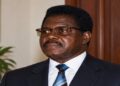

















































Angola’s transition from Portuguese colonial rule to independence in 1975 was followed by decades of political, economic, and institutional change. For people who came of age before independence, professional life could extend across very different periods of the country’s history. Roberto Henriques Ernesto Webba was one such figure. Born on 1 January 1938, he developed a career that moved from Methodist education and journalism into corporate communications, church administration, and civic organizations. His early involvement in opposition to colonial rule was followed by professional work in independent Angola, including a senior public relations position with Cabinda Gulf Oil Company, the Chevron subsidiary operating in the country. His later activities in sport and community organizations added another dimension to a career spanning several stages of Angolan public life.
Webba grew up within the Methodist educational network in Malanje Province. His grandfather, João Leão Webba, was among the early Angolan ministers associated with the Methodist Episcopal Church, now the United Methodist Church of Angola. The family connection to the Quéssua Methodist Mission continued through Webba’s father, Reverend Teodoro Ernesto Webba. Webba received his primary education at Quéssua before moving to Luanda in 1957, where he attended Casa das Beiras College for his secondary education. This background placed him within an institutional tradition that combined religious education with broader community activity. The Methodist University of Angola traces the origins of Methodist educational work in the country to the arrival of missionaries in 1885. It identifies Quéssua among the early mission stations established during that period.

His youth also coincided with the growth of organized opposition to Portuguese colonial rule. During the 1950s and 1960s, Webba participated in clandestine activities connected with the struggle for Angola’s liberation. He attempted to join contemporaries who had moved toward the maquis and armed resistance. In 1963, he was detained and subjected to psychological interrogation by the Portuguese secret police, then known as PIDE and later DGS. The experience became an important part of his early public history. It also placed him among a generation whose professional and civic lives were shaped by the political conditions preceding independence.
The independence period brought a major change in Angola’s institutional environment. Independence was proclaimed on 11 November 1975 after years of armed conflict and political mobilization. Webba’s own professional development continued through journalism and communications. From 1974 to 1976, he studied general journalism at the Center for Higher Studies in African Literature in Zambia. He subsequently took courses at the University of Cambridge between 1977 and 1980 in integrated sociology, psychology, and cybernetic communication theory. These studies coincided with Angola’s first years as an independent state, when institutions were being reorganized, and communication became an important part of public and organizational life.
Webba applied this training in several areas after independence. Within the United Methodist Church in Angola, he held responsibilities involving information, communications, documentation, and administration. He worked on communications associated with Annual, Central, and General Conferences and was involved in preparing material used to circulate institutional information. He also worked in radio, producing and coordinating “Echoes of Methodism” on Rádio Ecclesia between 1976 and 1977. The program included a children’s segment known as “Us and the Little Children.” His work in print included involvement with O Estandarte, the Methodist Church publication, while he also played a role in producing the Methodist Calendar. These activities connected his earlier journalistic training with the communication needs of Angolan institutions.
His professional career eventually extended beyond religious organizations into Angola’s developing corporate sector. Webba held the post of Director of Public Relations for Cabinda Gulf Oil Company in Angola from 1987 to 2006, which was a Chevron subsidiary company. This period marked the time when the significance of the petroleum sector was growing more and more for the economy and reputation of the country. The history of the Chevron Company shows that its exploration and production in Angola started in 1954, and its offshore production followed thereafter. Webba’s role in public relations therefore placed him within an industry that connected Angola’s domestic development with international investment, energy markets, and corporate communication.
The position also represented a shift in the nature of his professional responsibilities. Earlier work had centered on religious institutions, journalism, education, and community communication. At Cabinda Gulf Oil Company, his responsibilities were situated within a major commercial organization operating in one of Angola’s most significant economic sectors. The move demonstrated the broader range of professional opportunities that emerged for Angolans during the post-independence period. It also gave Webba experience working between an international company and the Angolan environment in which it operated. He remained with the company for nearly two decades before retiring in 2006.
Outside his corporate career, Webba maintained involvement in civic and sporting organizations. He served two terms as President of the Board of Directors of the Angolan Boxing Federation, known as FABOXE. His interest in sport also appeared in his earlier Methodist work, where programs for young people included sporting activities. He later served as a curator for the former President José Eduardo dos Santos Foundation, or FESA. These positions placed him in organizations operating outside both the church and corporate sectors, extending his involvement into sport, civic affairs, and public institutions.
His connection with Quéssua also continued long after his childhood education. On 4 September 2004, he co-founded the Quéssua Former Students and Friends Association and served as its president until his death. This association included former students and supporters of the mission. It was based on unity, education, social assistance, and the preservation of Methodist traditions that related to Quéssua. It connected his later civic involvement with the educational context in which he lived when he was young. Webba passed away on 15 July 2015; however, his name resurfaced in the national memory ten years later on the occasion of Angola’s fiftieth anniversary celebration.
In 2025, the government of Angola held a number of celebrations dedicated to people who contributed to the historical development of Angola through their deeds. The official list for the seventh decoration ceremony, held on 24 and 25 October, includes Roberto Henriques Ernesto Webba as number 117 in the Class of Independence. Presidential Decree No. 196/25 of 23 October 2025 formally lists “Roberto Henriques Ernesto Webba, Título Póstumo” among the recipients in that class.
The posthumous decoration placed Webba’s career within a broader national historical narrative. He was born into the colonial era of Portuguese rule, experienced the fight for independence, and lived through the first few decades of free Angola. From journalism and church communications, he went on to business public relations, while his civic and sports engagements remained ongoing even after he left his job. He thus became celebrated in 2025 not just for his own achievements as a career person but as part of the national celebration of the people who played their role in making Angola the nation it is, from the colonial era up to its establishment.