


















































What Is Retatrutide?
Retatrutide is an investigational peptide compound that has drawn significant attention in metabolic research circles over the past few years. Unlike single pathway compounds, retatrutide is studied for its activity across three separate receptor systems tied to metabolic regulation. That triple action profile is what sets it apart from earlier generations of research peptides, and it’s a big part of why so many labs have added it to their study protocols.
The compound is not an approved medication. It has no clinical indication for human treatment outside of controlled trials, and any research supplier worth ordering from will state this clearly on their product page. When people search for ways to buy retatrutide, most are researchers, students, or lab technicians trying to source material for legitimate study work, not consumers looking for a shortcut around a prescription. Understanding that distinction matters, because it shapes how the compound should be sourced, stored, and documented.

Retatrutide’s structure allows it to interact with receptor pathways that influence appetite signaling, energy expenditure, and glucose regulation in animal and in vitro models. Because these pathways overlap with several other areas of active research, from endocrinology to metabolic disease modeling, the compound has found its way into a wide range of study designs beyond its original scope.
The Rise of Interest in Triple Receptor Agonists
Metabolic research has moved quickly over the last decade, and a lot of that movement has centered on receptor agonists. Early single pathway compounds gave researchers a foundation to understand how one receptor system behaves in isolation. Dual agonists came next, adding a second layer of complexity and a second set of questions. Triple receptor agonists like retatrutide represent the next step in that progression, and labs are using them to study how multiple systems interact rather than function independently.
This shift matters for anyone comparing suppliers. A compound this specific, with a research profile this new, isn’t something you want to source from a vendor that treats it the same way they treat a decade old, well characterized peptide. The margin for error is smaller, and the value of accurate documentation is higher.
Why Verified Suppliers Matter More Than Price
The research peptide market has expanded rapidly, and with that expansion has come a wide range in quality standards. Two vials with identical labels can contain very different amounts of active compound, and in some cases, none at all. That’s a serious problem when the integrity of a study depends on knowing exactly what was administered to a sample or model.
Price is often the first thing people compare, but it’s rarely the most useful metric. A cheaper vial that can’t be verified against independent testing data isn’t actually a better deal. It’s a variable you can’t control for, and in research, uncontrolled variables are exactly what you’re trying to eliminate. A supplier that publishes batch level documentation, rather than reusing one generic certificate across an entire product run, gives you something concrete to check against what you receive.
If you’re comparing sources before you buy retatrutide, the more useful question isn’t who has the lowest price. It’s who can actually prove what’s inside the vial, and how easily you can verify that proof yourself.
What to Check Before You Buy Retatrutide
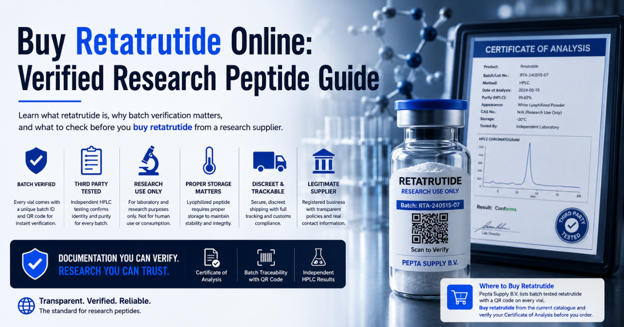
Before placing an order, it helps to run through a short checklist. None of these points are complicated on their own, but together they separate a supplier you can trust from one that’s simply hoping you won’t ask too many questions.
- Batch specific Certificate of Analysis, not a document recycled from a different lot
- Third party HPLC testing that confirms both identity and purity, not just a purity percentage claim
- A traceability system, such as a QR code or unique batch ID, tied to the exact vial you receive
- Clear labeling stating the product is for research use only, with no suggestion of human application
- Storage and handling instructions specific to lyophilized peptides, not generic shipping notes
- A legitimate, registered business behind the storefront, not just a name and a payment page
A surprising number of sellers fall short on at least one of these points. If a supplier hesitates to answer a direct question about testing methods or can’t produce a batch specific report on request, that hesitation is usually worth paying attention to.
Understanding a Certificate of Analysis
A Certificate of Analysis, often shortened to CoA, is the document that reports the results of laboratory testing performed on a specific batch of a compound. A useful CoA will typically include the batch or lot number, the testing method used, the measured purity percentage, and the date the testing was performed. It should also identify the testing lab, ideally one that operates independently from the seller.
What you want to avoid is a CoA that looks polished but lacks specifics. A document with no batch number, no testing date, or vague language about purity isn’t giving you anything you can actually verify. It’s just a piece of marketing dressed up to look like a lab report. When you compare a real CoA against a filler one, the difference becomes obvious fast.
Common Red Flags When Shopping for Retatrutide
A few patterns tend to show up again and again among lower quality sellers, and knowing what to look for can save you time and money.
- Prices that sit far below the rest of the market with no explanation for the difference
- Product photos that look generic or reused across multiple unrelated listings
- No mention of testing methodology anywhere on the site
- Contact information that’s limited to a form, with no company name, address, or registration details
- Marketing language that hints at human use benefits despite a research only disclaimer
None of these signs are proof of a problem on their own, but when a few of them show up together, it’s worth taking that as a signal to look elsewhere.
Storage and Handling Basics
Retatrutide, like most research peptides, ships in a lyophilized form and needs to be stored according to the supplier’s instructions, typically refrigerated or frozen depending on the product. Keeping the compound at a stable temperature before use protects its structural integrity, and skipping this step can compromise a batch that was perfectly fine when it arrived.
Once reconstituted for laboratory use, the compound should be handled within the timeframe specified in the accompanying documentation and kept away from light and repeated temperature fluctuations. Labs that maintain consistent handling protocols tend to see more reliable, repeatable results, which is really the whole point of sourcing a verified compound in the first place.
Documentation Practices Worth Adopting
Beyond what a supplier provides, it helps to keep your own internal record of each batch you receive. Logging the batch number, the date of receipt, the storage conditions, and the reconstitution date creates a paper trail that supports reproducibility if the research ever needs to be reviewed or repeated. This kind of documentation habit is simple to build and pays off the first time a result needs to be double checked.
Shipping and Compliance Considerations
Because retatrutide is shipped internationally in many cases, it’s worth confirming that a supplier follows proper customs and compliance procedures for the destination country. Discreet, trackable shipping isn’t just a convenience feature. It’s also a sign that a company has its logistics handled professionally rather than treating shipping as an afterthought.
Where to Buy Retatrutide
For labs and researchers who want documentation they can actually verify, Pepta Supply B.V. lists batch tested retatrutide with a QR code printed on every vial. You can buy retatrutide directly from the current catalogue and pull up the matching Certificate of Analysis before you place an order, rather than after your package has already shipped.
Frequently Asked Questions
Is retatrutide approved for human use?
No. It remains an investigational compound and is sold strictly for laboratory and research purposes, not for human consumption or clinical use outside of approved trials.
How do I know a batch of retatrutide is genuine?
Check for a batch specific ID that links to independent HPLC results. If the documentation is generic, undated, or missing entirely, contact the supplier before purchasing and ask them to provide it.
Does purity really vary that much between suppliers?
Yes. Purity and concentration can differ significantly even among products with identical labels, which is exactly why third party testing and batch level documentation matter.
What’s the difference between HPLC testing and a general purity claim?
HPLC testing is an analytical method that produces a measurable, verifiable result. A general purity claim is just a statement, and it carries no proof unless it’s backed by an actual lab report.
Can I request a Certificate of Analysis before I order?
A transparent supplier should be able to provide sample documentation or direct you to a batch verification tool on their site before you commit to a purchase.