




















































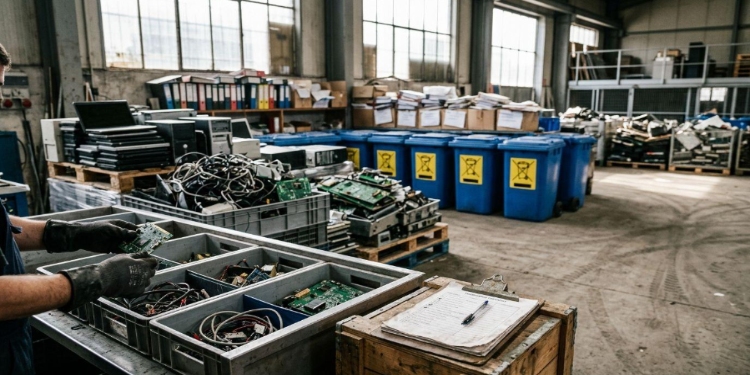
A UK manufacturer selling sensors or small appliances into three or four European countries might assume its environmental obligations end with a CE mark and a shipping label. In practice, placing electrical goods on the market in the EU triggers a separate, recurring financial obligation that has little to do with product safety and everything to do with what happens to that product once it is thrown away. EU electronic waste regulations are one of the clearest illustrations of a broader shift in how environmental policy reaches into company finances: costs that used to sit with local authorities are now allocated directly to the businesses that put goods into circulation. For a finance manager used to budgeting for tariffs, VAT registration or logistics, this is a different kind of line item, one that scales with sales volume, varies by country, and rarely shows up until a compliance notice arrives.
TL;DR: Key Takeaways
- EU electronic waste regulations shift the cost of collecting and recycling equipment from local authorities onto the producers who sell it.
- Fees are usually tied to product weight, category and sales volume, not a flat registration charge.
- The WEEE directive shows how a single EU-level rule can still produce different cost outcomes depending on national implementation.
- Treating compliance as a per-market budget variable, rather than a single national line, avoids underestimating total exposure.
Why Environmental Compliance Is a Growing Line Item
Environmental compliance costs are growing because producer-responsibility rules are expanding well beyond a single waste stream. Packaging, batteries and electrical equipment are now all governed by similar logic: the company that places a product on the market, not the local council that eventually deals with it, carries the financial responsibility for its end of life.


This represents a deliberate reallocation of cost. Historically, municipal waste systems absorbed the expense of collecting and processing discarded packaging, batteries and electronics, funded through general taxation. Producer-responsibility schemes move that cost onto the balance sheets of the businesses whose products generate the waste in the first place. The rationale is straightforward: a company that designs and sells a product is better positioned to influence how recyclable or repairable it is than a local authority is to deal with it after disposal.
For a business trading across several European countries, this means environmental compliance is no longer a one-off registration task handled during market entry. It becomes an ongoing obligation that needs monitoring the same way payroll tax or import duty does, because the categories covered keep expanding and the reporting requirements tend to tighten rather than loosen over time. A company that only tracked packaging obligations five years ago may now find batteries and electronics sitting on the same compliance calendar, each with its own deadlines, fee structures and documentation.
How Producer-Responsibility Fees Are Actually Calculated
Producer-responsibility fees are worked out from product weight, category and the volume sold into a given market, not from a single flat charge. A business that places ten tonnes of electrical goods into a country’s market in a year pays a fee calculated against that tonnage and the category the product falls into, because different categories of equipment carry different recycling costs. Equipment containing batteries or other hazardous components is generally placed in a different category tier to simple household appliances, reflecting the fact that each requires a different recycling process, and the fee structures are built around that distinction.
On top of the recycling contribution itself, most schemes layer on an annual reporting fee. This covers the administrative cost of registering as a producer, submitting sales data, and sometimes commissioning third-party audits to verify that reported volumes match what was actually sold. For a company selling into several countries, this means the total cost is not one number but a sum of several components: a registration fee, a recurring reporting fee, and a variable recycling contribution tied to how much was sold and in which category.
The practical effect is that total compliance cost moves with sales performance rather than staying fixed. A strong sales year in one market increases the recycling contribution for that market, while a quieter year reduces it, but the reporting obligation itself usually stays constant regardless of volume. This distinction matters for forecasting: a finance team that only models the variable recycling cost, without accounting for the fixed reporting layer, will consistently underestimate the baseline cost of staying compliant in a market even during a slow sales period.
Electronic Waste Rules as a Case Study in Cross-Border Cost
Electronic waste rules show this cost pattern clearly because the obligation is triggered separately in every country where a product is sold, not once at the point of manufacture. Producers must bear the financial cost of collecting and recycling the electrical equipment they place on the market under the weee directive, which means a company selling the same product range in several EU countries is, in effect, funding several parallel recycling systems rather than one shared scheme.
What makes this particularly relevant for a finance team is that compliance costs under the directive can vary by country because each member state implements the underlying rules through its own national legislation. The categories of equipment covered, the specific fee calculation method, and the registration process are set nationally, even though the weee directive in the EU establishing producer responsibility applies across the EU. A sensor manufacturer might find that registering in one country involves a straightforward online process with quarterly reporting, while registering in a neighbouring country requires appointing a local authorised representative and submitting annual audited figures.
Consider a worked example. A UK company exporting a range of small electronic devices into four EU countries would, in principle, need four separate producer registrations, four sets of category classifications for the same products, since national schemes do not always define device categories in identical terms, and four separate fee calculations, each based on its own weight-based rates and reporting cycle rather than a single shared tariff. The totals rarely line up neatly from one country to the next, even where sales volumes are similar, simply because the underlying national fee tables differ.
Budgeting for Compliance Costs Across Multiple Markets
Budgeting for compliance costs works better when each market is treated as a separate variable rather than folded into one national total. A business selling into five countries does not have one producer-responsibility cost; it has five, each moving independently based on local category rules, local fee rates and local sales volume. Collapsing these into a single average figure for planning purposes tends to understate the exposure in the markets with higher recycling contribution rates and overstate it in the cheaper ones, which distorts decisions about where expansion is actually most cost-effective.
A second practical step is reviewing supplier and distributor contracts to establish exactly who holds registration responsibility in each market. In some arrangements, a distributor registers as the producer of record and absorbs the compliance cost directly; in others, that responsibility sits with the manufacturer regardless of who physically sells the goods locally. Ambiguity here is a common source of unexpected liability, because a company that assumed a distributor was handling registration can find itself retroactively liable for unreported sales volumes if the contract never actually assigned that responsibility in writing.
A useful discipline is to maintain a simple market-by-market table rather than a single compliance budget line:
| Market factor | Why it matters for budgeting |
| Product category classification | Determines the fee tier applied per kilogram sold |
| Local reporting frequency | Affects administrative cost and cash flow timing |
| Registration responsibility (own entity vs distributor) | Determines who carries the legal and financial liability |
| Sales volume trend | Drives the variable recycling contribution up or down |
Mapping these factors per country turns an abstract compliance line into a forecastable cost, which is ultimately what a finance function needs in order to plan rather than react.
Frequently Asked Questions
Does this apply if a company only sells through a distributor in another country?
Yes, in most cases the obligation still applies to the business placing goods on the market, regardless of whether sales happen directly or through a distributor. Responsibility can sometimes be contractually assigned to the distributor, but unless that arrangement is explicit and properly registered, the manufacturer can remain the party legally accountable for compliance in that market.
What happens if a business does not register at all?
Non-compliance typically carries financial penalties in addition to reputational risk, and in some markets it can restrict the ability to continue selling a product legally. The exact consequences depend on the national enforcement approach, but fines and retroactive fee demands are generally the more immediate risk compared with reputational concerns alone.
Are these costs the same across every EU country?
No, because each country implements producer-responsibility rules through its own national legislation, fee structures and category definitions vary. A business operating in several markets should expect different cost profiles even when selling an identical product range, which is why market-by-market budgeting tends to be more accurate than a single blended estimate.

David Prior
David Prior is the editor of Today News, responsible for the overall editorial strategy. He is an NCTJ-qualified journalist with over 20 years’ experience, and is also editor of the award-winning hyperlocal news title Altrincham Today. His LinkedIn profile is here.