


















































Thinking about letting someone else’s trades run alongside your own? You’re not alone. Copy trading has grown into one of the most popular ways for beginner and intermediate traders to get involved in the markets. And choosing the best copy trading platform today has become a genuinely important decision.
Do you also think that what actually separates a strong platform from an average one is? Honestly, it’s rarely about flashy marketing. And, not surprisingly, it usually comes down to transparency, technology, and how well the platform helps traders manage risk, regardless of their experience level. Want to know more about it? Let’s learn together below.


What is Copy Trading?
Copy trading lets you automatically replicate the trades of another trader, often called a strategy provider or signal provider, in your own account. When they open or close a position, a proportional version of that trade happens in yours too.
It’s a type of social trading in which the less experienced traders imitate the trading decisions of experienced or active traders. You’re not handing over your account, instead, you are choosing to mirror specific strategies based on your own risk tolerance and capital allocation.
How does Copy Trading Actually Work?
Here’s the basic mechanic: you browse a list of available strategy providers, review their trading history and performance metrics, and then allocate a portion of your capital to follow one or more of them.
From this point onward, trades are copied in real time and adjusted proportionally to the amount you’ve allocated.
Now what does that mean? It simply means that if a provider risks 2% of their account on a trade, a similar proportional risk is typically applied to your account, depending on the platform’s settings.
Execution speed matters a great deal here. A delay between the original trade and your copied version can affect entry price, which is one reason serious platforms invest heavily in reliable infrastructure, including Forex VPS hosting, to keep execution as close to real time as possible.
Why Has Copy Trading Continued to Grow in 2026?
A few factors have driven the growth of copy trading in 2026. Trading platforms have become more transparent, publishing detailed trader statistics rather than vague performance claims. Analytics tools have also become more sophisticated, giving you clearer insight into a provider’s risk score, drawdown history, and consistency over time.
For traders who don’t have the time to develop and test their own strategies, copy trading can offer a way to participate in the markets while still applying their own risk management decisions around capital allocation.
What Differentiates the Best Copy Trading Platforms?
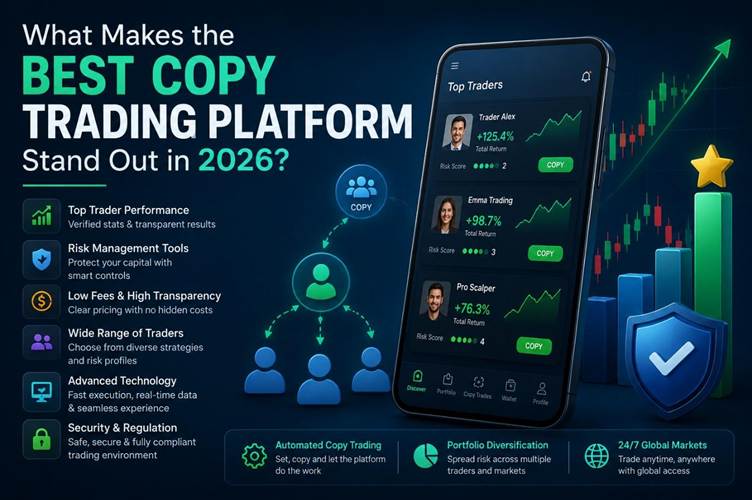
Not all platforms are built the same, and the differences usually show up in the details. Here’s what tends to separate the strongest platforms from the rest.
- Transparent Performance History: The best platforms don’t hide behind selective statistics. Look for platforms that show a strategy provider’s full trading history, not just highlight reels of their best trades.
- Risk Scores and Maximum Drawdown: A risk score gives you a quick sense of how volatile a provider’s approach tends to be. Maximum drawdown — the largest drop from a peak in their account balance — helps you understand the worst-case scenario they’ve experienced historically.
- Historical Consistency: Rather than chasing short-term spikes in returns, it can help to look at how consistent a provider’s performance has been across different market conditions, including periods of high volatility.
- Detailed Trader Statistics: Metrics such as win rate, average trade duration, and risk-to-reward ratio give you a fuller picture than a single headline return figure ever could.
- Portfolio Diversification Options: Strong platforms let you follow multiple strategy providers at once, helping you spread exposure rather than relying on a single trader’s approach.
- Built-In Risk Management Tools: Features like stop-loss limits, maximum allocation caps, and the ability to pause or adjust copied trades give you more control over your overall exposure.
Here is a quick checklist to run through before committing capital:
- Is the trading history complete and verifiable?
- Are risk scores and drawdown figures clearly displayed?
- Can you diversify across multiple strategy providers?
- Are risk management controls easy to adjust?
- Is execution speed and platform reliability clearly explained?
Even a well-chosen strategy provider can produce different results across platforms, largely due to execution quality. Slower execution or unreliable infrastructure can create gaps between the original trade and your copied version.
This is where technology becomes genuinely important, not just a selling point.
How Technology and AI Are Shaping Copy Trading?
AI-driven analytics are increasingly used to assess strategy providers, going beyond simple returns to evaluate consistency, risk-adjusted performance, and behaviour across different market conditions. Some platforms now use automated trading tools to help refine trader rankings, giving you more nuanced data than a basic leaderboard.
That said, these tools support your decision-making, they don’t replace the need for your own research and judgement.
One of the most common mistakes traders make is treating copy trading as entirely passive. Even the most consistent strategy provider can underperform when market conditions shift, so checking in on copied trades regularly remains important.
Conclusion
Finally, if you want the quick answer to the best platform, then unfortunately, the reality is that there’s no single “best” copy trading platform that suits every trader. Well, it doesn’t mean that all of them out there are not reliable or good for nothing. The strongest ones share common traits. This includes transparent performance history, clear risk metrics, reliable execution, and tools that support genuine portfolio diversification.
So, if you want to try copy trading, always take the time to thoroughly research strategy providers. Not only this, but you should also understand the risks involved and monitor your copied trades regularly, rather than assuming the process runs itself.