

















































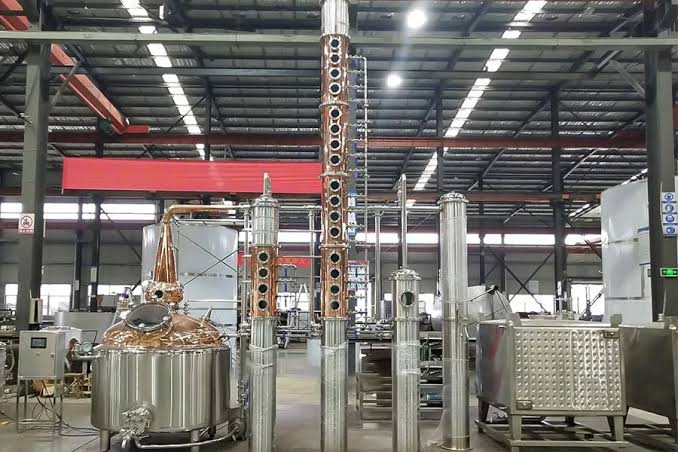
The core distillery equipment you need to start a UK distillery is a still, a fermentation or holding vessel, a cooling water supply, storage tanks, and bottling and labelling kit. Before any of it produces spirit for sale, HMRC must approve both you and your plant.
What equipment do you need to start a distillery?
The distillery equipment you need to start falls into five groups: production, cooling, storage, safety, and packaging. You don’t need the biggest version of each to begin. You need a workable version of all of them, because a gap in any group stops you from turning raw material into a bottle you can legally sell.


The still is the centrepiece, but it’s useless on its own. Fermenters (or bought-in neutral spirit) feed it, a cooling system condenses the vapour, and tanks hold your low wines and finished spirit before proofing. Packaging kit gets it into a bottle, and safety equipment keeps your team and your licence intact.
According to the American Distilling Institute, a basic build list “may include a mill, cooker/mash tun, fermenters, still, receiving tank, mash pump, transfer hoses, bottle filler, labeler and corker.” That list scales down neatly for a gin or small-batch operation buying in neutral spirit.
| Equipment group | Core items | Why you need it |
|---|---|---|
| Production | Still, condenser, parrot/hydrometer | Converts wash or neutral spirit into distillate |
| Fermentation | Mash tun, fermenters (skip if buying neutral spirit) | Produces the alcohol you distil |
| Cooling & water | Cooling system, water supply, pump | Condenses vapour and controls cut points |
| Storage & proofing | Receiving tanks, spirit safe, IBCs | Holds and dilutes spirit to bottling strength |
| Packaging | Bottle filler, labeller, corker/capper | Prepares sellable, compliant product |
Getting a distillery layout and equipment specification right from the start avoids costly retrofits. Independent guidance, or hands-on distillery setup consultancy, can size your kit list against your actual production plan rather than a generic template.
Do you need a licence before buying distillery equipment?
You can legally buy a still and ancillary equipment before you hold a licence. What you cannot do is use it to distil spirits until HMRC has approved you. Owning the kit is not the regulated act; producing spirit is.
According to HMRC’s internal spirits manual, “no distiller shall begin to manufacture spirits until they have received approval of the plant and processes.” In practice that means two separate things: approval of you as a producer, and approval of the specific still and process you intend to run.
Since 1 February 2025, new UK producers must apply for an Alcoholic Products Producer Approval (APPA). The GOV.UK alcoholic products technical guide sets out “how and when to apply for approval as a new alcoholic products producer and the information you must provide” to prove you’re fit and proper. HMRC often expects a business plan as part of that application.
Distilling spirits at home without approval is not legal in the UK, even for personal use. The licence covers commercial and private distillation alike, which is why “I’ll just test it in the shed first” is a route that risks your future application.
| Requirement | What it covers | When it applies |
|---|---|---|
| Producer approval (APPA) | Approves you and your business as a producer | Before you produce alcohol for sale |
| Plant & process approval | Approves your specific still and method | Before you begin distilling |
| Excise & duty registration | How you account for and pay spirit duty | Once you produce dutiable spirit |
Sequence your spending around this. Committing to a large bespoke still before you understand your approval conditions can leave you with equipment that doesn’t match what HMRC signs off. Confirm your licensing path in parallel with equipment selection, not after it.
Pot still vs column still: which should you choose?
The still you choose shapes what you can make. A pot still is a batch still built for flavour; a column still is a continuous-style still built for high-strength neutral spirit. Neither is “better” in the abstract; each is better for a specific spirit.
A pot still is the traditional choice for gin, malt whisky and rum, where you want to carry aromatic compounds through the run. A column still (or a pot still fitted with a rectification column) climbs to higher alcohol strength and strips flavour, which is exactly what you want for vodka or a clean base spirit to redistil with botanicals.
Most craft distillers don’t own both on day one. A copper pot still with a small dephlegmator or column section gives you flexibility: run it as a pot for a flavourful gin, or push reflux for a cleaner cut. A compact copper pot still such as the Copper Baby Pro mini still suits recipe development and small commercial batches where versatility matters more than volume.
| Feature | Pot still | Column still |
|---|---|---|
| Best for | Gin, malt whisky, rum, character spirits | Vodka, neutral base spirit |
| Spirit character | Retains flavour and texture | Strips flavour, very clean |
| Typical strength | Lower per run, multiple distillations | High strength in fewer passes |
| Operation | Batch | Continuous or semi-continuous |
| Craft flexibility | High, especially with a column add-on | Lower for flavour-led products |
According to the American Distilling Institute, copper and stainless steel are the mainstream build materials, with copper prized for removing sulphur compounds during the run. Copper contact is a genuine quality factor for pot-distilled spirits, not just an aesthetic one.
How big should your first still be?
Size your first still to your route to market, not to your ambition. A pilot still is a low-risk way to prove recipes and demand; a large production still is a commitment that only pays off once orders are consistent. Buying too big too early is one of the most common and expensive early mistakes.
A small still lets you develop recipes, run limited releases, and refine your cuts without tying up capital or floor space. It also keeps your first HMRC plant approval simple. Once you have proven demand, a repeatable process and the space to expand, scaling to a larger still is a straightforward next step rather than a gamble.
There’s no universal “right” litreage. It depends on your spirit, your batch cadence, and how much of your production you outsource. A gin maker redistilling bought-in neutral spirit needs far less capacity than a grain-to-glass whisky distiller fermenting and distilling from scratch. Model your weekly output first, then choose a still that comfortably covers it with headroom, not one sized for a best-case year three.
Space, power and cooling all scale with the still. A bigger still needs more cooling water, more robust ventilation, and often three-phase power, so the equipment cost is rarely the whole story. Factoring these in early, ideally with someone who has commissioned distilleries before, stops you from buying a still your building can’t actually support.
How much does distillery equipment cost to get started?
Startup equipment costs vary enormously with scale and how much you produce in-house. The still is usually the single biggest line, but it’s rarely more than half of the total once cooling, storage, safety and packaging are added.
According to Square’s UK distillery guide, “a high-quality still may cost anywhere from £50,000 to over £200,000” for a full production setup. At the other end, a compact pilot still with basic ancillary kit can launch a trial or small-batch operation for a fraction of that, which is why so many craft distillers start small and reinvest.
| Setup tier | Typical scope | Where the money goes |
|---|---|---|
| Pilot / trial | Compact pot still, basic cooling, manual bottling | Still, safety kit, small tanks |
| Small commercial | Mid-size still, fermenters or bought-in spirit, semi-auto packaging | Still, fermentation, cooling, storage |
| Full production | Large still(s), full mash and ferment, automated line | Still(s), buildings, three-phase power, effluent |
Beyond equipment, budget for premises work, HMRC approval, insurance, and working capital to hold stock, especially for aged spirits that can’t be sold for years. Underestimating these non-still costs is a frequent reason new distilleries run short before their first release.
The cheapest equipment is rarely the cheapest overall. A still that’s poorly matched to your product, or a layout that forces a retrofit, costs far more than getting the specification right once. Whether you plan it yourself or bring in distillery setup consultancy, tie every purchase back to a realistic production and sales plan.
The UK spirits scene has room for well-run newcomers. According to the Wine and Spirit Trade Association (WSTA), the number of UK gin distilleries has more than tripled since 2016, evidence that a focused, appropriately equipped craft operation can still find a market.
Frequently Asked Questions
What is the minimum equipment needed to start a distillery?
At minimum you need a still, a fermentation vessel (unless you buy in neutral spirit), a cooling water supply, storage and proofing tanks, and bottling and labelling equipment. You also need HMRC-approved premises and basic safety kit, including ventilation and a fire plan, before you produce any spirit for sale.
Do you need a licence before buying distillery equipment in the UK?
You can buy equipment before you’re licensed, but you can’t legally use it to distil until HMRC approves you. Since 1 February 2025, new UK producers must hold an Alcoholic Products Producer Approval (APPA), and HMRC must also approve your specific plant and process before you begin distilling.
Should I choose a pot still or a column still for a craft distillery?
Choose a pot still for gin, malt whisky and flavour-led spirits, and a column still for high-strength neutral spirit such as vodka. Many craft distilleries run a copper pot still with a small column or dephlegmator so a single still can handle both flavourful and cleaner spirits.
How big should my first still be?
Size it to your route to market. A small pilot still lets you trial recipes and produce limited runs at low cost and low risk, while a larger still only makes sense once demand, space and licensing are proven. Model your weekly output first, then buy a still that covers it with modest headroom.
How much does distillery equipment cost to get started?
It varies widely with scale. According to Square, a high-quality still alone may run from £50,000 to over £200,000 for a full production setup, while a compact pilot still and basic kit can start a trial operation for far less. Budget separately for fermentation, cooling, storage, safety, packaging and premises.