






















































Microsoft’s new testimony in Elon Musk’s lawsuit against OpenAI reveals a broader picture of what is happening around the largest AI partnership in recent years. Previously, the market mainly focused on the $13 billion figure for Microsoft’s investments in OpenAI, but now it becomes clear that the corporation’s real costs of supporting the startup and the related infrastructure will exceed $100 billion by the end of June. In fact, it’s no longer just about investing in a promising company, but about building an entire computing ecosystem that is gradually becoming a central element of the stock heatmap giant’s strategy.
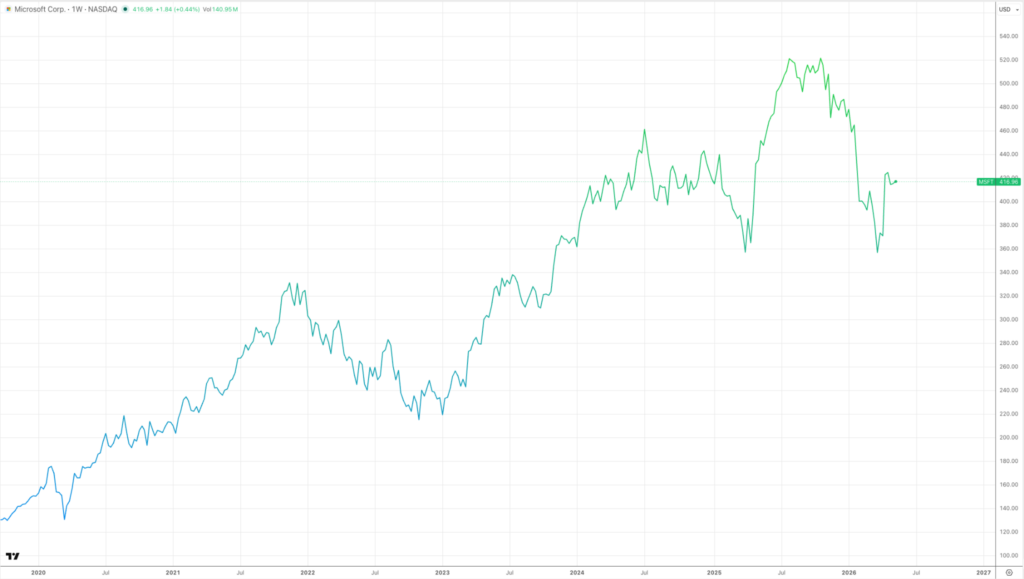
It is especially significant that the Microsoft itself viewed the partnership as a commercial opportunity from the beginning. Satya Nadella confirmed in court that Microsoft had expected to earn at least $92 billion from its early investments in OpenAI. This stands in stark contrast to Elon Musk’s argument that OpenAI’s transition to a commercial model marked a departure from the startup’s original humanitarian mission. The trial increasingly demonstrates that the largest technology players viewed generative AI not as a research initiative, but as the potential basis for a new infrastructure market.


At the same time, the details disclosed in court show how early Microsoft realized OpenAI’s strategic importance. As early as 2022, a few months before the release of ChatGPT, Nadella expressed concern that OpenAI could eventually surpass Microsoft, effectively repeating the history of IBM’s relationship with the company in the 1980s. At that time, the young Microsoft managed to turn MS-DOS supplies for IBM into the basis of its own multi-trillion-dollar ecosystem, while the former market leader gradually lost its dominant position. This is why Microsoft had been striving from the very beginning to secure access to OpenAI’s intellectual property and remain present at every level of the software stack.
In fact, the current relationship between the companies has long gone beyond the classic investor-startup model. Microsoft remains the largest shareholder of OpenAI, its key cloud partner, and a direct competitor in the field of AI model development. Moreover, the corporation has gradually begun to diversify its risks. Since last year, Microsoft has been cooperating with OpenAI’s competitors, including Anthropic. This underscores that Microsoft’s main asset is no longer a specific model or startup, but control over the infrastructure and computing platform on which the entire AI economy is being built.
The infrastructure component of these investments is particularly important. Microsoft technical director Kevin Scott said in court that the first specialized data center for OpenAI contained 10,000 GPU accelerators and took six months to build. Since then, the scale of investments has multiplied. In fact, OpenAI has become not only a partner for Microsoft, but also an experimental platform that allowed the corporation to accelerate the development of new-generation supercomputers optimized for generative AI. It is this infrastructure expertise that is becoming one of Azure’s key competitive advantages today.
Against this backdrop, the published materials from 2017-2018 look particularly noteworthy, demonstrating how skeptical Microsoft initially was about OpenAI. At that time, the management of Azure and research departments did not yet fully understand the practical value of the startup’s developments. Moreover, some top managers viewed OpenAI only as a consumer of huge GPU resources without obvious commercial benefits. Kevin Scott explicitly stated that OpenAI treated Azure as a massive GPU cluster, not as a technology partner.
Nevertheless, fear that OpenAI could shift its cloud business to Amazon eventually pushed Microsoft to deepen the partnership. Even then, the corporation understood that a potential breakthrough in AI could become a strategic advantage for any cloud provider that managed to secure such a partner. In retrospect, this calculation turned out to be one of Microsoft’s most successful infrastructure decisions in recent decades.
However, the current trial also demonstrates the downside of such a strategy. OpenAI is gradually turning into an independent center of power with a valuation of $852 billion and less dependence on Microsoft, reportedly preparing for an upcoming IPO. By March 2025, Microsoft’s OpenAI-related revenue reached $9.5 billion, but the corporation itself already openly recognizes OpenAI as a competitor. This creates a paradoxical situation in which Microsoft actually helped create one of the strongest players in the AI market — one that simultaneously strengthens Azure and threatens Microsoft’s long-term dominance in the software ecosystem.
Taken together, everything that is happening shows how dramatically the scale of investment in artificial intelligence has changed. If, at an early stage, the partnership between OpenAI and Microsoft looked like a relatively risky investment in a research startup, now we are talking about building infrastructure worth hundreds of billions of dollars. And the more AI becomes the basis of cloud services, enterprise software, and computing platforms, the more obvious it becomes that the largest technology companies are no longer competing so much for individual products as for control over the entire architecture of the future digital economy.

David Prior
David Prior is the editor of Today News, responsible for the overall editorial strategy. He is an NCTJ-qualified journalist with over 20 years’ experience, and is also editor of the award-winning hyperlocal news title Altrincham Today. His LinkedIn profile is here.