




















































Electrical BIM modeling is the process of creating intelligent 3D models of electrical systems, including power distribution, lighting layouts, and conduit routing, within a Building Information Modeling environment. Electrical work accounts for 10 to 15% of total commercial construction budgets, and poor coordination between electrical, structural, and mechanical trades drives costly field rework. Catching clashes between these disciplines before installation starts keeps projects on schedule and within budget. This article covers the direct benefits of electrical BIM modeling and explains how Scan to BIM strengthens the process for existing buildings.
What Is Electrical BIM Modeling?
Electrical BIM modeling creates a precise digital representation of a building’s electrical infrastructure. The model captures every component, from power distribution panels and lighting fixtures to cable trays, conduit pathways, fire alarm systems, and low-voltage networks, as data-rich 3D objects within a single coordinated environment.


Traditional 2D CAD electrical drafting produces flat line drawings where each sheet exists in isolation. An engineer draws conduit runs, panel locations, and circuit paths on separate 2D plans. Change a panel location on one sheet, and you update every related drawing by hand. Electrical BIM modeling in Autodesk Revit MEP replaces that manual process. Every parametric electrical component carries properties like voltage, amperage, and circuit assignment. Move a distribution panel in the model, and connected conduit paths, circuit schedules, and load calculations update across the entire project automatically. That parametric intelligence separates 3D electrical design from static 2D drafting.
Key Benefits of Electrical BIM Modeling
Electrical BIM modeling delivers 4 measurable advantages: reduced coordination conflicts, lower rework costs, accurate material quantification, and better facility management data.
- Clash detection and coordination. Electrical conduit, cable trays, and junction boxes compete for space with HVAC ductwork, plumbing pipes, and structural beams. Without a coordinated MEP model, these conflicts surface during installation, when fixing them costs up to 10 times more than resolving them on screen. Stanford University’s Center for Integrated Facilities Engineering (CIFE) found that BIM eliminates up to 40% of unbudgeted changes across 32 major projects. Electrical BIM modeling flags interference between disciplines before a single piece of conduit reaches the job site.
- Cost and time savings. Construction rework accounts for 5 to 8% of total project cost, according to Construction Industry Institute (CII) research. Electrical trades contribute a large share of that rework when conduit routes and panel locations conflict with other systems. Prefabricating electrical assemblies from BIM data cuts field labor time because installers work from exact dimensions rather than measuring and adjusting on site.
- Accurate quantity takeoffs. Revit extracts cable lengths, conduit runs, fitting counts, and panel requirements directly from the 3D electrical model. Manual estimation carries error rates that cascade through procurement and scheduling. BIM-based takeoffs tighten material quantities and connect them to procurement timelines.
- Facility management. An as-built electrical model gives maintenance teams direct access to circuit information, panel locations, breaker assignments, and cable routing paths. Building owners carry that data through the entire lifecycle instead of relying on paper records that lose accuracy the moment renovations begin.
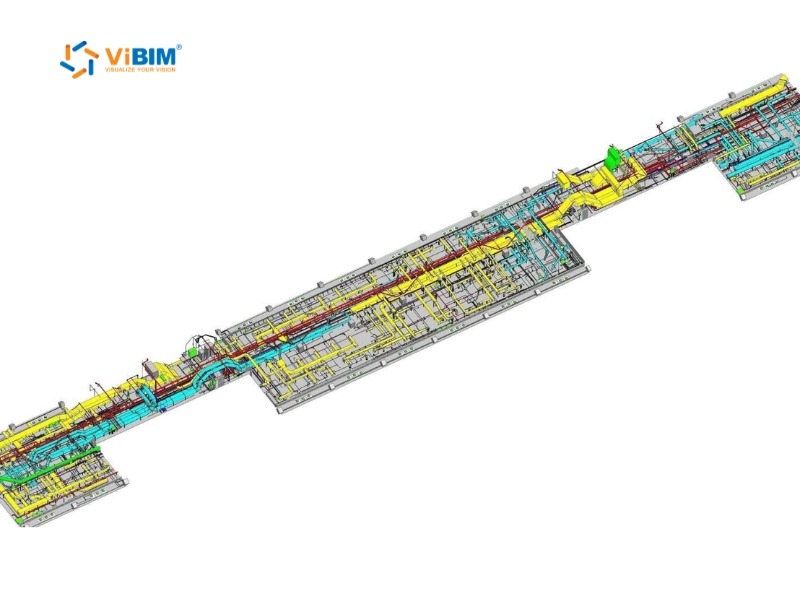
Maximize project efficiency and eliminate costly clashes with the precision of Electrical BIM modeling.
How Scan to BIM Enhances Electrical BIM Modeling
Scan to BIM converts point cloud data captured by laser scanning into accurate 3D BIM models. For electrical systems in existing buildings, this matters because as-built drawings rarely reflect current conditions. Renovation, retrofit, and facility upgrade projects depend on knowing exactly where current infrastructure sits. Existing documentation is often outdated or missing entirely.
The process starts with laser scanning using instruments like Leica or FARO scanners that capture millions of measurement points per second. Those scans record existing electrical infrastructure: cable trays, conduit runs, panel locations, junction boxes, and lighting fixtures. After registration and processing, BIM specialists model each electrical component in Revit at LOD in BIM 200 to 400, where LOD defines the geometric detail and data richness of each element. Positional accuracy stays within ±2mm (±0.08 in.).
In commercial and institutional projects, electrical conduit systems follow standard sizing that BIM modelers must capture at correct dimensions. The table below shows conduit diameters and electrical box sizes common in Scan to BIM electrical projects.
| Component | Imperial (in.) | Metric (mm) |
| Conduit diameter | 1/2″, 3/4″, 1″, 1-1/2″, 2″, 2-1/2″, 3″, 3-1/2″, 4″ | 16, 21, 35, 53, 78, 103 |
| Electrical junction box | 4×4, 6×6, 8×8, 10×10, 12×12, 16×16 | 100×100, 150×150, 200×200, 300×300, 400×400, 500×500 |
Assigning correct sizes from point cloud data ensures the coordination model reflects actual space constraints in ceiling plenums, wall cavities, and riser shafts — where electrical conduit competes with HVAC ductwork and plumbing for routing space. The output is a Revit model containing electrical families with circuit data, routing paths, and connection points ready for coordination with other MEP disciplines.
The output is a Revit model containing electrical families with circuit data, routing paths, and connection points ready for coordination with other MEP disciplines.
Outsourcing this workflow to a specialized team accelerates project timelines without straining internal resources. Teams that lack in-house Revit capacity can turn to Revit BIM outsourcing services to handle electrical modeling from point cloud data. ViBIM delivers electrical BIM models with:
- 99% on-time delivery record
- Turnaround times 30% faster than the market average
- A team of 30+ BIM professionals covering architectural, structural, and MEP disciplines
- Modeling within the Autodesk platform (Revit, Navisworks, ACC)
Accelerate project timelines and ensure as-built accuracy with expert Scan to BIM electrical modeling services.
Electrical BIM modeling improves coordination, reduces rework costs, and produces better project outcomes across every phase. Scan to BIM extends those benefits to existing buildings where accurate documentation doesn’t exist. Contact ViBIM to discuss your next electrical modeling project.