


















































Soup is particularly challenging to package for takeaway because it combines high temperatures with a liquid consistency. Unlike solid foods, soup can shift inside the container during handling, while steam and heat can put additional demands on the packaging during holding and transport. Even a short journey can affect its temperature and presentation by the time it reaches the customer. Choosing the right packaging can help operators keep soup hot and contained throughout this journey, while reducing the risk of spills that affect the food, packaging and customer experience. This guide explains how to assess soup packaging for reliable takeaway and delivery performance.
What keeps soup hot and stops leaks


Several packaging features work together to keep hot soup contained and maintain its condition during takeaway and delivery.
- Material construction and liquid barrier: Soup packaging needs a construction that can withstand prolonged contact with hot liquid. The material and any inner lining or barrier help prevent liquid penetration while supporting the container’s strength and heat retention. General-purpose paperboard without suitable protection can soften when exposed to hot or oily soup, so the construction needs to match the food and service conditions.
- Lid design and seal security: The lid and container rim need to work together to keep the soup contained during handling and transport. A secure closure limits liquid movement and reduces the risk of spills when orders are bagged, stacked or carried. Leak resistance therefore depends on the container and lid working as a system, rather than on the lid alone.
- Structural strength when filled and hot: The container needs enough rigidity to hold its shape under the weight and temperature of hot soup. If the walls or base soften or deform, the pack becomes harder to handle, and the closure can also be affected. Structural strength therefore supports both spill resistance and reliable handling.
Practical recommendations for soup packaging that performs
The principles above give you a starting point for assessing soup packaging, but the next step is to apply them to the options available to your business. Material, format, size and lid design all need to work together around your menu and delivery requirements. This is where working with a supplier with a dedicated soup packaging range can be useful. PandaPak, a UK foodservice packaging supplier, offers soup containers across different sizes and formats, with matching lid options for takeaway and delivery.
From a foodservice perspective, we recommend focusing on three practical areas when choosing soup packaging for your operation.
Material suited to hot liquid
Choose a container construction with an effective liquid and grease barrier that can withstand hot soup and the expected holding time. Common options include:
- Lined paperboard: Combines a liquid barrier with a lightweight, rigid format, making it widely used for takeaway soup.
- Moulded fibre or bagasse: Provides a fibre-based alternative that may suit operators with particular sustainability requirements.
- PP: A plastic option that can provide strong moisture resistance and rigidity, depending on the container design.
Choose the material based on the soup you serve, how long it needs to stay in the container, and the conditions it will face during service and delivery.
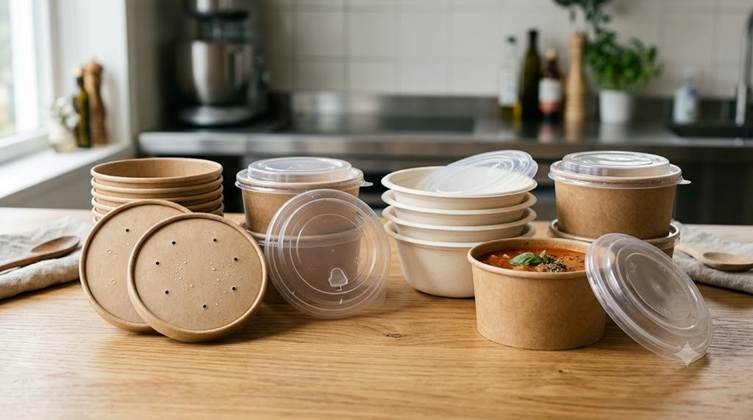
For operators choosing paper-based packaging, PandaPak’s paper soup containers use 320gsm paperboard and are available in eight sizes from 8oz to 54oz, with matching lid options. Selected lids use 25–26 locking points around the rim for a secure closure during takeaway and delivery.
Format and shape that support secure handling
Choose the container format according to the portion, eating experience and transport conditions. Taller formats generally suit individual portions, while wider formats can make the contents easier to access.
Common soup containers’ formats include:
- Taller soup cups: Suitable for individual portions such as broths, ramen and many takeaway orders.
- Wider soup bowls: Useful for larger portions, soups with toppings or presentation-focused service.
Lid choice should also reflect how the soup will be transported. Common options include:
- Vented paper lids: Allow steam to escape from hot soup, making them a practical option for hot food where steam management is important.
- PP lids: Provide a plastic closure option that can offer a secure fit for takeaway and delivery, depending on the specific lid and container system.
Whichever option you choose, check that the lid is designed specifically for the container. Material alone does not determine how securely a lid will close, so the fit, locking mechanism and compatibility with the container rim also need to be considered.
Size and lid compatibility
Choose a capacity that matches the actual serving volume and leave enough headspace for safe handling. As a practical guide:
- 8–12oz: Starters and smaller portions
- 16oz: Standard individual servings
- 26–32oz: Heartier or noodle-based soups
- Larger formats: Sharing or catering where appropriate
Leave a small gap below the lid rather than filling the container to the rim. This gives the soup room to move during handling and reduces the risk of it contacting the lid when the container is tilted or carried.
Finally, check that the lid is specifically designed for the container and its rim dimensions. A lid that looks like it fits may still fail to create a secure closure if the dimensions or locking mechanism do not match.