





















































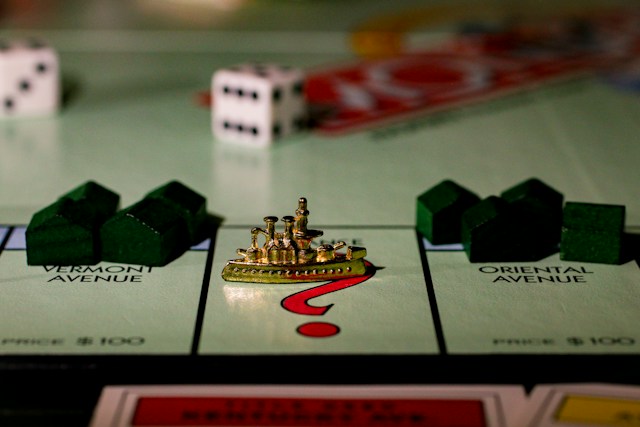
There are very few games that can be recognised from a single glance at a square board, a set of little houses and a top hat-shaped playing piece. MONOPOLY is one of them. Whether you remember long games that ran well past tea time or simply know the familiar names of Mayfair, The Strand and Old Kent Road, it remains part of Britain’s shared entertainment vocabulary.
That staying power feels especially notable as board games continue to enjoy a proper revival. Cafés host game nights, pubs keep shelves of well-worn classics, and people are increasingly looking for screen-free ways to spend an evening together. In that setting, MONOPOLY hasn’t become a relic. It has become a familiar starting point, remade through themed editions, social versions and digital adaptations.


Its history is more complicated than many people realise, too. The game developed from earlier property-trading games, including Elizabeth Magie’s The Landlord’s Game, which was designed to explore ideas around land ownership and economic inequality. You can read more about that unusual backstory in Wikipedia’s history of MONOPOLY. Yet, whatever its origins, the British edition has long made London streets feel like part of the game’s cast.
The board that turns streets into characters
MONOPOLY’s British appeal begins with the board itself. A trip around it is a trip through names that have become oddly familiar, even to people who’ve never lived anywhere near central London.
There’s something satisfying about knowing that Mayfair is the premium address, while Old Kent Road sits at the other end of the scale. The colours, the rent cards and the little property deeds give every square its own identity. You don’t just land somewhere, you form an opinion about it.
That is a clever bit of design. The board gives players a shared language almost immediately:
- “I need the orange set.”
- “Don’t land on my hotel.”
- “I’ll trade you that station.”
- “How have you got out of jail again?”
Even people who haven’t played for years tend to remember the essentials. Roll the dice, move around the board, negotiate, make choices, and hope chance doesn’t spoil your carefully laid plans.
The names might be rooted in London, but the game’s appeal has always travelled much further. It captures the feeling of building a small world together, then trying to outmanoeuvre everyone else inside it.
Why classic board games remain a social fixture
MONOPOLY is not a quiet, solitary puzzle. It asks people to talk, barter, disagree and occasionally make a very questionable deal. That social friction is a large part of why it remains memorable.
A game can change direction with one roll of the dice, but luck alone never tells the whole story. Do you hold onto a property because it completes a colour set? Do you make a trade that helps another player now, hoping it helps you more later? Do you accept an offer because the alternative is waiting several turns for something that may never happen?
These are small decisions, but they give a session personality.
For many British households, that’s the point of a family game night. It isn’t necessarily about finishing quickly or playing perfectly. It’s about the chat around the table, the mock outrage when someone lands on a heavily developed square, and the running jokes that appear before the first circuit of the board is complete.
The game also suits mixed groups because its basic rules are easy to grasp. You can explain the main idea in minutes, then discover the tactical side as you go. Some players love striking deals. Others prefer keeping their cards close to their chest. A few just enjoy rolling the dice and seeing where they end up.
That flexibility has helped MONOPOLY crop up across British popular culture. It is shorthand for property, competition, family disputes and the occasional over-ambitious plan. A board on a coffee table tells a story before anyone has even started playing.
More than a classic box on the shelf
The original format is still familiar, but MONOPOLY is no longer limited to one standard board and a handful of metal tokens. Over the years, licensed editions have shifted locations, changed themes and brought new worlds into the square-board format.
That’s one reason it stays visible. Fans may be drawn to a version based on a place they know, a sport they follow or a wider entertainment franchise. The rules can remain recognisable while the artwork, tokens and property names offer a different flavour.
Modern social play has changed the way people approach it, too. A full traditional game can take time, so groups often agree house rules, choose shorter variants or make an occasion of it. There are board-game cafés for those who want company without hosting at home, while online communities swap rule debates, custom boards and memorable tales from the table.
I find that this is where MONOPOLY makes most sense. It isn’t only a set of rules. It’s a familiar framework for an evening with other people. The board creates a reason to gather, and what happens around it is usually the bit everyone remembers.
From the tabletop to screens
It was always likely that a game with such clear visual identity would move into digital entertainment. The corner squares, coloured property groups, dice and recognisable mascot translate well to screens.
However, not every digital MONOPOLY experience is the same. It is worth separating the formats rather than lumping them together.
Digital board-game versions
These are closest to the tabletop original. Players follow the board, take turns, buy properties and make trades, sometimes against computer-controlled opponents and sometimes with other people online. The attraction is convenience: no need to set up the board, count notes or find the missing token under the sofa.
Mobile social adaptations
Mobile versions may retain the broad property-and-dice theme while changing the pace and structure for shorter play sessions. They often use bright animations, collections and event-style activities designed around phone use rather than an hours-long table game.
Console and PC editions
These tend to focus on visual presentation, local multiplayer and online play. They can make familiar moments feel more theatrical, with animated boards, changing camera angles and digital effects that would be rather difficult to manage with cardboard houses.
Each format borrows something from the original, but the experience can be quite different. The enduring link is the game world: movement around a square board, property imagery, recognisable symbols and a playful sense of competition.
How familiar board-game aesthetics appear in adult casino-game presentation
For adult audiences, MONOPOLY’s visual language has also appeared in casino-game entertainment. These games are not digital versions of the board game in the traditional sense. They use slot-based mechanics, so the format, pacing and rules differ from moving a token around a board and negotiating trades with other players.
What carries across is the presentation.
A board-game-themed slot may use visual elements such as:
- property-board styling and colourful street squares
- dice, playing tokens and rail-themed imagery
- houses, hotels and property-themed symbols
- animated characters or board-game scenes
- bonus-style rounds built around recognisable motifs
That familiarity helps establish the atmosphere quickly. Someone who knows the classic board can spot the reference points, even though the activity is a separate form of adult entertainment with its own rules and information.
It is important not to confuse thematic recognition with a continuation of the family board game. The board game is a social tabletop activity; casino games are age-restricted products intended for adults only. Anyone who chooses to take part should read the game rules, understand the format and treat it purely as entertainment.
A familiar name, still finding new places to go
MONOPOLY has lasted because it is instantly legible. The board looks familiar. The objectives are clear. The arguments over trades are practically built in. At the same time, it has proven adaptable enough to work in new editions, digital board-game formats and adult themed entertainment.
That combination is rare. Plenty of games are popular for a while, but few become cultural shorthand. MONOPOLY has done so by being both dependable and flexible, a recognisable fixture on British shelves that can still be reinterpreted for new settings and audiences.
For adults exploring themed casino formats
Adults looking to see how the familiar board-game aesthetic translates to digital slot entertainment can view the MONOPOLY-themed selection at Monopoly Casino.
This is for 18+ only. If you decide to explore casino games, keep it entertainment-only, set personal time and spending limits beforehand, and step away if it stops feeling enjoyable.